

Every CFO I sit with tells me security spending can’t be tied to a return. An entire industry disagrees, does the math every quarter, and mails them the bill.
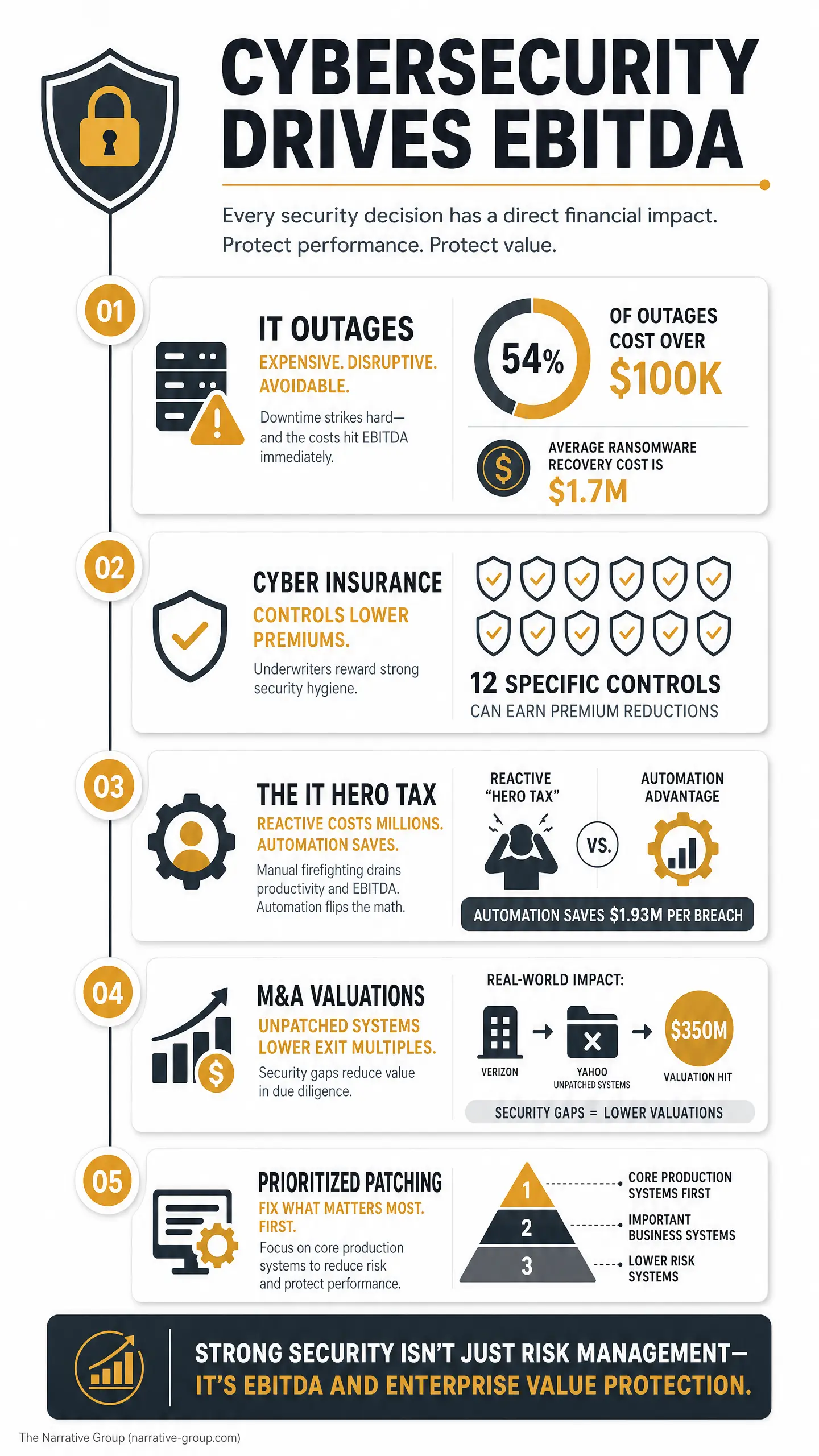
The cyber insurance questionnaire in their inbox has already attached a dollar figure to multi-factor authentication, tested backups, and endpoint detection, because Marsh reports underwriters now insist on 12 specific controls and cut rates 5% for the firms that mature. Someone with real money riding on the answer has already priced the risk they swear is unpriceable.
Your security posture is already moving your EBITDA, whether or not anyone has read the statement. The open question is whether you use the risk model the underwriters built for free, or keep insisting the number can’t be found while it sits in your inbox.
Key Takeaways
- Cyber insurance underwriters like Marsh now mandate 12 specific cybersecurity controls for coverage, rewarding organizations that demonstrate mature security postures with a 5% reduction in premium rates.
- Mid-market companies with 100 to 250 employees intercept ransomware before encryption only 34% of the time, trailing the 46% success rate of companies 10 times their size.
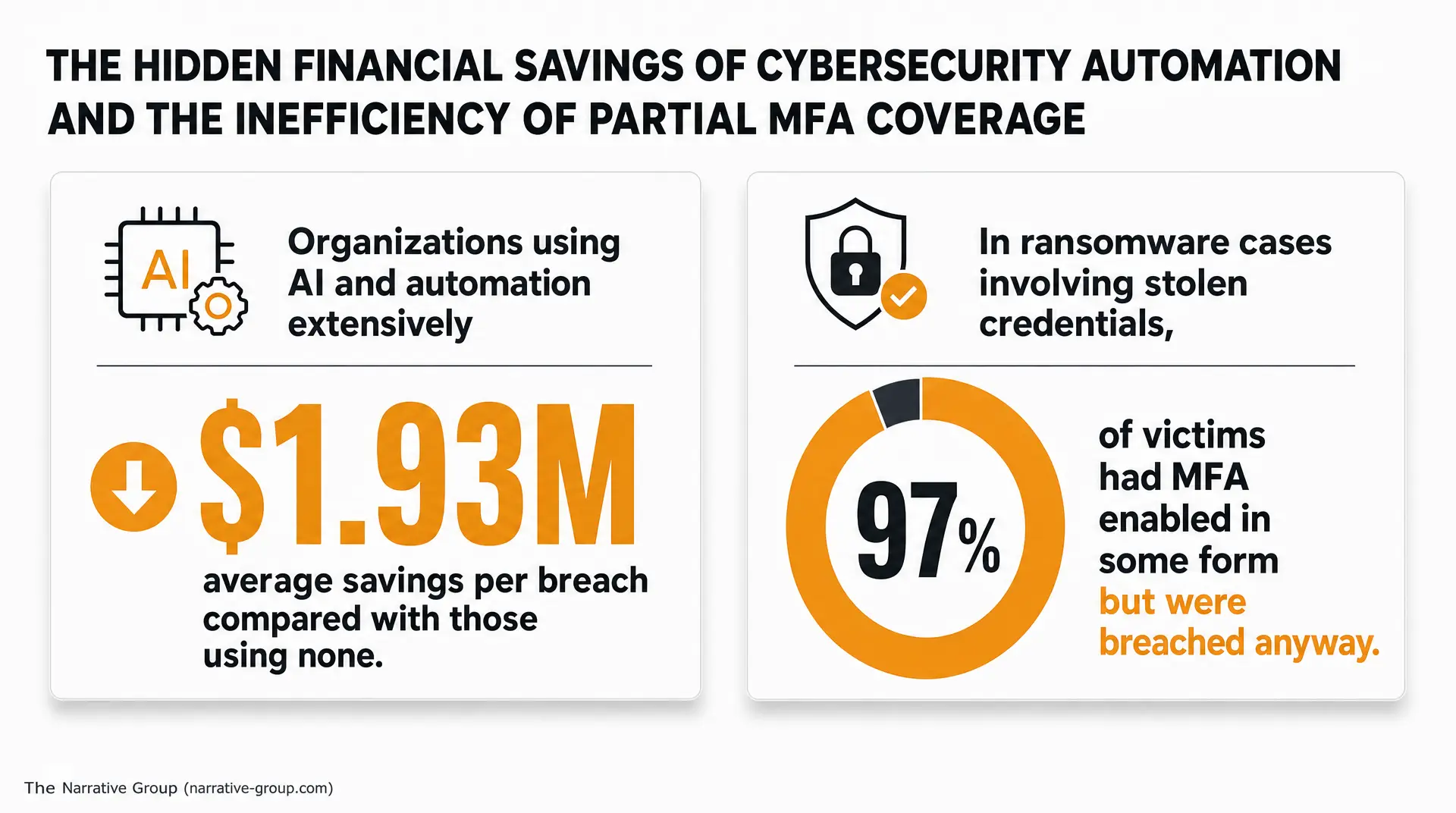
- In ransomware attacks originating from stolen credentials, 97% of victims had multi-factor authentication enabled but were breached anyway due to partial coverage or non-phishing-resistant methods.
- Extensive implementation of artificial intelligence and automation within security operations reduces the financial impact of a corporate data breach by an average of $1.93 million.
- Undocumented infrastructure and security gaps directly discount acquisition valuations, with 53% of M&A dealmakers discovering critical cybersecurity issues severe enough to jeopardize a transaction.
- Unpatched software vulnerabilities have overtaken stolen passwords as the primary initial attack vector, accounting for 31% of all modern data breaches.
What Is the True Financial Cost of an IT Outage for Mid-Market Enterprises?
At CompuCom, I was part of the team that secured a $170M, three-year managed services renewal. On our Suncor Energy managed services contract, a P1 incident, the kind where core systems stop, carried financial consequences written straight into the agreement. Real dollars, negotiated before anything ever broke.
One of Canada’s largest energy companies refused to treat an outage as a technical inconvenience. They priced the hour and made their vendor sign the price.
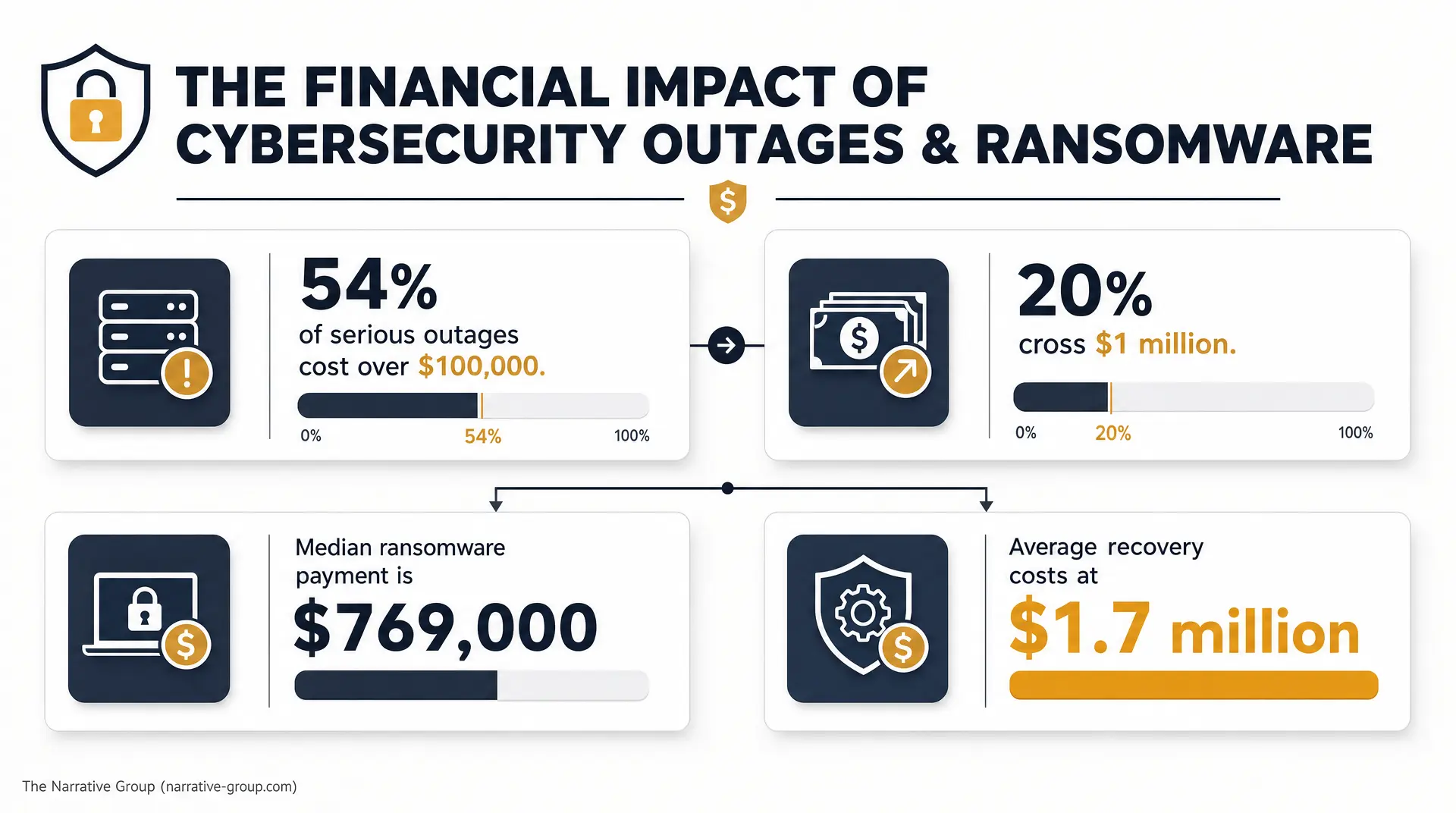
So what does one hour of downtime cost your company? Most mid-market executives I meet can’t tell me. That missing number quietly distorts every security decision downstream, because you end up weighing a known cost, the monitoring and hardening and tested backups, against a blank space. The blank space wins almost every budget fight, and it shouldn’t. In Uptime Institute’s 2025 outage analysis, 54% of respondents said their most recent serious outage cost over $100,000, and one in five said it crossed $1 million.
Ransomware sharpens the point. Sophos’s 2026 ransomware survey of mid-sized organizations puts the median ransom payment at $769,000 and average recovery costs at $1.7 million. The odds also worsen as your bench gets smaller. Sophos found that only 34% of firms with 100 to 250 employees stopped the attack before encryption, against 46% of companies 10 times their size. You carry enterprise-grade exposure without the enterprise bench, which is exactly why I tell mid-market leaders to leverage the intelligence of the enterprise play, but right-size it.
Whether an outage costs you an afternoon or a month comes down to unglamorous preparation. At The Narrative Group, we test disaster recovery by building a mirrored copy of the client’s environment and running real-world conditions against it before anything depends on it. A restore you have never actually run is a guess about your recovery time, and guesses are expensive.
What Are the Hidden Cybersecurity Costs Missing From Corporate IT Budgets?
How Do Cyber Insurance Renewals Expose Hidden Cybersecurity Budget Inefficiencies?
Executives tell me security ROI is impossible to calculate. Meanwhile, an entire industry calculates it every quarter and mails you the results. Pull out your last cyber insurance questionnaire. The carrier asked about multi-factor authentication, endpoint detection, tested backups, and incident response because underwriters have attached loss data to each control. Marsh’s latest market update notes that carriers now treat 12 specific hygiene controls as essential, and average U.S. rates actually declined 5% as insured companies matured. Discipline gets rewarded in premium.
The checkbox era is ending, though, and most mid-market boards haven’t caught it. In ransomware cases where stolen credentials were the root cause, 97% of victims had MFA enabled in some form. Enabled, and breached anyway, because coverage was partial or the method wasn’t phishing-resistant. Underwriters read the same data I do. Expect the questionnaire to stop asking whether you have a control and start asking how far it actually reaches.
Treat the renewal as a diagnostic you didn’t have to pay for. Any investment that lowers a recurring premium, or keeps you insurable at all, lands on the P&L as one of the cleanest cost reductions you will ever book.
What Is the IT Hero Tax and How Does It Impact Hidden Cybersecurity Costs?

At a large utilities company, we found an IT manager trapped in the hero position. He was so buried in manual catch-up work that there was no time to innovate, let alone harden anything. We went to leadership and made the case for automation projects to take the manual load off him. Within the first six months, that saved hundreds of full-time employee hours, cut costs, and improved the service their own customers received.
A weak security posture manufactures reactive hours at scale. Every incident and near-miss pulls your best people off margin-creating work, and you pay full salaries for hours that return nothing. The data supports automating your way out. Organizations using AI and automation extensively in security operations saved an average of $1.93 million per breach compared with those using none.
The hero pattern hides a second exposure most CFOs never price. When the knowledge of where every system lives sits inside one exhausted person’s head, your infrastructure has a single point of failure who can resign. Whenever we help a client move off a risky platform, step one is documenting where every piece of infrastructure actually lives, precisely so the map survives a resignation letter.
How Do Industry-Specific Regulatory Compliance Requirements Impact Corporate Financial Performance?
Earlier in my career, I had email addresses at Suncor Energy, Encana, Enerplus, and TransCanada Pipeline. I walked those hallways for years. Later, at Univeris, I sold the back-office platform that mutual funds across Canada run on, and I sat with Toronto banking clients week after week. What surprised me was how identical the governance and compliance requirements were. Oil and gas answered to safety and environmental regulators, banks answered to financial ones, and the discipline demanded was the same.
The enforcement math lands directly on the income statement. HHS enforcement data shows $144.88 million collected across 152 HIPAA cases. If your business touches health data, that is the table you’re playing at.
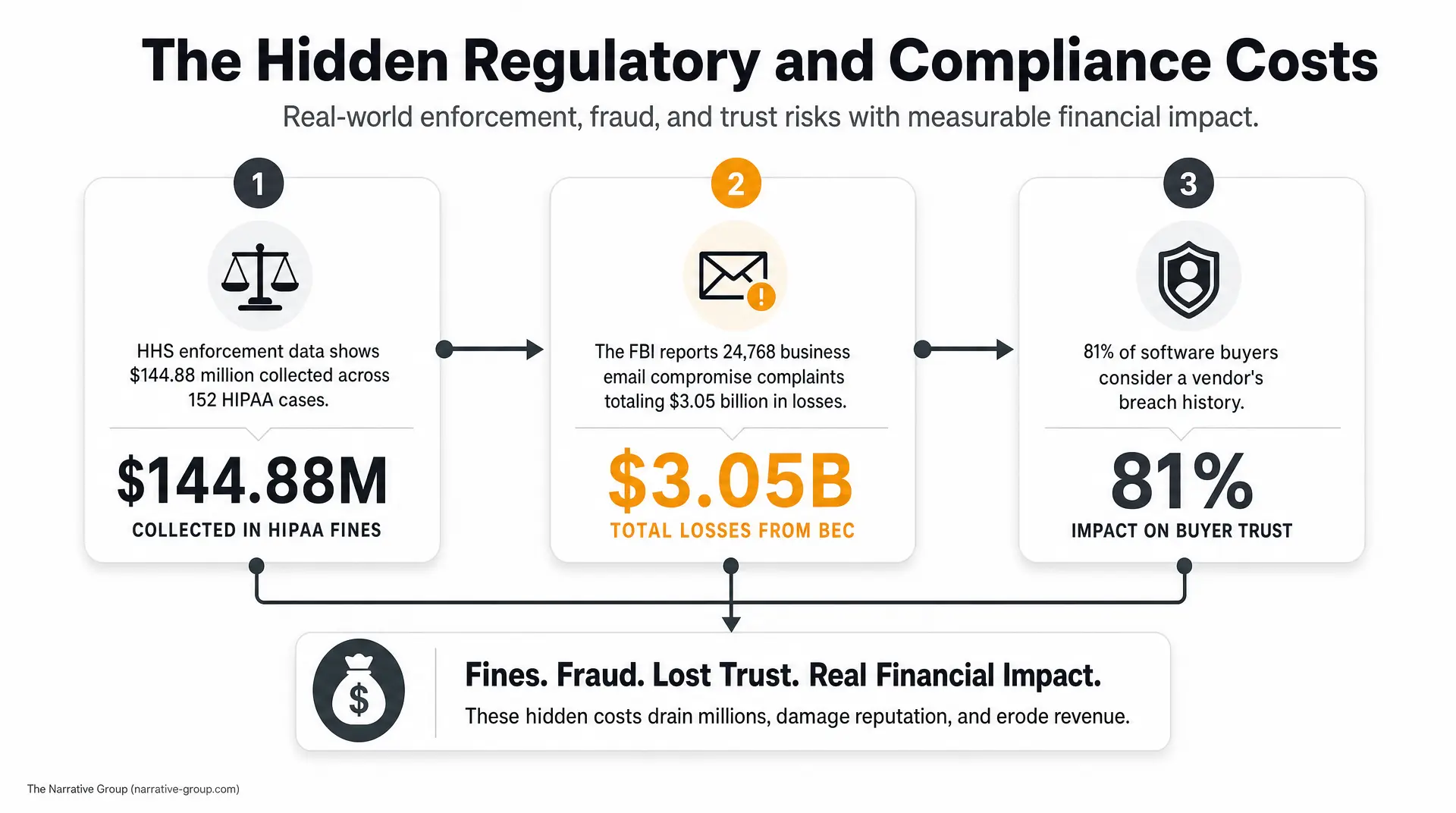
Two more costs never appear on any fine schedule. First, wire fraud has become a finance-department problem, whatever the org chart says. The FBI’s latest internet crime report logged 24,768 business email compromise complaints totalling $3.05 billion in losses, which makes your payment-approval process a security control. Second, lost revenue. Some 81% of software buyers now consider a vendor’s breach history before purchasing. When your deals stall inside a customer’s security questionnaire, nobody books that lost pipeline to “security,” but that is exactly where it belongs.
How Does Cybersecurity Due Diligence Impact M&A Valuations and Exit Multiples?

If you plan to sell your company, the buyer’s diligence team will crawl through your technology hunting for skeletons. Unpatched systems, undocumented infrastructure, unlicensed software, open gaps. Every skeleton becomes a lever to discount your price. Forescout found 53% of dealmakers have hit a critical cybersecurity issue serious enough to jeopardize the transaction. There is hard precedent on the cost, too. After Yahoo’s breaches surfaced mid-acquisition, Verizon took $350 million off the purchase price and made Yahoo split post-closing breach liabilities.
We built a pre-exit diagnostic at The Narrative Group for exactly this window, starting twelve to eighteen months before a sale. Bruce Fairley, our founder and the former CTO of Loblaw Companies and Shoppers Drug Mart, takes control of finding and closing every hole before the auditors arrive. During diligence, nobody talks to the auditors except Bruce, so the buyer sees one cohesive picture instead of five nervous department heads. He ran that play for Conversation Health, a healthcare company. For Xtiva Financial, a commission-calculation software firm, he kept their operations secure while enhancing their platform to better align with their value chain, ultimately enabling an additional 25 basis points of margin. Both sold at over 10x multiples.
The principle underneath is worth noting. Processes that depend entirely on people read as risk in diligence, because people can quit. Automated, documented, secured systems read as assets, and assets raise the multiple. Your security posture is baked into that math whether you have ever calculated it or not.
How Does Cybersecurity Overspending Negatively Impact Business Productivity and EBITDA?

I’d be lying if I claimed the swing only goes one way. I have watched companies paint everything with the red brush, applying maximum lockdown to every workflow and every file, and strangle their own productivity in the process. I’ll also confess something from my sales years: I have been guilty of wishing the compliance team would just go away so a deal could close. I understand both failure modes from the inside.
The real work is dissecting your workflows to figure out which parts genuinely need protection and which parts need speed and open communication between departments to get things done. Anybody who paints it with one brush ends up suffering on security or suffering on productivity, and EBITDA absorbs the hit either way.
There is an organizational truth underneath every one of these decisions. Finance wants costs down. Operations wants risk down. Sales wants productivity and customer satisfaction up. All three groups need to be made whole, and a control that satisfies one while punishing the other two is a bad investment no matter how technically elegant it looks. It has to make sense for the 5,000-foot view as well.
How Should Executives Prioritize Cybersecurity Vulnerability Patching Based on Threat Impact?

When we assess a mid-market company and find several problems at once, aging backups, an exposed network, creaking core software, the CFO’s instinct is almost always to fund the cheapest fix first. I push back on that, respectfully, every time.
Our ranking starts with any security threat to a production or core system. That gets fixed first, non-negotiable, regardless of where it sits on the price list. Then we split the remainder into high-impact quick wins, longer-cycle complex priorities, processes that genuinely should stay with humans, and items the business can safely defer.
The threat landscape is why sequence beats sticker price. Verizon’s latest breach data shows 31% of breaches now start with software vulnerabilities, overtaking stolen passwords as the most common way in. The old server the CFO defends because “it still works” has become the front door, and a deferred five-figure patch is how companies end up funding a seven-figure incident.
How Can Organizations Align Cybersecurity Investments With Revenue Generation and EBITDA?

So how do you get your security people and your finance people into the same conversation? You start where we start every engagement, with how the company actually makes money. Our Financials First approach, the engine inside our Value Alignment Assessment, begins with the P&L and the value chain, then interviews everyone who touches finance and technology. That surfaces the gaps between what leadership believes is happening and what is actually happening on the ground. Our badge of honor is that we see things clients can’t see, and then we price them.
Your security posture is already moving your EBITDA. The only open question is whether you’re measuring the swing or absorbing it blind. The next time your security lead asks for budget, skip the debate about whether the threat is real. Ask which of the five channels the investment closes and what dollar figure sits behind it. If nobody can answer, that gap is your first project: build the translation layer between your server room and your income statement.
And if you want a blunt read on which channel is quietly costing you the most, even if it arrives as a truth bomb, book 15 minutes with me here: https://cal.com/sklinghoffer/15min
Frequently Asked Questions
How do third-party vendor vulnerabilities threaten mid-market EBITDA?
Third-party failures hit your P&L directly. Verizon shows third parties are in 55% of SMB breaches. If your supply chain isn’t audited, you absorb unpriced risk that swings EBITDA downward without your IT ever failing.
Does paying a ransom request minimize the total EBITDA swing during an attack?
No, paying rarely limits financial bleeding. Sophos found the median ransom is $769,000, but average recovery costs still hit $1.7 million. You fund criminal R&D while paying for downtime. True EBITDA protection comes from tested backups, not extortionists.
Should CFOs structure cybersecurity investments as CapEx or OpEx to protect EBITDA?
Moving security to OpEx is the smartest financial play. Instead of massive CapEx hardware depreciating slowly, subscription-based managed services let you right-size enterprise tools. This smooths cash flow, keeps defenses current, and aligns monthly security spend against recurring revenue.
How does a public data breach permanently depress EBITDA through customer attrition?
Lost revenue is the quietest EBITDA killer. A breach destroys pipeline. A G2 survey shows 81% of buyers consider a vendor’s breach history. When enterprise clients stop trusting your infrastructure, deals stall in procurement and permanently reduce valuation.
Can increasing cyber insurance limits fully offset the financial impact of an outage?
Insurance transfers financial shock. It doesn’t replace operational resilience. While 20% of companies recently increased cyber limits, insurance cannot refund lost market share. A policy check won’t reverse the customer churn or operational inefficiencies permanently draining your EBITDA.