
One of the reasons I founded The Narrative Group was simple. I got tired of hearing people talk about “the business” and “IT” like they were separate. They are not. My paycheck always had the same company name on it as everybody else’s. When technology gets in the way of how you make money, the whole company feels it.
I spent more than 20 years in enterprise leadership, including senior roles at Loblaw and Shoppers Drug Mart. Then I built The Narrative Group to make that level of advice accessible to smaller and mid-market companies. A lot of those companies do not need a full-time CTO still. They do need CTO-level judgment.
That is where a fractional CTO fits. You get senior technology leadership in a form that matches the size and pace of your business. The whole point is to help a business without breaking it first.
What Is a Fractional CTO?
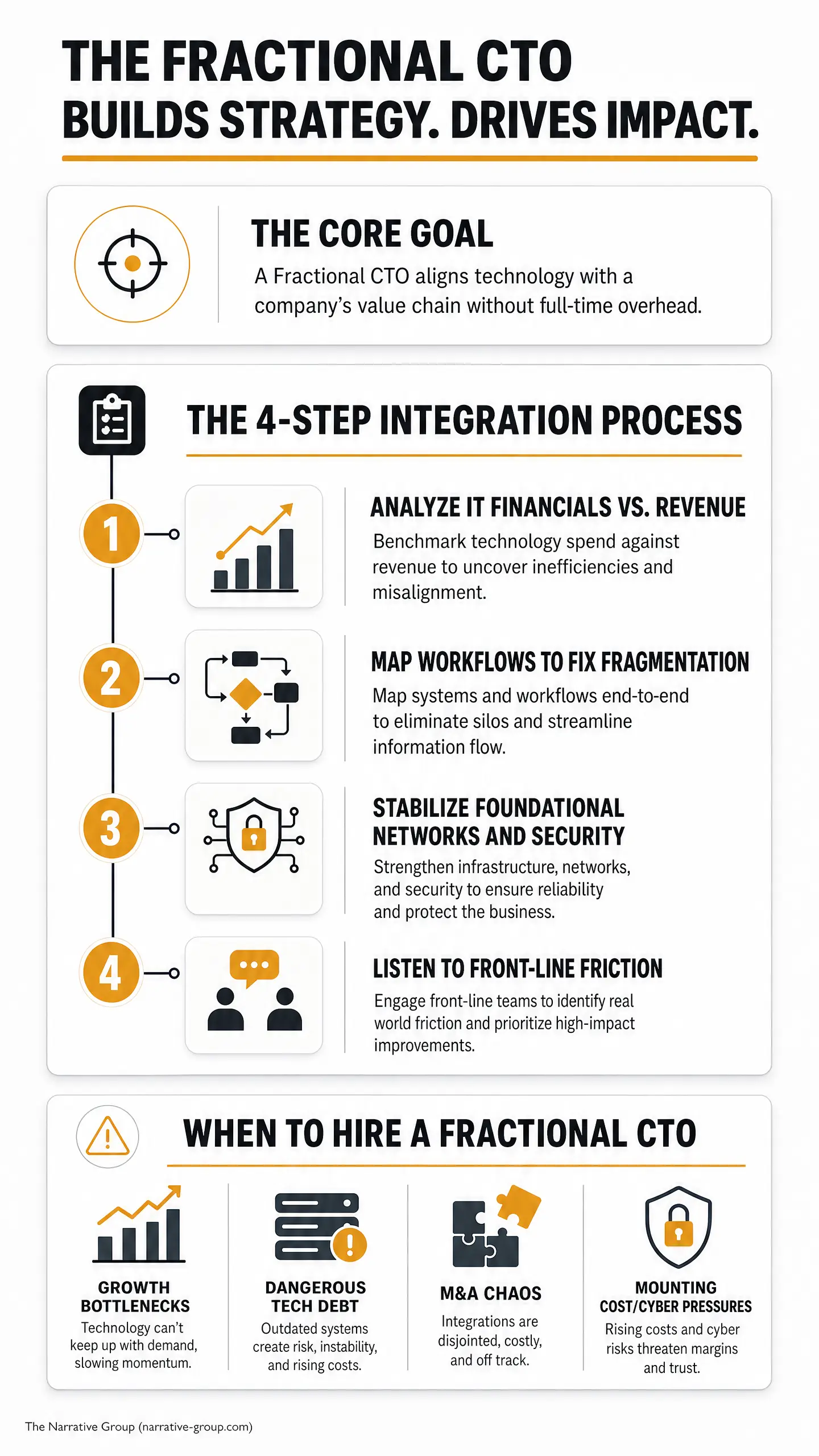
A fractional CTO is a part-time executive technology leader who helps a company make strategic technology decisions without hiring a full-time CTO. For mid-market companies, the role often includes IT strategy, technology governance, vendor oversight, cybersecurity leadership, roadmap planning, and executive decision support. Sometimes it leans more CTO. I care more about what gets done than what is printed on the title.Start with the Only Question That Matters
I always start with the same question. How do you actually make money? Every business is here to make money. Period. So that is where I begin.
Follow the money. Understand the value chain. Understand how people, process, and technology work together to deliver it. Once you see that clearly, you can spot where the technical architecture is in conflict with the value chain.
Every business also runs on long-running processes. Orders. Production. Claims. Deliveries. Billing. Service. If those flows are unclear, technology decisions drift. That is why I split the picture in two. I look at the primary value chain, where value gets created. Then I look at the supporting functions that shape the cost structure.
From there, the role gets practical very quickly. What needs to be stabilized now? What should be standardized? Where does automation make sense? Where should you slow down? Then you help the company move without blowing up day-to-day operations.
What I Actually Do as a Fractional CTO
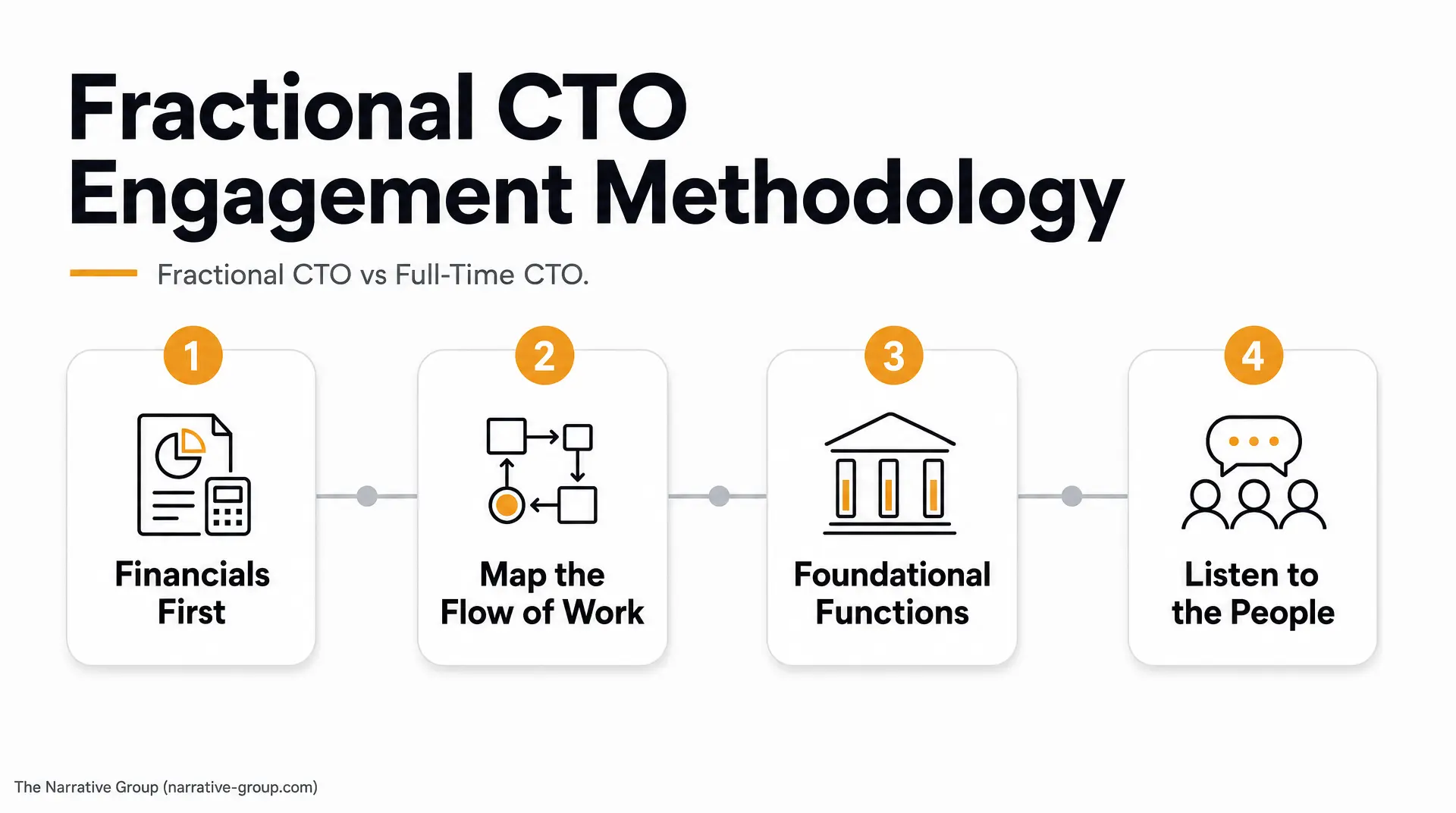
I Start with Financials First
When I step into this role, I start with Financials First. I want to see how you spend on IT. I want to see that spend against revenue and operating costs. I want to see where downtime hurt productivity, where labor got added to patch over weak systems, and where vendors are draining money without giving you enough back.
That pressure is only getting stronger. Gartner found 77% of CFOs and senior finance leaders planned to increase technology spending in 2025. Fine. If spend is going up, value has to be visible. What gets measured gets managed.
At The Narrative Group, we track IT contribution year over year. We look at total IT spend versus revenue, the balance of IT labor and non-labor, and overall service levels. Boards and owners do not need more jargon. They need to see what the spend is doing.
Then I Map the Flow of Work
After that, I draw the picture. What are the systems? Who is talking to who? How often? Where does data stop? Where does it get keyed twice? Where is a vendor touching a critical handoff, but nobody owns the full process? Draw it all out. The picture tells a thousand words.
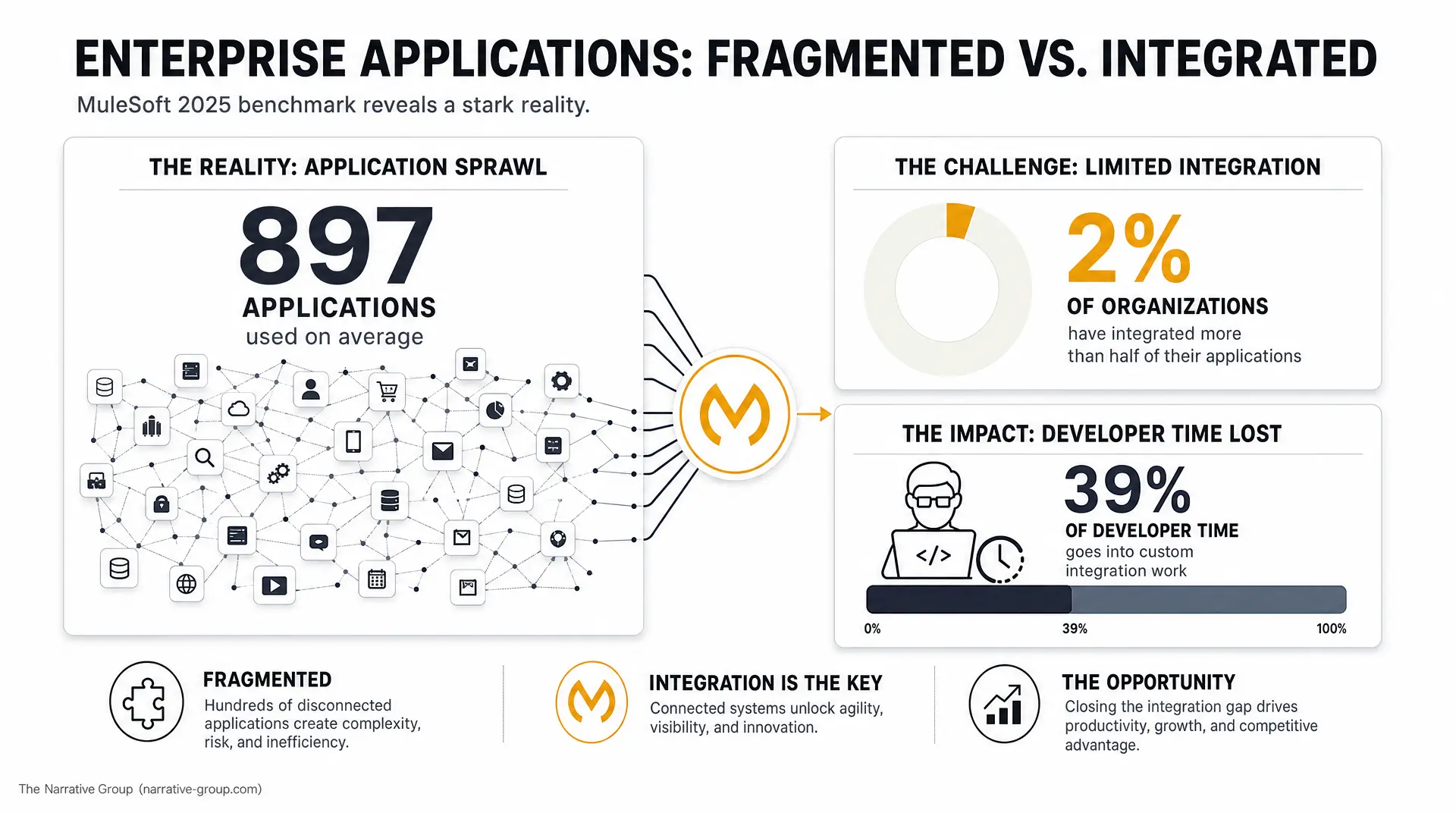
This matters because fragmentation is real. In MuleSoft’s 2025 benchmark, organizations used 897 applications on average. Only 2% had integrated more than half. MuleSoft also found 39% of developer time goes into custom integration work.
Even if your business is smaller than that survey average, the pattern is familiar. Systems drift apart. Vendors work in their own little vacuum. Then your people become the integration layer. That is expensive. It is slow. It creates confusion. It also makes decision-making harder than it should be.
Then I Go After the Boring Foundational Functions
I always look for the boring foundational functions first. Networks. Devices. Identity. Servers. Meeting rooms. Backup. Security hygiene. These things are not flashy, but they matter because poor foundations create firefighting, and firefighting keeps leaders out of the strategic conversations they should be having.
One company came to us with six offices and a basic complaint. People moved from one office to another and could not connect to the network. Meeting rooms barely worked. Every request to IT got blocked in the name of security. We assessed the environment, replaced core switches and network gear, retired outdated servers, put devices on a lifecycle plan, and fixed the meeting rooms. Three years later, the managing director told me, “You’ve created a problem for me. Everybody wants the office to look exactly like the new office you created because it’s that good.”
That is what happens when IT gets out of the way and starts enabling work. It is also why I care so much about foundations. Uptime Institute reported that 55% of respondents had a data center outage in the prior three years, and 39% had seen outages caused by human error. Reliability is a process issue as much as a technology issue.
I push hard for standardization here too. In most businesses, what makes you unique is the people, not the plumbing. Be ruthless about that. Figure out exactly where you are different. For common processes, I want vanilla software. Mainstream, not leading edge, not bleeding edge. For the things that are commodities, treat them as commodities. Take the pieces that do not represent a competitive advantage and outsource them.
Then I Listen to the People Doing the Work

After that, I listen. Show me the day in the life. Show me where the process breaks. Show me what your team has to do because the technology is letting them down. Most frustrations land in one of two places. Role definition is unclear, or the technology is not doing what the company is asking it to do.
If your operations leaders tense up when the tech team walks in, trust is already broken. You rebuild that trust by listening first, then by delivering. People may vent. Fine. They are telling you where the friction is. The people closest to the work usually show you where the real conflicts are.
I like site visits for a reason. You see the visual clutter. You see the physical bottlenecks. You see the workaround nobody wrote down. That is where the real story usually is.
How a Fractional CTO Differs from a Full-Time CTO
This is where executives usually ask the obvious question. Why not just hire a full-time CTO?
Sometimes that is the right answer. If technology is your product, or the pace of change is constant and heavy, you probably need that role filled full time. The day-to-day work can look similar either way. The difference is capacity and coverage. A full-time CTO is in the seat every day. A fractional CTO focuses executive attention where it matters most and works through your internal teams, vendors, or a partner like mine to get the work done.
A lot of mid-market companies are in a different spot. Technology is critical, but it is not the thing they sell. They need senior judgment, vendor discipline, cybersecurity oversight, architecture, and a roadmap. They do not always need full-time executive overhead before the business is ready for it.
That overhead is real. In the United States, the median annual wage of $171,200 for computer and information systems managers gives you a sense of the fixed burden. Demand is not easing either. The occupation is projected to grow 15% from 2024 to 2034.
I often say IT is effectively two departments. One is the core operational layer. In most businesses, that layer is a commodity. Pay commodity-oriented prices for it. The other layer is strategic. It learns the business, shapes the roadmap, and drives enterprise value. A fractional CTO lives in that second layer and makes sure the first one is stable.
This role is also different from an MSP, and different from the consultant who drops off a deck and disappears. An MSP keeps the lights on. A good fractional CTO decides which lights matter, how the wiring should work, and how the spend connects back to business performance. If someone is talking in ambiguity, keep asking questions. When the rubber hits the road, ambiguity does not deliver.
When a Business Should Seriously Consider a Fractional CTO

Growth Is Exposing a Productivity Problem
Most businesses have a productivity problem. They just feel it in different places. If every new customer, order, product, or location forces you to add more labor, your operating model is running out of room.
This is where a fractional CTO can create leverage quickly. I start with standardization and automation. The goal is to reduce the cost to operate and increase capacity. That lets you redeploy people into higher-value work and slows the rate of hiring as the company grows.
In one e-commerce engagement, a product setup process stretched across five weeks. One person could spend up to three weeks just doing the setup work. We applied workflow automation and AI to a specific part of that process. The work dropped to four hours. That is where AI earns the right to stay. That kind of tedious, detail-heavy work is exactly where I see the most promise. Outside research points in the same direction. An NBER paper found a 14% average productivity increase when generative AI was applied to a defined customer support workflow.
Modernization Is Starting to Feel Dangerous
Sometimes growth is not the trigger. Sometimes the environment is just old, brittle, and expensive to carry. E-commerce does not talk to inventory. Reporting takes forever. Upgrades keep slipping because every system has some custom tweak hanging off it.
Where do you begin when nothing talks to anything else? You go back to the business model. How are you fulfilling? From a distribution center? From a store? Through direct shipment? Click and collect? Draw the flows first. Then the fix becomes much more obvious.
This is also where cheap decisions come back to bite you. Low-cost IT providers can look attractive until you need scale. Then the business pays in rework, downtime, and missed opportunities. I have also seen companies cut software license costs and push the expense straight into manual labor. The accounting line may look better for a quarter. The business slows down for years.
Be careful with short-term custom software too. If temporary contractors or students build a tool with no long-term ownership, you are planting a ticking time bomb. For common processes, use vanilla software. Whenever you have a common process and try to make it unique and special, you are creating cost that is hard to remove later.
Phasing matters here. McKinsey and the University of Oxford found that large IT projects ran 45% over budget on average and delivered 56% less value than predicted. You reduce that risk by assessing first, finding the quick wins, piloting where you can, and then moving in controlled steps.
An Acquisition or Leadership Gap Has Created Chaos
Acquisitions expose hidden technology debt very quickly. Different networks. Different vendors. Duplicate tools. Conflicting security models. No agreed target state. The same kind of chaos shows up when a CTO or head of IT leaves and the company gets stuck in reaction mode.
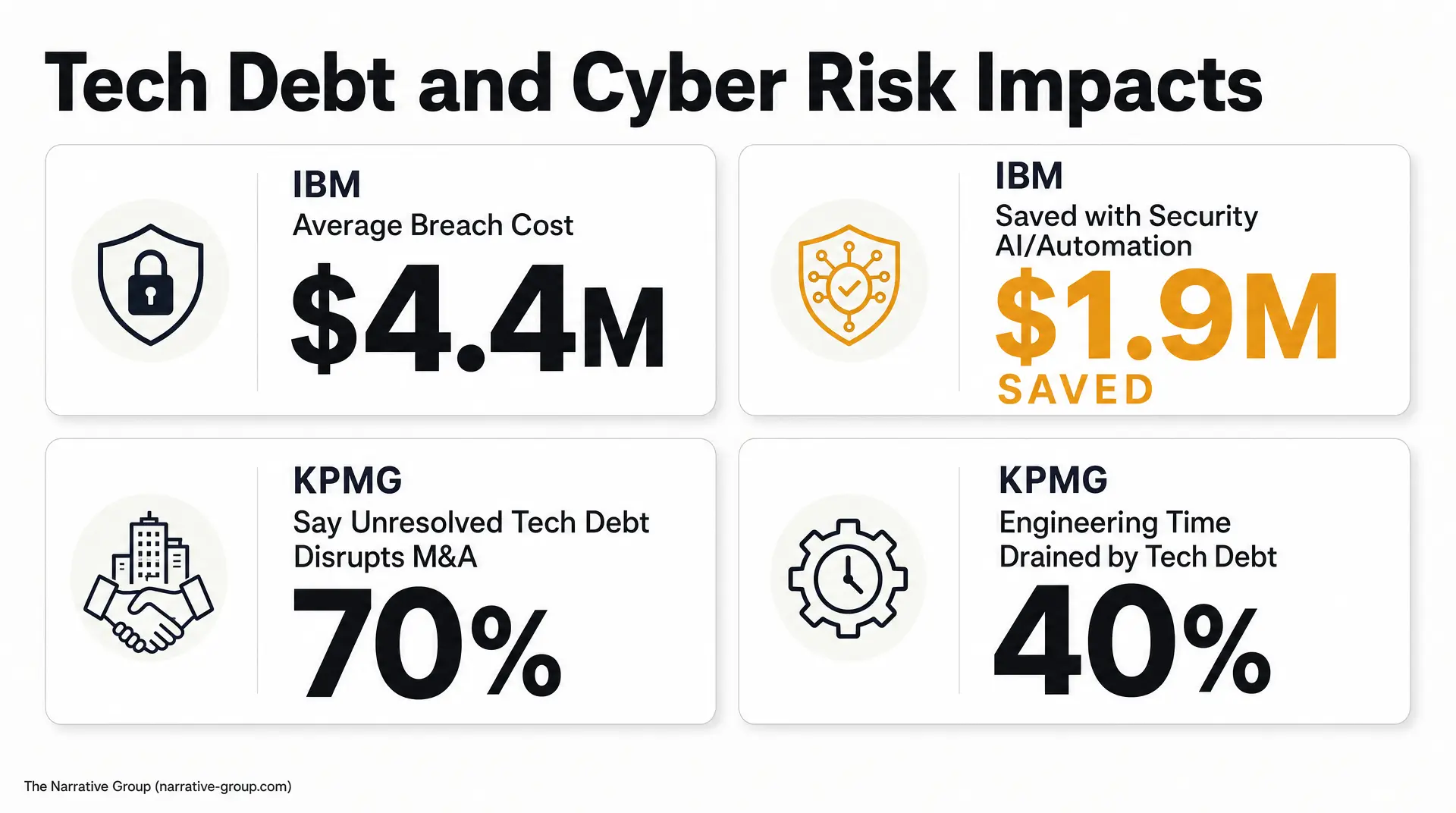
KPMG found 70% of respondents said unresolved tech debt can cause significant operational disruption in M&A. It also found tech debt consumed up to 40% of engineering staff time for many deal professionals in the prior year. That is a huge capacity drain.
A fractional CTO gives you a bridge. Someone can slow the chaos down, map the environment, set the governance, and help executives make decisions they own. That matters, especially when internal leaders are stuck in firefighter mode and missing the strategic discussions they should be in.
Cost, Cyber, and AI Pressure Are Hitting at Once
A lot of companies bring in a fractional CTO when several pressures hit at the same time. Finance wants tighter cost control. The board wants a cleaner cyber story. Vendors are noisy. Everybody suddenly wants an AI strategy.
That pressure is justified. IBM put the average breach cost at $4.4 million. Verizon found third-party involvement doubled to 30%. In the same report, ransomware showed up in 88% of SMB breaches. Vendor management is business risk management now.
I am optimistic about AI, but I stay practical. Generative AI can produce confident answers without reliable business context. A lot of what is being sold today is not ready for prime time. IBM found 63% lacked AI governance policies. If you try to use AI to make up what the business process is, you lose control. Start with the business rules. Clean up the data. Pilot in a controlled setting. Then scale. Used properly, security AI and automation can help too. IBM found organizations with extensive use of those tools saved $1.9 million on average in breach costs.
What Results Should You Expect from a Fractional CTO?

Start with clarity. A good fractional CTO should show you where the money is going, where the real constraints are, what can be fixed quickly, and what needs a longer path. The roadmap should tie back to revenue, margin, productivity, uptime, security, and enterprise value.
You should also expect a more stable operation. Less downtime. Better change discipline. Cleaner data. Better vendor accountability. More confidence from operations because IT is intended to be an enabler, not a blocker.
You should expect measurable productivity improvements too. I like to measure process time before and after. How long did the work take? How long does it take now? In some companies, the win is higher throughput. In others, it is fewer errors, better service, or a slower rate of hiring because the same team can now do more.
You should expect change management to be treated seriously as well. Prosci found projects with excellent change management were seven times more likely to meet objectives. Change starts at the top of the house. If senior leaders buy in, the business has a much better chance of moving with confidence.
And yes, these outcomes show up financially. I have worked on mandates where the result showed up in gross margin, in lower IT spend as a share of revenue, and in enterprise value during a transaction. That is why I keep bringing the conversation back to the business model and the P&L.
How the Engagement Usually Works
Ongoing, Part-Time Leadership
In an ongoing model, I join the executive rhythm of the business. I help with priorities, budgets, cyber posture, vendor management, architecture decisions, and board-ready reporting. If there is an internal IT leader, I coach them. If there is not, my team can carry more of the load.
For smaller mid-market organizations, that can extend all the way into acting as the IT department. That matters because credibility gets built through delivery. You solve the foundational problems first. Then you move up into business process optimization.
Project-Based Transformation

In a project-based model, the mandate is tighter. It may be modernization, acquisition integration, an interim leadership gap, a security reset, or a workflow automation program. We start with a Financials First discovery assessment. Then we map how data flows, how the value chain is executed, and where the real conflicts sit.
From there, we usually organize the work into three, four, or five themes. We take the quick wins first. Then we move through the bigger items in phases. No big-bang heroics. Labs matter, but real-world learning matters more.
That phased approach is important. Transformation should be done with the business, not to the business. Leaders stay involved. Front-line teams get heard. Risks get tested in the real world, not only in a lab. The operating change has to show up in measurable results.
Final Thought
If your company is too complex to run on tickets, vendor calls, and hope, but not ready for a full-time CTO, a fractional CTO is often the right next step.
Start with the simplest question in the room. How do you actually make money? Follow the money. Map the work. Fix the conflicts between the value chain and the technology.
Do that well, and you create capacity, reduce waste, and build confidence. To me, innovation is making the operation of a business model elegant. That is the job.
Once you know the role makes sense, the next practical question is cost. After that comes comparison. How does a fractional CTO stack up against a full-time CTO, a CIO, or an MSP? Those are the right next questions to ask.
Need Executive Technology Leadership Without a Full-Time CTO?
If your company is growing, modernizing, preparing for acquisition, or facing rising technology complexity, a fractional CTO can help leadership make better decisions without adding full-time executive overhead.
Narrative Group provides fractional CTO services built around Financials First: connecting technology decisions to business performance, risk reduction, operating capacity, and enterprise value.
Explore Fractional CTO Services or book a 15-minute discovery call.
Still sorting through competing technology requests? Start with the IT Investment Prioritization Scorecard.
Fractional CTO Series
- What Is a Fractional CTO – and When Does Your Business Need One?
- Fractional CTO vs Full-Time CTO: Which Is Right for Your Business?
- How Much Does a Fractional CTO Cost? A Mid-Market Pricing Guide
- 7 Signs Your Mid-Sized Company Needs a Fractional CTO
- How a Fractional CTO Prepares a Mid-Sized Company for Acquisition
Frequently Asked Questions
What does a fractional CTO do for a mid-market company?
A fractional CTO provides executive technology leadership without the cost or commitment of a full-time hire. For mid-market companies, this often includes technology strategy, roadmap planning, investment prioritization, vendor oversight, cybersecurity guidance, IT governance, board-level reporting, and support for major technology decisions.
The role is not just to manage technology activity. It is to help leadership connect technology decisions to business performance, risk reduction, operational efficiency, and growth.
When should a company hire a fractional CTO?
A company should consider a fractional CTO when technology decisions have become too important or complex to manage informally, but the business does not yet need a full-time CTO.
Common triggers include rising IT spend, vendor sprawl, cybersecurity exposure, major systems modernization, acquisition preparation, growth pressure, or an internal IT team that can execute but needs senior strategic direction.
How is a fractional CTO different from a full-time CTO?
A full-time CTO is a permanent executive who sits in the business every day. A fractional CTO provides senior technology leadership on a part-time, retained, or project-based basis.
For many mid-market companies, a fractional CTO is the right step before hiring a full-time executive. It gives the company access to senior judgment, governance, vendor oversight, and roadmap leadership without adding full-time executive overhead too early.
How quickly should a company expect results from a fractional CTO?
You should see financial clarity within the first 30 days. Because large IT projects historically run 45% over budget, early value often comes from identifying weak governance, vendor issues, failing initiatives, security exposure, or spending that is not connected to business value.
Measurable operating results may take longer, especially if the work involves modernization, automation, cybersecurity improvement, or process redesign. A realistic expectation is early clarity first, followed by measurable productivity, risk, or cost improvements over the next several months.
Can a fractional CTO help with AI, cybersecurity, and vendor risk?
Yes. A fractional CTO can help leadership evaluate AI, cybersecurity, and vendor risk in business terms.
That may include defining AI governance, reviewing cybersecurity exposure, prioritizing security investments, improving vendor oversight, clarifying ownership, and helping executives understand where technology risk could affect operations, revenue, compliance, or enterprise value.
How is a fractional CTO different from an MSP?
An MSP typically manages day-to-day IT operations such as support, infrastructure, devices, monitoring, and service delivery.
A fractional CTO helps leadership make strategic technology decisions. That includes deciding what to fund, what to fix, what to stop, how to govern vendors, how to reduce risk, and how to align technology investment with business goals.
In simple terms, an MSP helps run the environment. A fractional CTO helps leadership decide where the environment needs to go.
What should a company do before hiring a fractional CTO?
Before hiring a fractional CTO, leadership should get clear on the business problem. Is the issue rising IT spend, vendor sprawl, cybersecurity exposure, modernization risk, weak reporting, poor system integration, acquisition preparation, or lack of executive technology leadership?
The clearer the business problem, the easier it is to define the right scope. A strong first step is to assess where technology is helping the business, where it is creating drag, and which decisions need executive-level governance.