
I have had this conversation for years. A CFO is looking at the budget. A COO is tired of operational friction. The CEO wants growth without chaos. Then somebody asks whether the next IT investment should be CapEx or OpEx.
It is a fair question. It usually comes too late.
I start somewhere else. How do you actually make money? If I do not understand the business model, the value chain, and the way data moves through the company, then the accounting treatment is just a label. The label matters. The business matters more.
I have never liked the old commentary that there is “the business” and then there is “IT.” My paycheck always had the same company name on it as everyone else’s. When I was at Loblaw, I helped align more than $300 million of capital spend to enterprise strategy.
At The Narrative Group, I use the same thinking with mid-market companies that need enterprise-grade IT leadership without enterprise bloat.
So let’s make this simple. CapEx versus OpEx affects cash flow, EBITDA, board approvals, flexibility, and enterprise value. Cloud has pushed a lot of spending into OpEx. That has helped many businesses. It has also created a governance problem. If you are leading a mid-market company, you need to see the whole picture.
Start with the Business, Then Talk About the Budget Code

At The Narrative Group, I start with what I call Financials first. I look at how you spend money on IT, how you deploy capital, and how technology is actually being used. Then I map the value chain and the data flows. I want to know where people are frustrated. I want to know where the technical architecture is in conflict with the value chain. I want you to show me the day in the life.
Why do I start there? Because IT goes far beyond ones and zeros. I care about execution. I care about whether your people can do their jobs without fighting the system.
CapEx in Plain English
CapEx is capital expenditure. In IT, that usually means you are buying or building something that should last beyond the current year. Core network gear is a good example. So are servers, device refreshes, office technology buildouts, and some implementation costs tied to major systems.
That spend usually lands on the balance sheet. Then it is recognized over time through depreciation or amortization. For tax purposes, the IRS generally gives a five-year recovery period for computers and 36 months for qualifying software. Your controller and tax advisor will handle the exact treatment. The strategic point is simpler. CapEx spreads recognition over time, but the cash usually goes out up front.
OpEx in Plain English
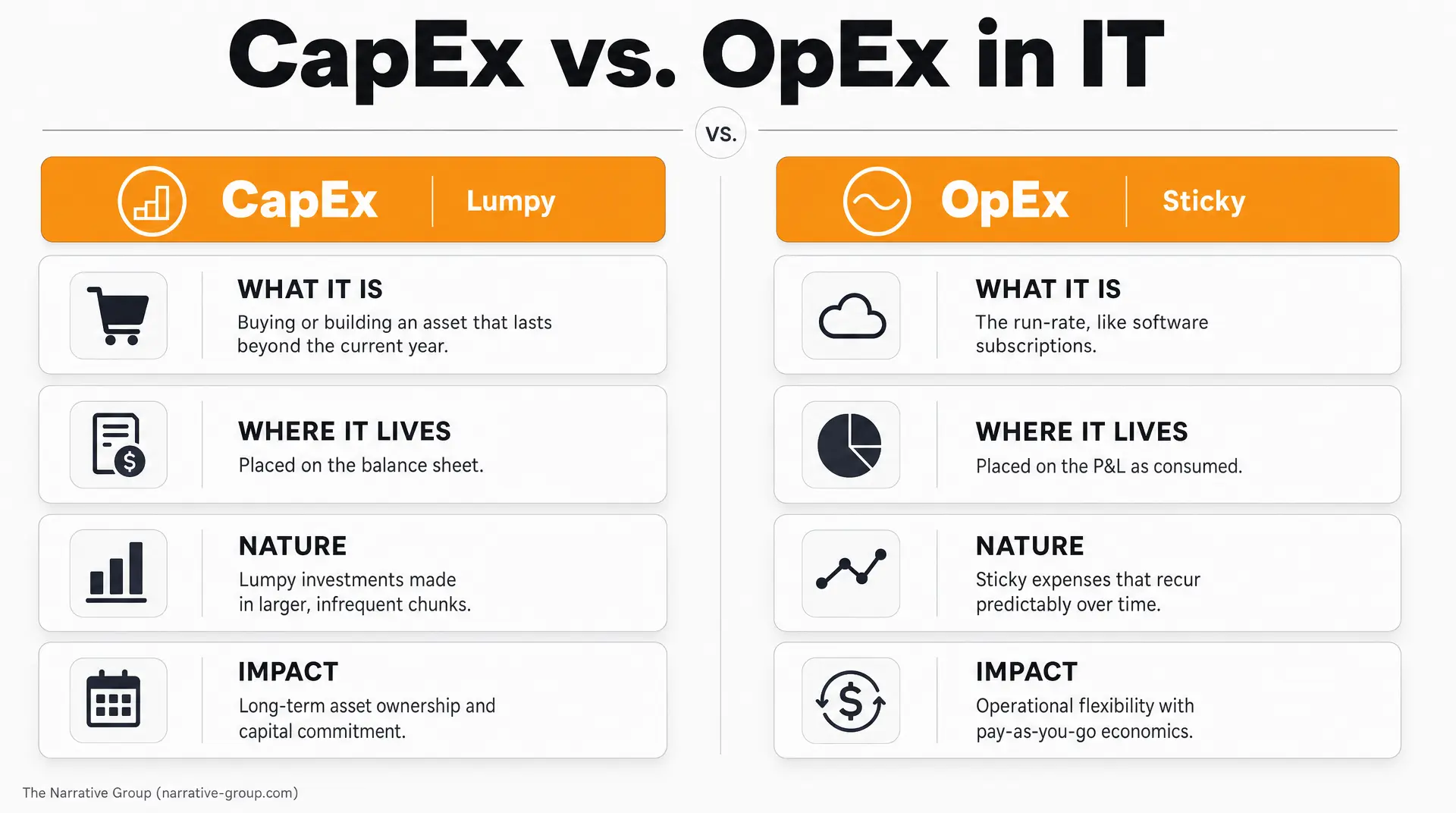
OpEx is operating expenditure. This is the run-rate. It includes software subscriptions, cloud infrastructure, managed services, cybersecurity monitoring, licensing, and support contracts. The bill comes monthly, quarterly, or annually. The expense hits the P&L as you consume it.
That makes OpEx easier to start. It often needs less cash on day one. It can also get out of hand faster than leaders expect, because a monthly bill feels smaller than a big capital request. It is easier to sign. It is easier to hide. It is easier to forget.
The Accounting Nuance That Trips People Up
Cloud adds one wrinkle. A SaaS subscription is usually an operating expense. Some implementation costs can be treated differently under FASB ASU 2018-15, even when the hosting arrangement itself is a service contract. Canadian organizations follow ASPE or IFRS, which handle these entries differently. Whichever standard applies, your accounting team needs to sort out the entries.
The business case still comes first. You still need to decide whether the investment helps the business make money, improve control, or scale cleanly.
Why Mid-Market Leaders Need to Care
Cash Flow and Board Thresholds

If you are a CFO, you already know where the pressure sits. Cash matters. Debt covenants matter. Board thresholds matter. In many mid-market businesses, a meaningful capital request goes through a harder approval process. Owners want to know why the spend is needed, what the payback is, and whether the timing makes sense.
That scrutiny is useful. It forces discipline.
OpEx can bypass some of that discipline when departments buy tools one subscription at a time. Then you wake up six months later with five overlapping platforms, three vendors doing similar work, and a monthly bill nobody really owns. I see this all the time.
CapEx is lumpy. OpEx is sticky. You need governance for both.
EBITDA Matters, but It Is Not the Whole Story
This is where a lot of conversations go sideways. Leaders look at EBITDA and decide CapEx feels better because depreciation sits below EBITDA, while OpEx hits it right away. That view is incomplete.
If you buy the wrong asset, you may protect EBITDA in the short term while damaging cash and flexibility. If you consume the same capability as a service, the expense hits faster, but you may also remove manual work, reduce downtime, and slow the rate of hiring. That can improve operating leverage in a very real way.
I have seen businesses cut software costs and move the expense straight into labor. The license line looks better. The business gets slower. People start doing manual work to compensate for weak systems. Innovation drags. Culture gets stuck. Those decisions create delay disguised as discipline.
There is real evidence here. An NBER field study found a 14% average productivity gain when customer support agents used a generative AI assistant. For less experienced workers, the gain was even bigger. I see the same pattern in the field. Good technology improves throughput. It can also cut cost. It gives people more capacity and slows the rate of hiring.
Enterprise Value Sits on Top of All of This
Enterprise value is shaped by the quality of your operations. Buyers, lenders, and boards care about predictable delivery, clean controls, cyber resilience, and the ability to scale without heroics. They also care about the mess you leave behind when you underinvest.
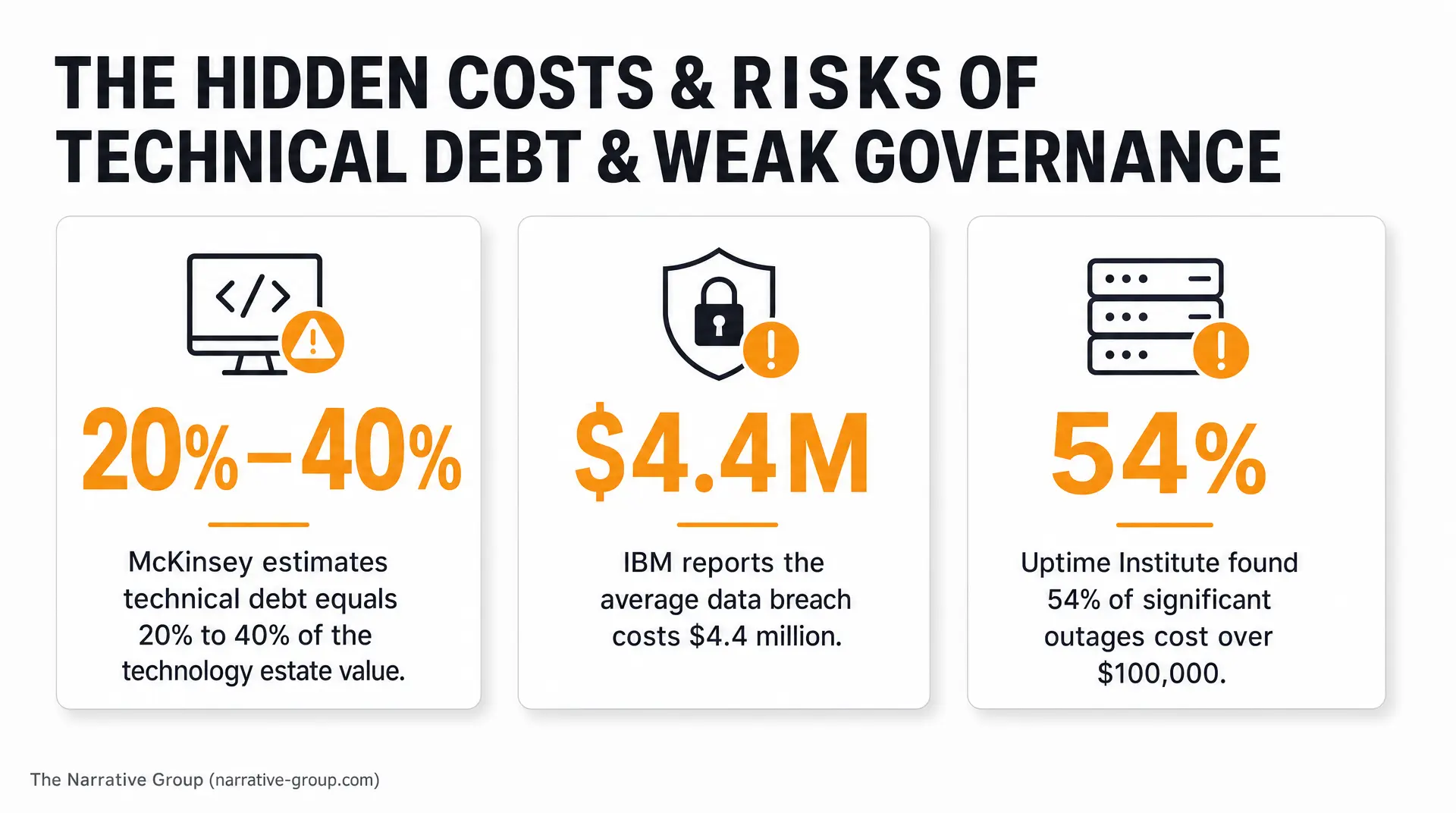
McKinsey has estimated that technical debt can equal 20% to 40% of the value of the technology estate. I believe it. Customizing common processes, delaying foundational upgrades, and buying cheap short-term fixes all create debt. Later, that debt steals time, cash, and management attention.
The risk side matters too. The Uptime Institute’s 2024 survey found that 54% of significant outages cost more than $100,000, and 20% cost more than $1 million. IBM found the average cost of a data breach reached $4.4 million. Verizon reported third-party involvement in breaches doubled to 30%. Vendor sprawl has a cost. Weak governance has a cost. You may not see it in the monthly invoice. You will see it somewhere.
Cloud Changed the Spending Model
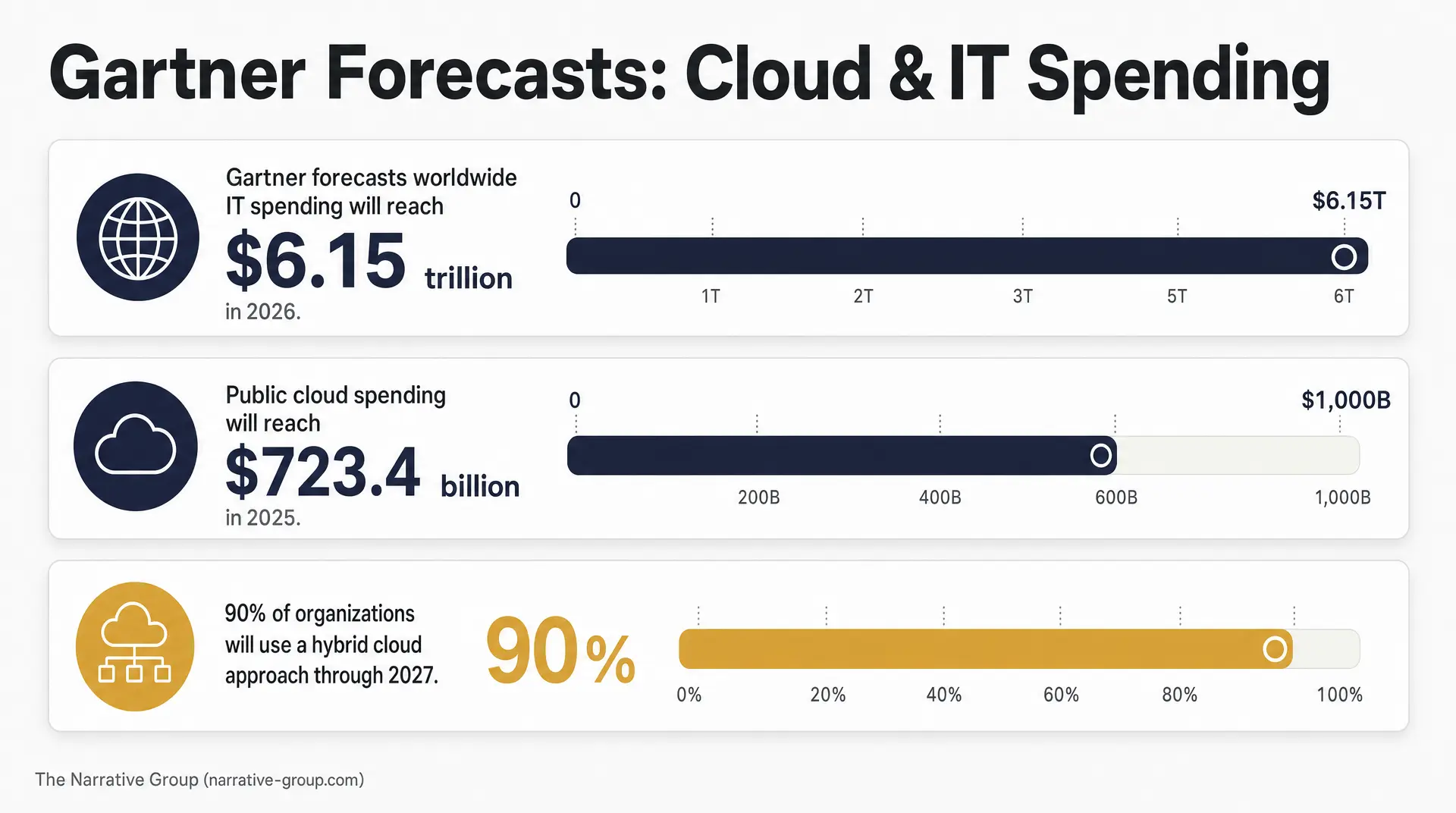
Cloud pushed a lot of IT from owned assets into consumption-based services. That shift is real. Gartner forecasts worldwide IT spending will reach $6.15 trillion in 2026, with software at $1.43 trillion and IT services at $1.87 trillion. The center of gravity has moved.
Cloud spending makes that even clearer. Gartner forecast public cloud spending of $723.4 billion in 2025, up 21.5% from the prior year. Gartner also expects 90% of organizations to use a hybrid cloud approach through 2027. That matches what I see. Most practical strategies are hybrid. Some spending remains capital. A lot of it becomes recurring service spend.
That brings flexibility. It also creates a management problem.
A Flexera cloud survey found that 85% of respondents rank cloud cost management as the top priority, 17% exceeded budget, and wasted IaaS and PaaS spend rose to 29%. Flexera also found only 49% of organizations use unit economics to understand cost per service, and among SMBs that falls to 32%. That tells you exactly what is going wrong. Leaders buy cloud for flexibility, then fail to manage it with business discipline.
So what do you do? You treat cloud like a financial operating model. Somebody has to own usage. Somebody has to own renewal dates. Somebody has to own license cleanup. Somebody has to tie the cost back to business output.
Monthly spend without ownership is drift.
Where I See Leaders Get This Wrong
They Chase Cheap and Lose Scale
One of the biggest hidden costs in IT is the low-cost decision that looked smart at the time. The provider is cheap. The custom tool is cheap. The workaround is cheap. Then the business grows. The cracks widen. Rework shows up. Service drops. Scale gets harder.
I have seen businesses avoid software costs in ways that came back to bite them later. A tool gets kept alive to avoid license fees. Years later it blocks a broader upgrade path and raises the cost of moving forward. That is what happens when you follow the invoice and ignore the architecture.
Temporary contractors and co-op students building cheap custom tools create the same problem. It feels efficient in the moment. It leaves a ticking liability inside the business.
They Customize Common Processes

This one is partly a leadership problem. People want to believe their process is special. Usually it is not.
Whenever you have a common process and try to make it unique beyond the commodity process, you are creating cost. You are also creating technical debt. Use vanilla software. Stay current. Stay mainstream, not leading edge, not bleeding edge. Save your creativity for the parts of the business that actually drive enterprise value.
You cannot just codify broken business processes. The same warning applies to AI. When you are trying to get AI to make up what the business process is, you lose control.
Specifically and ruthlessly figure out where exactly you are different. What makes you unique is usually your people, your customer relationships, your operating discipline, or your service model. It is rarely the help desk workflow or the way you route a standard approval.
They Skip the Boring Foundation
Find the boring foundational functions. Fix those first.
At The Narrative Group, we often build credibility by doing exactly that. For smaller mid-market organizations, we can act as the IT department. We stabilize infrastructure. We improve service. Then we move higher into process change and business enablement.
Talk is cheap. Actions speak volumes. If the network works, the devices are current, the meeting rooms work, and people stop fighting basic technology every day, the executive team starts to believe the transformation can actually happen.
The Framework I Use
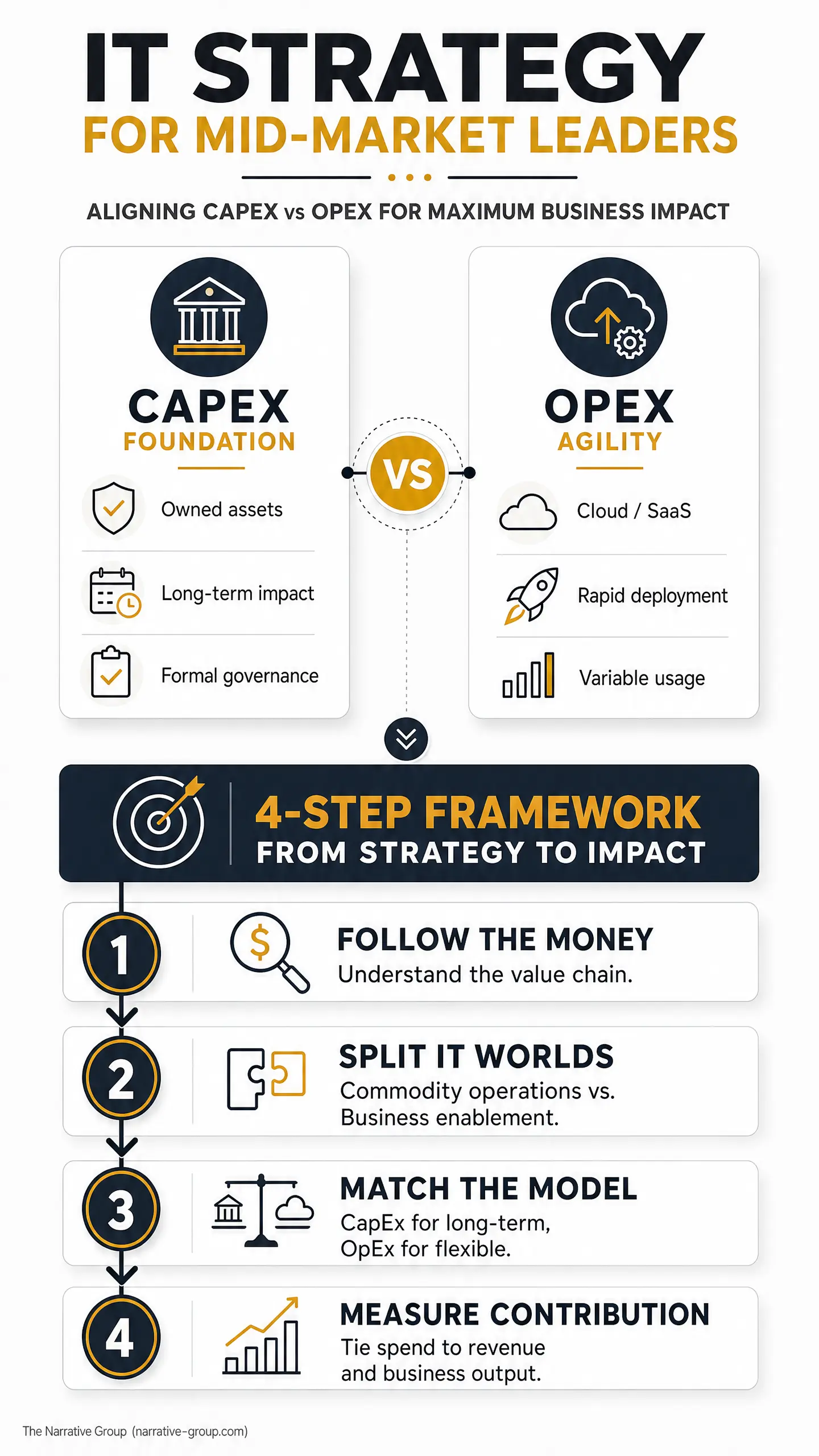
Follow the Money

My first question is simple. How do you actually make money?
Then I split the business into two views. The first is the primary value chain. How do you deliver your product or service? Where are the delays? Where is manual effort slowing throughput? Where is bad data hurting margin or customer experience?
The second is the supporting cost structure. Finance, HR, compliance, IT operations, and similar functions all matter. The goal there is to help those teams do more work with better control and less friction, without having labor grow linearly with the business.
If your team is arguing about tools before asking how the company makes money, stop. Stop focusing purely on requirements, and start asking core business questions.
Split IT Into Two Worlds
I often say IT is effectively two departments. One part is core operational IT. That includes the foundational infrastructure and support work that needs to be stable, secure, and boring. Much of that is a commodity. You should be paying commodity-oriented prices for it, often through outsourcing or managed services.
The other part is business enablement. That is where technology directly improves the value chain, raises productivity, reduces risk, or supports growth. Keep your strongest internal attention there.
This matters because the funding model should follow the nature of the work.
Match the Model to the Job

I lean toward CapEx when the investment is foundational, heavily used, and likely to stay in place for years. Core network upgrades, office technology buildouts, and structured refresh programs fit that logic. If the asset is central to operations and you have good governance around lifecycle management, capital treatment can make sense.
I lean toward OpEx when the need is variable, specialized, or easier to consume as a service. Cloud capacity, cybersecurity monitoring, managed support, SaaS platforms, and many AI or workflow tools fit here. They move faster. They change faster. They benefit from specialist management.
Most real strategies land in the middle. A hybrid approach is normal. You may use CapEx to refresh core infrastructure and OpEx to run cloud services, security monitoring, and support around it. You may pilot a new capability as OpEx first, prove the value, and then make a larger structural commitment.
That is how I work. Assess it. Find the conflicts. Take the quick wins. Build the broader program. Do it with the business leaders. They need to own the decisions.
Measure the Contribution
What gets measured gets managed. I want to see total IT spend against revenue. The SIM 2024 IT Trends study puts average IT spend at 4.9% of revenue across reporting organizations, with manufacturing closer to 2.0%. Use that as a reference point. The number only helps when it matches your model and growth plan.
I also want uptime, incident trends, cycle times, labor versus non-labor mix, and the cost per service where possible. If the board asks what IT produced, you should be able to answer in dollars, hours, and service levels. If you do not know what an outage cost you last year, quantify it. If you do not know what it costs to onboard a customer, launch a product, or fulfill an order, quantify it.
Follow the money.
Two Examples That Make the Point

I worked with a professional services firm that had six offices. People moved from one office to another and could not connect properly to the network. Meeting rooms barely worked. Staff were frustrated. The technology was letting them down. We assessed the infrastructure, replaced core switches and network gear across the organization, replaced outdated servers, put devices on a lifecycle plan, and improved the meeting room setup. Three years later, the managing director told me we had created a problem. Everybody wanted the rest of the offices to look exactly like the new one. That is what a smart foundational investment does. It reduces friction. It improves service. It builds confidence.
On the other end of the spectrum, we worked with an e-commerce client on AI and workflow automation. Their product setup cycle was taking five weeks. One person could spend up to three weeks on a setup task. We reduced that to four hours. That kind of operating expense can transform the P&L. It lowers the cost to operate. It increases capacity. It gives you room to redeploy people into higher-value work. It also supports growth without hiring linearly.
Those are very different examples. The logic behind both is the same. Follow the money. Improve the value chain. Give the business leverage.
The Bottom Line for Mid-Market IT Leaders
CapEx versus OpEx is a leadership decision with accounting consequences. It shapes cash flow, EBITDA, governance, flexibility, and enterprise value. It also shapes behavior. That is why the decision needs to start with the business model.
Ask how you make money. Map the value chain. Find the boring foundational functions. Use vanilla software for commodity work. Pay commodity-oriented prices where the work is a commodity. Keep your best internal energy focused on the areas that create value.
Every vendor wants to sell you the perfect tool. Ignore the show. Ask what line on the P&L it improves. Ask whether it helps people execute. Ask whether it gives you scale without chaos.
Innovation is making the operation of a business model elegant. When you do that well, technology becomes an enabler of growth, a protector of value, and a better path to the bottom line.
Need Help Aligning IT Spend with Business Performance?
IT budget planning should not be a spreadsheet exercise.
For mid-market companies, the IT budget should show what the business is protecting, what it is improving, and where it is investing for growth.
Narrative’s Financials First assessment helps leadership teams connect technology spend to the value chain, risk profile, productivity opportunities, and growth priorities of the business.
Use the IT Investment Prioritization Scorecard to evaluate your next round of technology investments, or explore Financials First if your leadership team needs a clearer view of what to fund, what to fix, and what to stop.
Technology Investment Strategy (This Series)
- IT Maturity Models Explained for Mid-Market Executives
- Technology Investment Prioritization: A Framework for Mid-Sized Companies
- IT Budget Planning for Mid-Sized Companies
- How to Build a Technology Business Case Your CFO Will Actually Approve
- CapEx vs OpEx in IT Strategy
- When to Replace vs Optimize Your Business Systems
- The Hidden Cost of Reactive IT in Mid-Sized Companies
Frequently Asked Questions
Does shifting to a cloud OpEx strategy automatically reduce total IT spend?
No. Cloud brings flexibility, but without rigorous governance, it breeds invisible sprawl. I see this constantly. Flexera notes wasted cloud spend hit 29%, and 17% of firms exceeded budgets. You must treat cloud like a financial operating model. Every dollar of consumption needs an owner and a business outcome attached. Otherwise, your monthly spend will simply drift upward without adding true enterprise value.
How do we build effective governance around a consumption-based hybrid IT strategy?
You must formalize cloud financial management. Ad hoc departmental purchasing destroys margins. Flexera data makes the gap visible: 85% of IT leaders rank cloud cost management as their top priority, yet 17% still exceed budget and wasted spend keeps rising. That gap exists because flexibility without governance is not a strategy. You need strict unit economics tying every hybrid consumption cost back to a measurable
What is the hidden financial risk of delaying foundational CapEx investments?
Delaying foundational upgrades creates technical debt that drains cash and management attention. I have seen it play out repeatedly. McKinsey estimates this debt equals 20% to 40% of the tech estate’s value. Avoiding CapEx refreshes to artificially protect short-term cash flow inevitably raises the long-term cost of operations and blocks scalable growth. The cheap decision today is often the expensive problem in three years.
How do we prevent SaaS subscription sprawl from silently eroding our EBITDA?
You need ruthless formal ownership. SaaS is sticky, easily expensed, and often forgotten. Flexera found only 49% of organizations use unit economics to understand cost per service, and among smaller businesses, that falls to 32%. When nobody is measuring spend against output, waste compounds silently. Someone must own usage, aggressively audit overlapping tools, and tie every renewal back to a measurable business outcome.
Is continuous cybersecurity monitoring an operating expense or a strategic investment?
It is a non-negotiable run-rate expense that protects enterprise value. I have seen what happens when businesses treat security as optional or defer it to save cost. With third-party breach involvement rising to 30%, weak governance is a financial risk, not just a technical one. IBM reports the average data breach costs $4.4 million. Funding robust security OpEx is not a cost center decision. It is an enterprise value decision.
Work With The Narrative Group
If this framework resonates and you want to apply it to your business, I would be glad to talk. At The Narrative Group, I work with mid-market companies across North America that need enterprise-grade IT leadership without the overhead of building a full internal team. Book a 15-minute call.