
Most mid-market companies do not choose reactive IT as a strategy. They drift into it. A system breaks. Somebody patches it. A license renewal gets cut to save cash. A spreadsheet fills the gap. The business keeps moving, so the pain gets tolerated.
I have seen this for more than 20 years, from my time at Loblaw and Shoppers Drug Mart to the work I do now through The Narrative Group. Different industries. Same movie. Reactive IT looks manageable because the cost is spread across the company. It lands in overtime, delays, missed opportunities, frustrated staff, and leadership distraction.
Most businesses already have a productivity problem before they admit they have an IT problem. Technology exposes it. Every company runs a series of long-running processes. Orders move, products get set up, invoices get approved, customers get served. When those flows are clogged with manual steps and weak systems, growth gets expensive.
So I start with a simple question: How do you actually make money? Follow the money. When you understand the value chain, you can see where the technology is helping and where the technical architecture is in conflict with the value chain. That conflict is where margin starts to leak.
Why Reactive IT Sticks Around

Reactive IT survives because it feels practical in the moment. Many mid-market firms do not have deep in-house IT leadership. They have a capable manager, a few outside vendors, and a lot of competing priorities. Urgent work wins. Preventive work gets pushed.
The cost-center mindset makes it worse. If you look at IT only through the lens of spend, every cut feels smart. Reduce licenses. Delay refreshes. Hire the lowest-cost provider. Build a quick custom fix. Each move looks small. Together, they create drag across the P&L.
Private companies feel this acutely. The owner sees a lower invoice this quarter. They do not immediately see the extra manual effort in operations, the slower close in finance, or the delay in onboarding. They usually see the impact later, after people have spent months carrying work the systems should have handled.
Vendors add to the noise. There is always another “perfect” tool being pitched into the boardroom. A lot of people talk in ambiguity. Everybody nods. Then when the rubber hits the road, the business rules are unclear, the workflows are messy, and the front line carries the pain.
Downtime Is the Obvious Cost. the Bigger Cost Sits Around It.
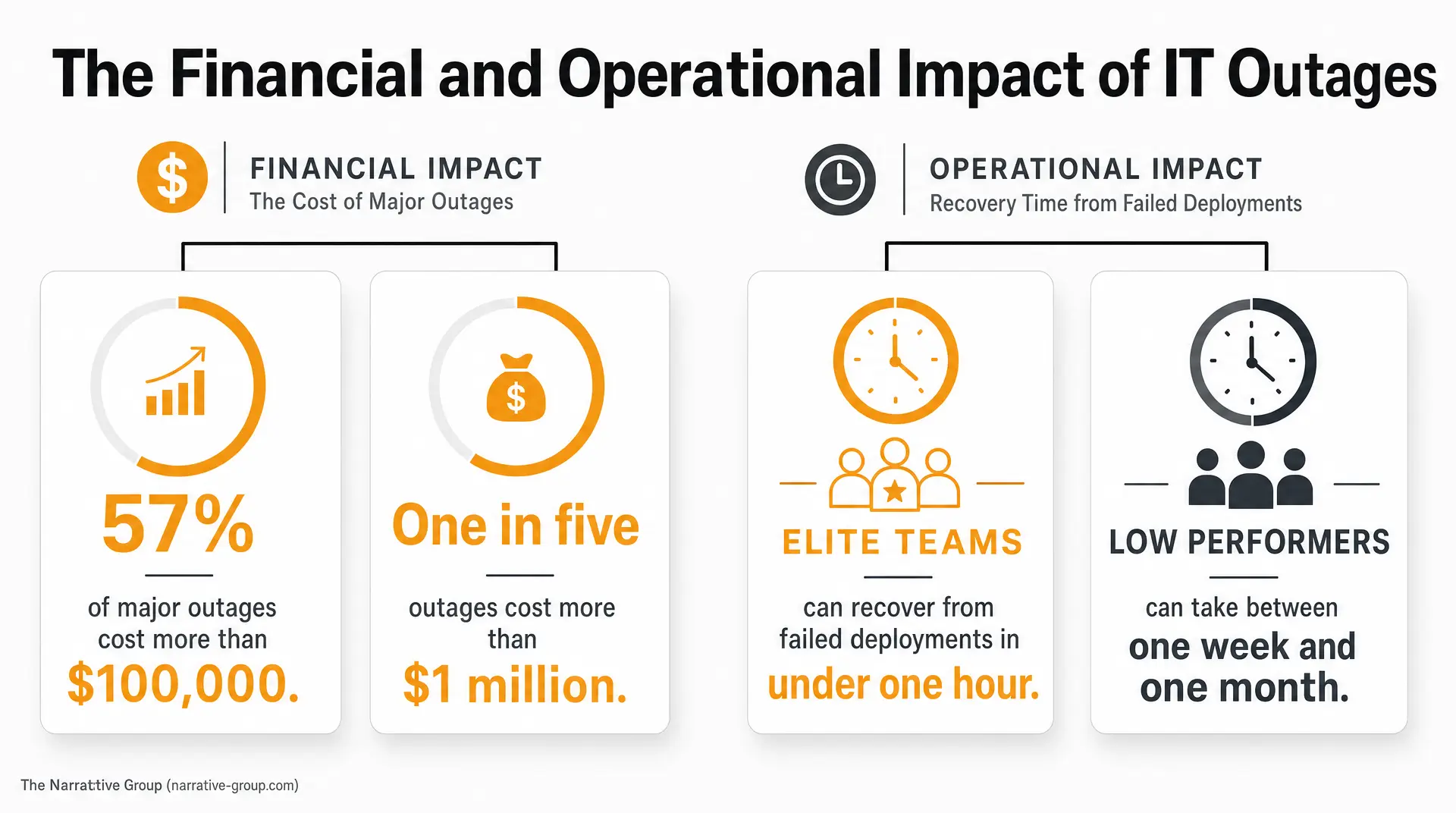
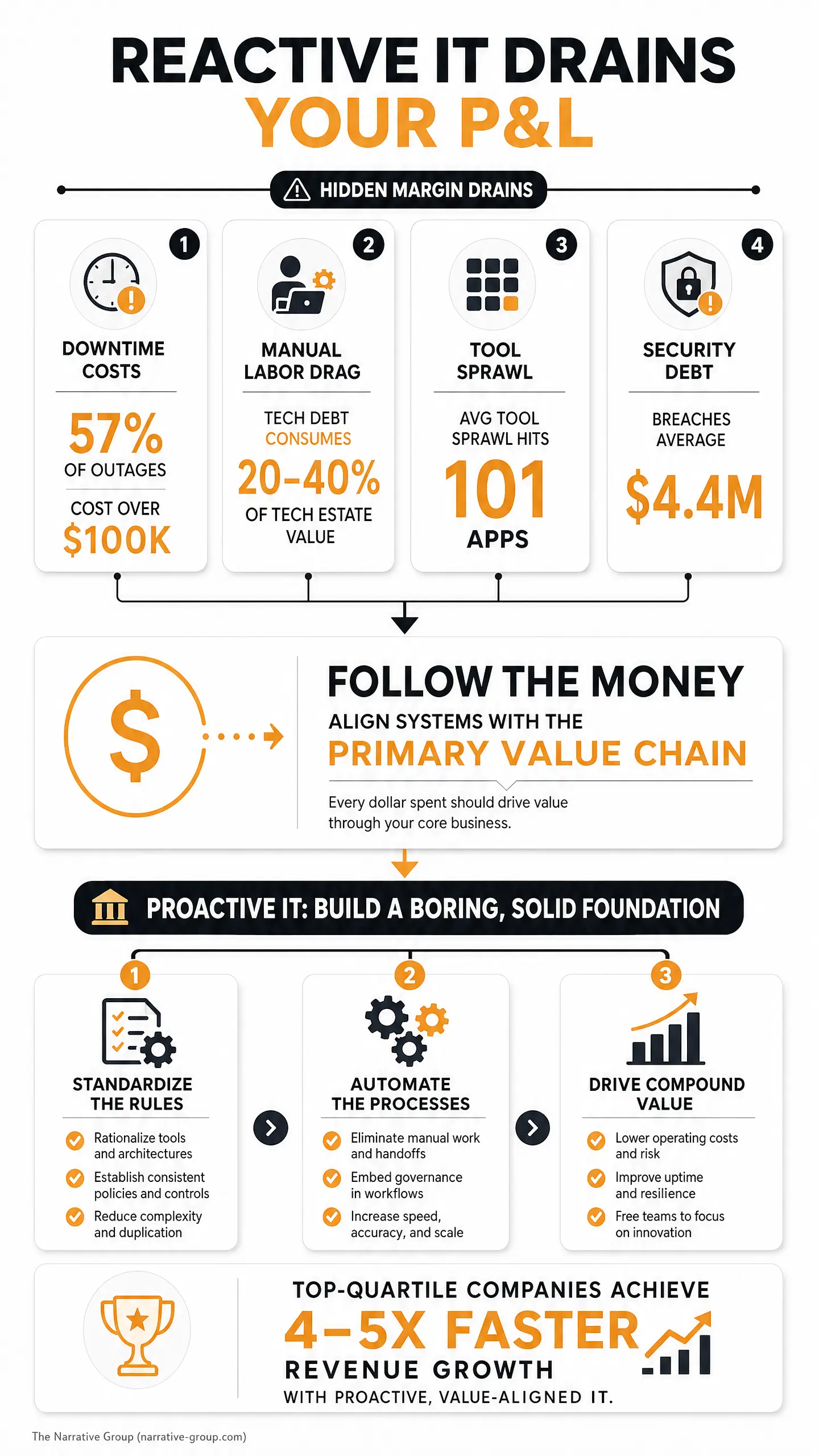
Downtime is where most executive teams first feel the problem. Even then, the math is usually too soft. Uptime Institute found that 57% of major outages cost more than $100,000. It also found that one in five outages cost more than $1 million.
Those numbers still miss the slow bleed. As of late 2025, employer compensation for U.S. private-industry workers averaged $46.15 per hour. If 100 employees lose one hour to a network or application issue, you are already at about $4,615 in direct labor cost before lost revenue, customer frustration, or remediation.
Many leaders only count the dramatic outage. They miss the half-day where a team cannot print. They miss the repeated VPN failures. They miss the conference room that never starts on time. They miss the file sync delays and the app timeouts that force people to key the same work twice. Those irritants chip away at throughput every day.
I had one client with six offices where people could not reliably connect to the network when they moved from one office to another. The meeting rooms barely worked. Every time they asked for help, security was being used as the reason nothing could be improved. That kind of environment teaches employees to see IT as something that gets in the way.
We started with the boring foundational functions. We replaced core switches and network gear. We retired outdated servers. We put devices on a proper lifecycle plan. We fixed the meeting rooms and made sure people knew how to use them.
Over time, the environment settled down. People could work without fighting the basics. Three years later, the managing director told me we had created a problem for him because everybody wanted the rest of the business to look like the new office we had built. Talk is cheap. Operational stability changes expectations because people feel the difference immediately.
That is the financial case for stability. If your IT environment is built solidly from the ground up, there is no firefighting, because things just work. Google’s DORA research shows that elite teams can recover from failed deployments in under one hour. Low performers can take between one week and one month. That gap comes from discipline, testing, and change control.
Manual Work Is Where Bad IT Hides
A lot of companies save money on software and spend it immediately on labor. They just do not call it that. They cut a license or skip an integration, and then people become the workflow engine. They rekey orders. They reconcile spreadsheets. They chase approvals in email. They check data by hand.
When the business is small, people absorb that work. As you grow, the same workaround becomes a tax. It slows product launches. It delays invoicing. It gums up customer service. It trains the culture to accept friction as normal.
Do you really save money when your people become the middleware? I do not think so. You have simply moved cost from software into labor, and labor is usually the most expensive line after the core cost of what you sell.
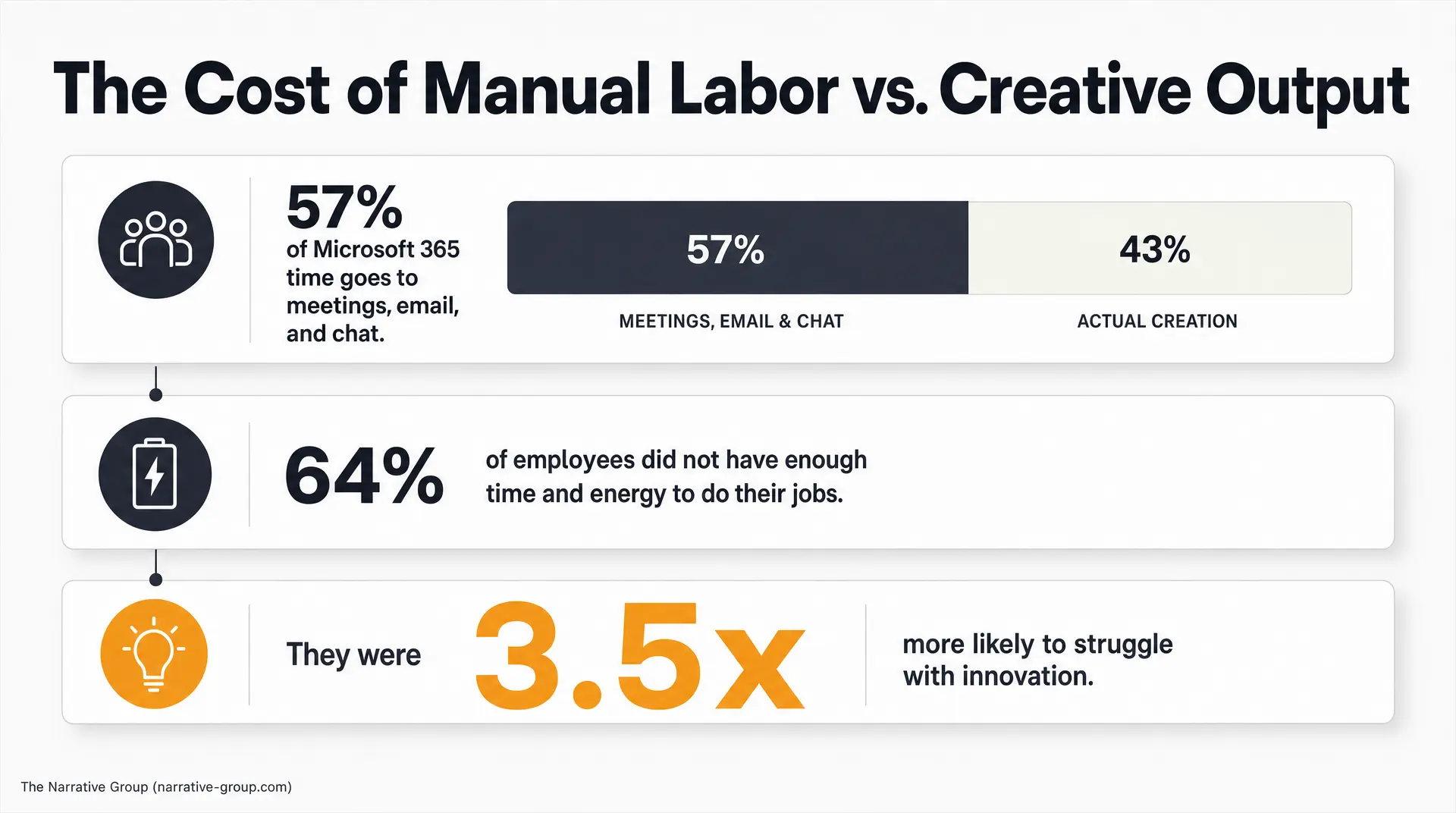
Microsoft found that 57% of Microsoft 365 time goes to meetings, email, and chat. Only 43% goes into actual creation. It also found that 64% of employees did not have enough time and energy to do their jobs. Those employees were 3.5 times more likely to struggle with innovation. If your systems force people into glue work, you are burning your best hours on low-value activity.
The quality risk climbs too. One controlled study found that 35% of spreadsheet models were incorrect. Even experienced users got it wrong far too often. When manual workarounds become part of the operating model, errors become part of the operating model too.
I saw this very clearly in retail with self-checkout. The labor savings only work if the experience is simple and the underlying data is right. If scans fail, prices are wrong, or the flow is clumsy, staff have to keep intervening. You add labor back into the model, and the promised savings disappear.
This is one of the biggest hidden costs of reactive IT. The software line may look leaner. The labor line gets heavier. The culture slows down. People stop improving the business because they are too busy carrying the business.
Cheap Choices Create Expensive Complexity
I hear this one all the time. A business chose the low-cost IT provider, the cheaper app, or the quick custom build because it seemed prudent. In my experience, the hidden cost is almost always scalability. The solution works while volume is low. Then growth arrives, and the shortcut turns into expensive rework.
I have seen businesses avoid Microsoft license costs by keeping older tools alive, including Mail Manager to save emails into SharePoint. That may look clever in one budget cycle. Later, something as basic as a Windows 11 upgrade becomes more complicated than it should be. The original saving gets paid back with interest.
Low-cost custom software creates another trap. If it was built by a temporary contractor or a co-op student, you are also buying hidden dependency risk. The business scales. The original builder is gone. The code stays. That is a ticking time bomb.
Tool sprawl makes this worse. Okta reported that the average company now uses 101 apps. Every app adds identities, vendors, integrations, support tickets, and data movement. McKinsey found that 10% to 20% of budgets meant for new products get diverted to tech-debt issues. It also estimated tech debt at 20% to 40% of the value of the technology estate. That is a very expensive way to stand still.
My advice here is simple. Use vanilla software for common processes. Stay current. Be mainstream, not leading edge, not bleeding edge. Most companies do not create enterprise value through a custom accounts payable workflow, a quirky onboarding path, or a special way of moving master data around.
So be ruthless. Figure out where you are actually different. Classify each process as a competitive advantage, an economic parity, or a commodity. Focus your custom effort where it drives enterprise value. In most organizations, the differentiator sits in the people and the business model. Commodity technology should stay commodity.
Security Debt Is Still Debt
Reactive IT creates security exposure in very predictable ways. Unsupported systems stay in place. Access grows without cleanup. Vendors get added without proper oversight. Production changes happen without governance. Security becomes either an excuse for delay or a problem nobody touches until something breaks.
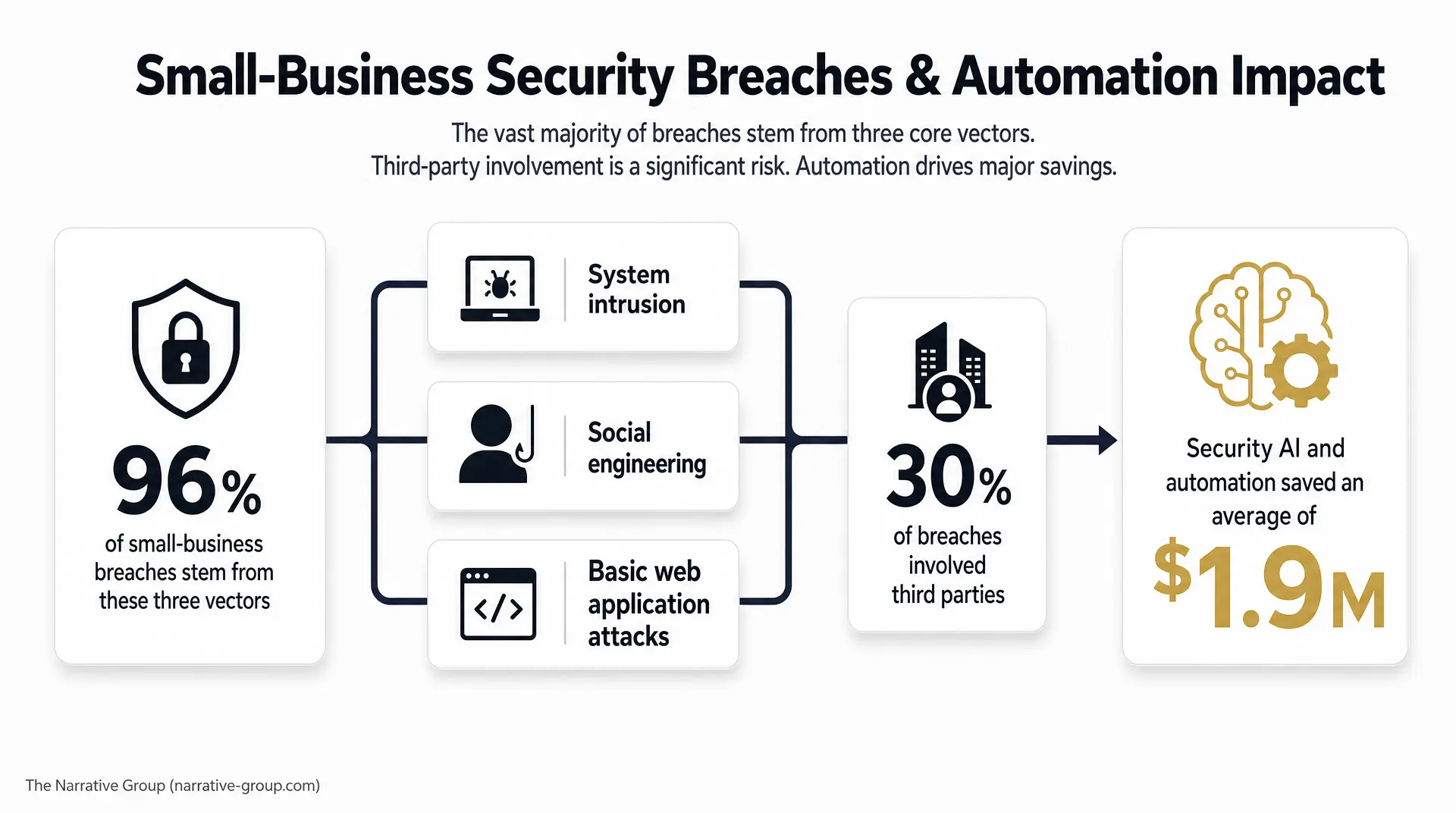
For mid-market companies, the risk is not theoretical. Verizon reported 2,842 confirmed data disclosures among small businesses. It found that system intrusion, social engineering, and basic web application attacks represented 96% of small-business breaches. It also found that third-party involvement reached 30% of breaches. If you are juggling multiple providers without one clear operating model, those numbers should get your attention.
Credential abuse and unpatched vulnerabilities are common problems. They come from weak basics, loose access, and poor discipline around change. IBM put the average cost of a data breach at $4.4 million. It also found that extensive use of security AI and automation saved an average of $1.9 million compared with organizations that did not use those tools. There is real value there, but only with governance.
I am optimistic about AI in long-running workflows, data quality, and decision support. I am cautious about hype. When you are trying to get AI to make up what the business process is, you lose control. IBM found that 63% of organizations lacked AI governance policies. A Harvard and BCG field experiment found users were 19 percentage points less likely to produce correct answers outside AI’s capability frontier. Use it where it helps. Supervise it. Document the process first. You cannot just codify broken business processes.
Leadership Attention Is a Hidden Line Item
One of the biggest costs of reactive IT never appears in the IT budget. It is leadership attention. How many hours did your COO spend last year on escalations that should never have reached that level? How many surprise approvals landed on the CFO’s desk because nobody planned the lifecycle of servers, devices, or software?
CFOs feel this in capital allocation. Instead of funding growth, they fund cleanup. Instead of a planned refresh, they get emergency spend. Instead of a clean story for the board, they get explanations.
I have watched a lot of IT leaders get stuck in firefighting. They act with good intent. They want to help. They want the business to succeed. But hero syndrome keeps the organization dependent on rescue work. The team does not learn. Governance does not mature. The same problems return in a different shape.
There is another cost. Firefighters miss strategy. When an IT leader spends the day dealing with urgent noise, they miss the meeting where business rules get defined, capital gets aligned, and risks get managed properly. Then the company spends more money later fixing decisions that were made without enough information.
What Proactive IT Looks Like
Start with Financials First

When I work with a leadership team, I do not start with a tool list. I start Financials First. What are you trying to transform? How does that connect to value creation? How do you actually make money?
From there, I split the analysis into two parts. First, the primary value chain. Where does productivity break down in the delivery of value to the customer? Second, the supporting functions. Where is labor growing faster than it should because the systems are weak? When you follow the money, the patterns become clear.
Then I map the flows. What systems are talking to what? How often? Where are the handoffs? Where is the rekeying? I also want to see the business in action. Show me the day in the life. Walk me through the office, the warehouse, the store, or the service desk. Visual clutter and physical bottlenecks tell you where undocumented processes are breaking down.
At The Narrative Group, we measure that contribution year over year. We track total IT spend against revenue and expenses. We watch the ratio of IT labor to non-labor. We look at uptime and service quality. When those numbers improve together, leaders can finally see IT as part of value creation instead of a black box. It also gives the board a readable story about contribution, risk, and return.
Build the Boring Foundation

A proactive model starts with the boring foundational functions. Network stability. End-user devices. Identity. Backup. Core cyber controls. Change management. Meeting room technology. Lifecycle planning. This work rarely gets applause. It matters a lot.
I also believe IT is effectively two departments. One side is the core operational function. That work is a commodity, and it should be priced like a commodity. The other side is the business-facing capability that understands the value chain and focuses on competitive differentiation.
Commodity work belongs with partners that can deliver strong service quality at commodity-oriented pricing. Your internal people should be learning the business, shaping workflows, and working on the things that drive intellectual property and competitive differentiation. That is how you turn IT into a growth engine.
Standardize, Then Automate

The first levers I pull are standardization and automation, in that order. Standardize the common work. Clean up the business rules. Then apply automation where it can improve productivity in a measurable way. If a task drops from 20 hours to five, you can see that. If a fixed-price delivery model uses fewer hours, margin improves immediately.
I saw this on an e-commerce engagement where the product setup cycle took five weeks. One person could spend up to three weeks inside that cycle just getting products set up. After we applied workflow automation and AI to a process with clear business rules, that work dropped to four hours. That kind of improvement changes capacity very quickly.
The first P&L benefit often shows up as a slower rate of hiring. A lot of leaders are surprised by that. Revenue grows, but support functions do not need to add people at the same rate. That is one of the cleanest ways technology improves profitability. It also gives a company a real chance to scale hard, even to double its customer base over 24 to 36 months, without breaking operations.
And quality of execution matters. McKinsey found that top-quartile software capability delivered revenue growth four to five times faster than bottom-quartile performers. NBER research found a 14% productivity gain when customer-support agents had access to a generative AI assistant. The opportunity is real. So is the need for discipline.
How to Move Without Breaking the Business

If your company is living in reactive IT today, do not start by buying another tool. Slow down first. Assess the current state. Listen to the people doing the work. Find where role definition is fuzzy or where the technology is not doing what the company is asking it to do. Those frustrations are signals.
Most employees are willing to help. The technology is letting them down, and they know exactly where. When you listen well, people will show you the conflicts in the process. They will show you the waste. They will also tell you where they are worried about change.
This has to start at the top of the house. In the mid-market, owners and senior executives usually have real skin in the game. When they buy into the change, they help set the stage for it. Staff become much more willing to show the problems. They can see the effort is about making work better and building capacity.
Then move in phases. Get the quick wins. Stabilize the foundation. Put proper governance around changes. Pilot where you can, because there is nothing like real-world experience. Do not promise a flawless rollout. Large-scale change always has some pain. What matters is how well you manage the risk, how clearly you communicate, and how quickly you learn and correct.
Once the facts are clear, the roadmap usually falls into three, four, or five themes you can manage as separate programs. That keeps the work organized. It also helps leadership see what gets done now, what gets done next, and how each body of work connects back to value.
Measure what matters. Downtime. Process time. IT spend versus revenue. IT labor versus non-labor. Service quality. What gets measured gets managed. And do the work with the business leaders who own the result. My job is to give executives enough information to make decisions and then help them follow through.
Final Thought
I founded The Narrative Group because I wanted to make enterprise-level thinking accessible to companies that do not have the scale to carry a full executive IT bench. Mid-sized businesses deserve better than reactive support and vague promises.
Reactive IT is an operating model, and it has a cost. You may not see it neatly inside the IT budget, but your P&L absorbs it every day. It shows up in downtime, labor drag, technical debt, security exposure, and leadership distraction.
Innovation is making the operation of a business model elegant. Start there. Ask the oldest question in the room. How do you actually make money? Then build the technology foundation that helps that happen cleanly, consistently, and at scale.
Need Help Aligning IT Spend with Business Performance?
IT budget planning should not be a spreadsheet exercise.
For mid-market companies, the IT budget should show what the business is protecting, what it is improving, and where it is investing for growth.
Narrative’s Financials First assessment helps leadership teams connect technology spend to the value chain, risk profile, productivity opportunities, and growth priorities of the business.
Use the IT Investment Prioritization Scorecard to evaluate your next round of technology investments, or explore Financials First if your leadership team needs a clearer view of what to fund, what to fix, and what to stop.
Technology Investment Strategy (This Series)
- IT Maturity Models Explained for Mid-Market Executives
- Technology Investment Prioritization: A Framework for Mid-Sized Companies
- IT Budget Planning for Mid-Sized Companies
- How to Build a Technology Business Case Your CFO Will Actually Approve
- CapEx vs OpEx in IT Strategy
- When to Replace vs Optimize Your Business Systems
- The Hidden Cost of Reactive IT in Mid-Sized Companies
Frequently Asked Questions
How much of our IT budget is likely bleeding into technical debt?
Reactive IT transforms capital into cleanup. According to McKinsey analysis, 10% to 20% of budgets meant for new products are routinely diverted to tech-debt issues. This hidden debt often equals 20% to 40% of your technology estate’s value. You are not saving cash. You are funding friction.
Are mid-market companies genuinely at risk for enterprise-scale data breaches?
Yes. Size does not grant immunity. Verizon’s 2025 DBIR reported 2,842 confirmed data disclosures among businesses with fewer than 1,000 employees. System intrusions and basic web attacks drove 96% of these breaches. Reactive IT leaves patching unmanaged, making mid-market companies highly predictable targets for costly exploits.
How does an unstable IT foundation impact our speed to market?
Speed requires stability. If your foundation is reactive, every deployment becomes a crisis. Google’s 2024 DORA report reveals elite teams deploy on-demand with a 5% failure rate. Low performers suffer one-to-six-month lead times and a massive 40% failure rate. Predictable IT is a prerequisite for rapid, profitable growth.
Does allowing departments to purchase their own software lower our IT burden?
No, it creates expensive tool sprawl. Decentralized buying feels agile but fractures architecture. The Okta 2025 report notes the average company now juggles 101 applications. Each app adds unmanaged identities, messy integrations, and security gaps. You simply shift costs from software budgets into highly inefficient administrative labor.
Can we use generative AI to bypass our legacy IT bottlenecks and lower costs?
AI cannot fix broken business rules. Applying AI over chaotic systems only amplifies errors. A Harvard/BCG study showed users were 19 percentage points less likely to produce correct solutions outside AI’s capabilities. You must standardize your manual workflows before automating them, or you will lose operational control.