

Cost behaves like energy. Cut it in one place, and it reappears in another, fatter and harder to see.
Cancel a software license to save a few dollars, and the work it performed lands on a person, the most expensive line you run, at $46.60 an hour. You swapped a fixed fee for a slower, more error-prone operation that costs more than the license ever did.
This is how a dashboard glows green for a year while EBITDA sits dead still. The savings were real. They relocated to a column no one thought to measure. And most companies never look: Deloitte found that the majority of organizations running intelligent automation never calculated the cost reduction they expected, and 70% never calculated the expected revenue gains. They are spending money to save money they never measured. Measuring it properly is the foundation of any intelligent automation strategy for mid-sized companies, and it’s what this guide is about.
Key Takeaways
- Retail stores processing 55 to 60% of transactions through fixed self-checkout experience a 31% increase in baseline grocery shrink due to unmeasured customer error rates.
- Implementing workflow automation and artificial intelligence reduced one e-commerce client’s product setup cycle from three weeks of manual preparation down to just four hours.
- A study of 5,000 support agents found generative AI lifted productivity 14%, while consultants using AI outside its core strengths were 19% more likely to produce wrong answers.
- Enterprise intelligent automation programs typically require 60 to 90 days to prove operational metrics before scaling to achieve an average 22-month financial payback period and 32% cost reduction.
- Early 2026 Bureau of Labor Statistics data shows U.S. business output rising 3.2% while hours worked increased just 0.4%, demonstrating how automation scales throughput without proportional hiring.
- Most organizations never calculate the cost reduction or revenue gain they expect from automation before spending, which is why savings so often relocate instead of landing.
Why Do Executive Dashboards Fail to Show True Automation ROI?

I look at every business from two heights, and you have to look at both.
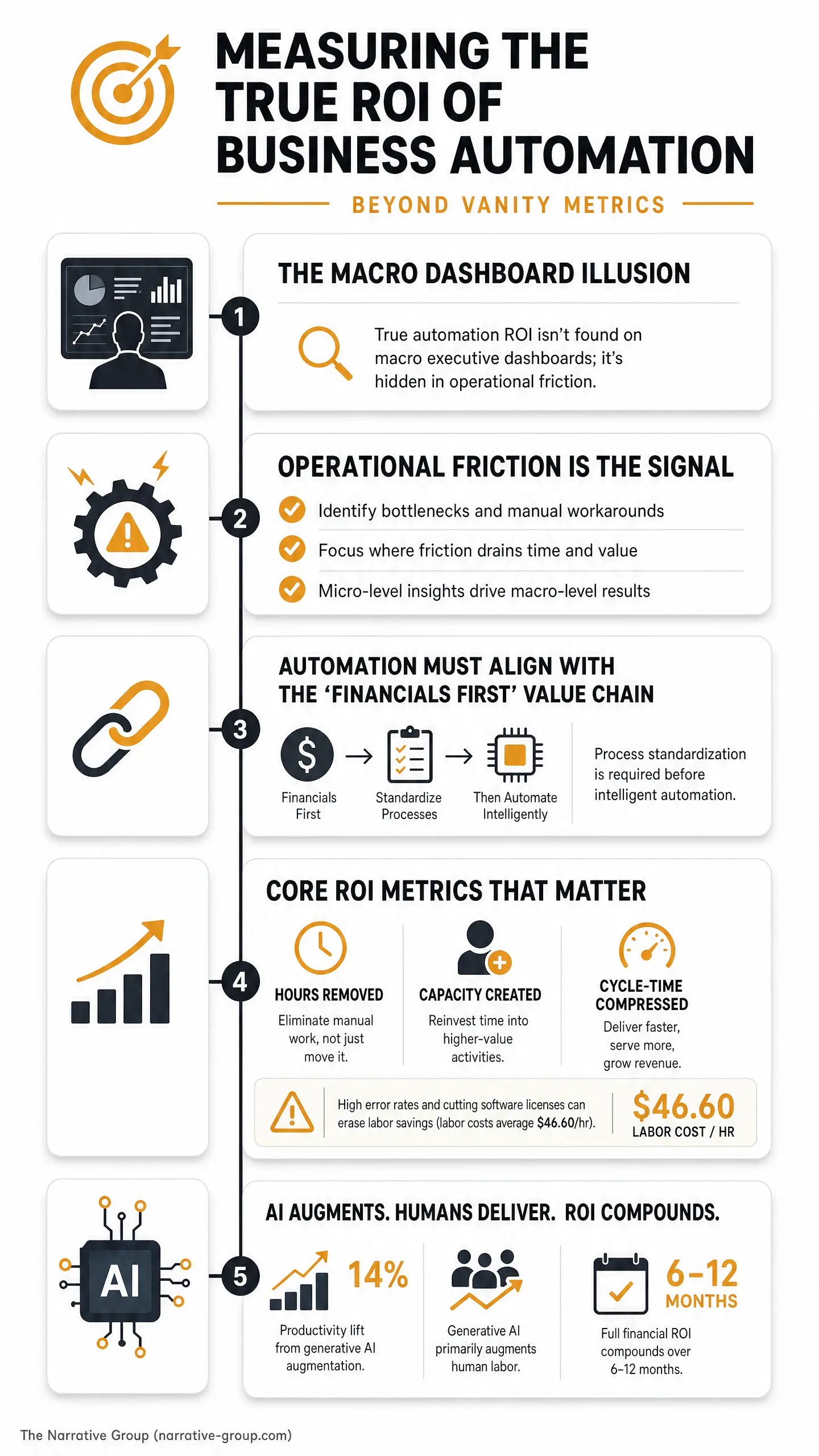
At the macro level you’ve got the numbers you live by. Sales, operating expense, gross margin. Those are real. But they’re top-down, and they only tell you what is being achieved. They don’t tell you what could be achieved. A page full of green is just a tidy picture of the ceiling you already settled for.
The truth lives one level down. And you will not find it in a report. You find it by talking to the people who do the work and watching how they actually execute their day, hour by hour. We’ve written a full field guide to running that discovery and picking the right targets.
Do that, and you see what no dashboard will ever show you. Friction. Frustration. Smart people buried in repetitive, low-value work that quietly kills their engagement. You’ll hear about the power imbalances inside a long-running process, where one step holds up everything stacked behind it. That’s where your automation ROI is hiding.
This is not a soft problem. Asana’s research across more than 9,000 knowledge workers found that “work about work,” the chasing, the status updates, the duplicate entry, still eats 58% of the average workday. That drag is real, it’s expensive, and it sits below the line your dashboard reports. If you want to create real leverage, you have to dig into the micro to move the macro. There’s no shortcut around it.
How Should Executives Align Business Automation With The Financial Value Chain?
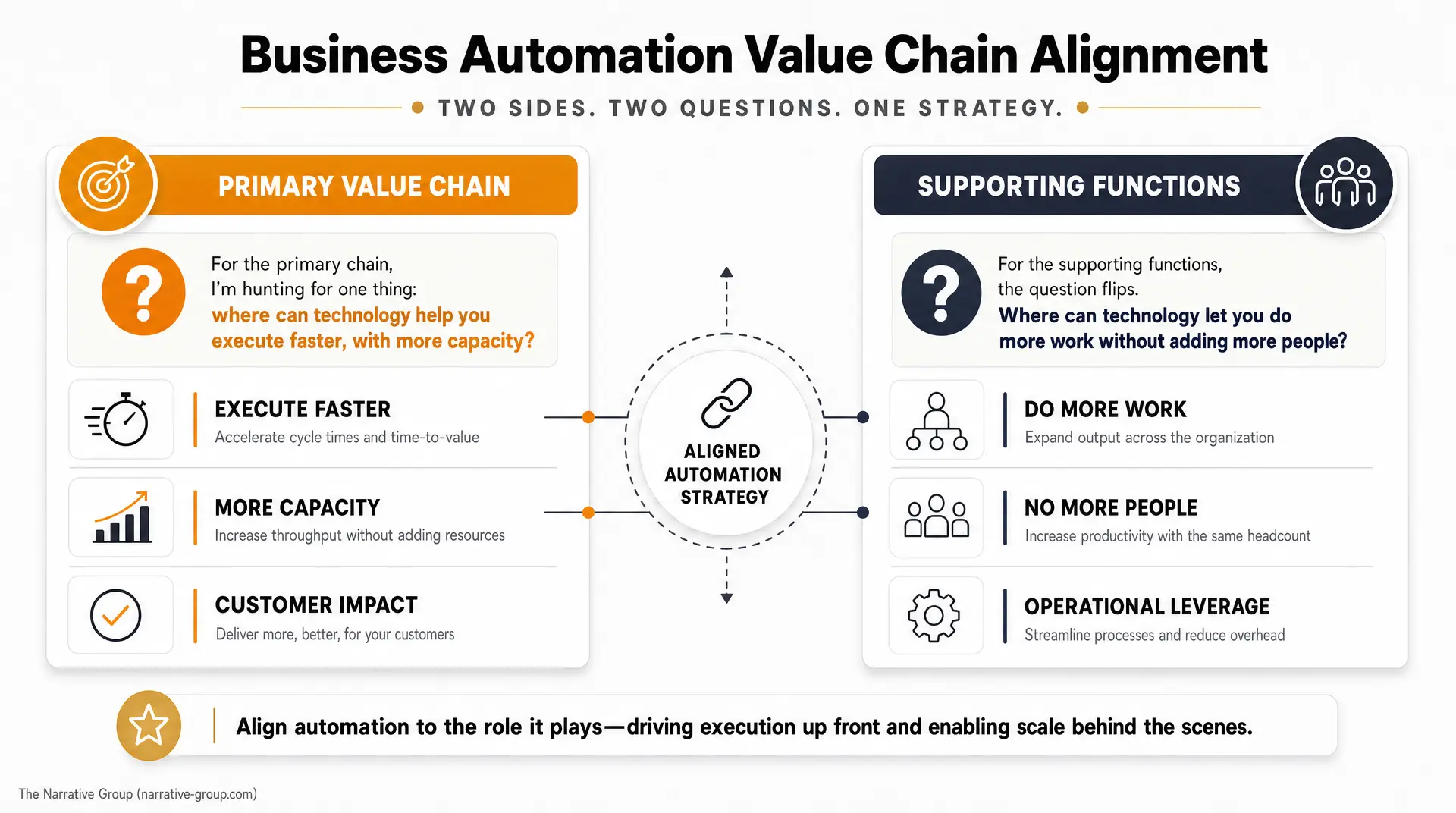
I run every engagement on one principle. I call it Financials First. Before I recommend a single tool or touch a single process, I ask the question that should drive every automation decision: how do you actually make money?
It sounds almost too basic to say out loud. But I watch automation projects launch all the time with no line drawn between the project and the value chain. Then everyone’s surprised when the savings don’t land.
So I split the business in two. There’s the primary value chain, the work that delivers your product or service and brings in revenue. And there are the supporting functions, the cost centers that keep the place running. For the primary chain, I’m hunting for one thing: where can technology help you execute faster, with more capacity? For the supporting functions, the question flips. Where can technology let you do more work without adding more people?
Once you know where the money comes from, the bottlenecks light up on their own. And now you can tell the difference between automation that protects margin and automation that’s just busy.
Why Is Business Process Standardization Required Before Implementing Intelligent Automation?
Here’s the fastest way I know to generate negative ROI. Automate a process nobody actually understands.
You can’t codify broken business processes. And when you try to get AI to make up what the process is supposed to be, you lose control of it. You don’t get efficiency. You get a bad process running faster, costing more, with fewer people watching it.
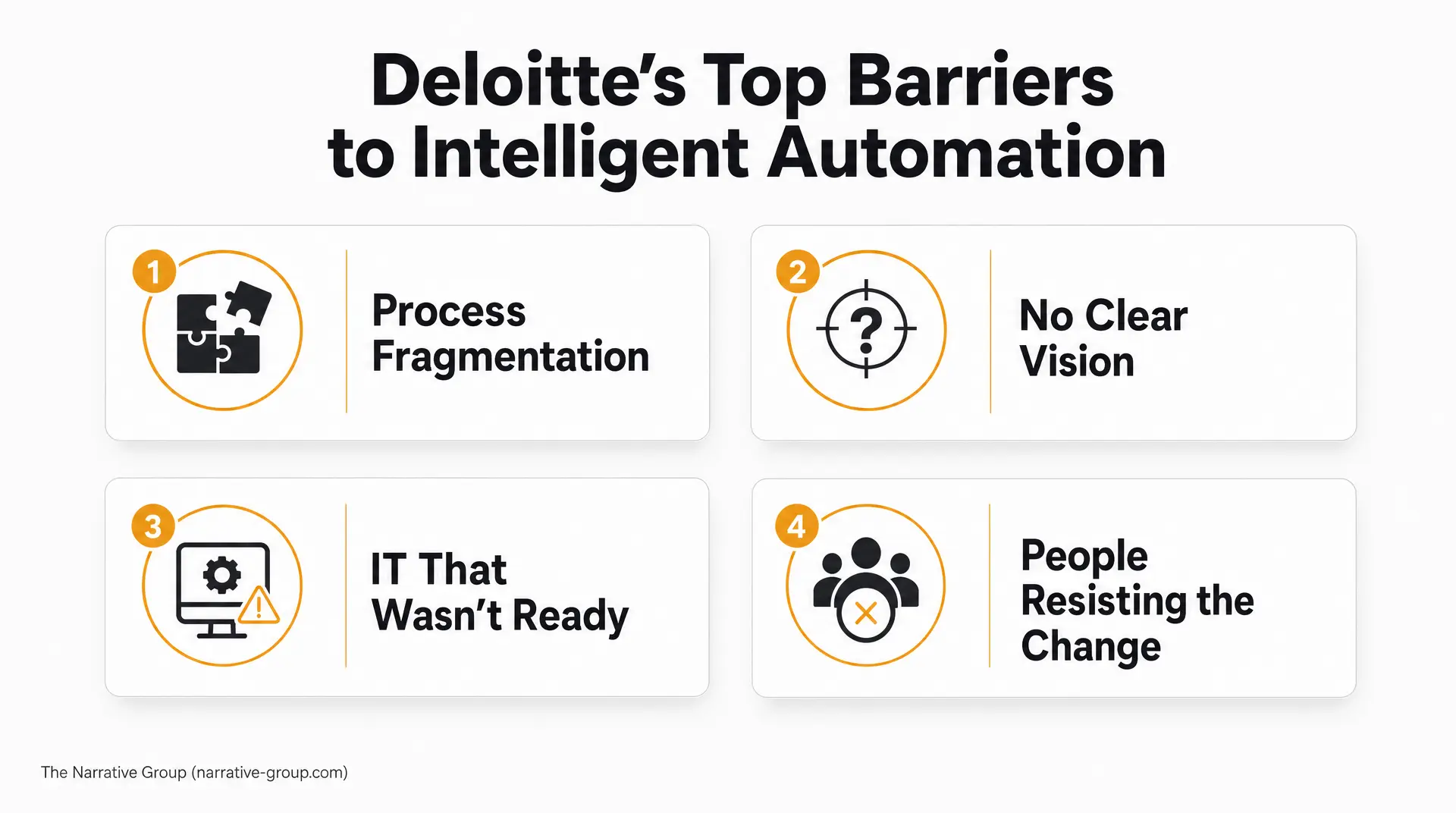
This isn’t just my opinion. The top barriers to automation aren’t technological; they’re the mess underneath the technology, and we’ve broken down the full list in why automation initiatives stall in mid-sized companies.
So standardization comes first. Document the standard operating procedure. Get the governance in place. Then automate. Standardization drives out cost, it drives up productivity, and it drives out friction. Skip that step and you’ve just poured concrete around your worst habits.
How Do High Error Rates Erase Labor Cost Savings in Business Automation?

Now, error reduction. This one gets ignored, and ignoring it is how automation savings quietly evaporate.
I learned this in retail, building self-checkout. The whole point of self-checkout is labor. It’s your biggest expense after goods for resale, and self-checkout shifts that work to the customer while packing more lanes into less floor space. Elegant on paper. But every time a scan throws the wrong price or the wrong item, you get what the industry calls an intervention. And every intervention drags a staff member over to fix it.
That’s the trap. At Loblaw, the first rollout had error rates so high and adoption so low that we had to rewrite the entire front-end interface from scratch. At Shoppers Drug Mart, we got the experience simple enough that customers could use it with no training, and it scaled past 400 stores. Same parent company, two completely different outcomes, and the variable that mattered most was error rate.
The numbers back this up hard. ECR Retail Loss found that stores running 55 to 60% of transactions through fixed self-checkout saw losses 13 to 21 basis points higher. On a typical grocery shrink baseline, that 21-point jump works out to a 31% rise in losses. You think you removed a cashier. What you actually did was swap a known labor cost for an unknown loss-and-intervention cost. Measure your error rate before you celebrate, or the savings leak right back out.
Why Does Cutting Software License Costs Often Increase Overall Manual Labor Expenses?
I have to be blunt here, because this is where I watch good executives torch real value chasing a saving.
You can’t cut cost to create greater friction. When you kill a software license to save a few dollars, that cost rarely disappears. It moves. It moves into manual labor. And labor is the most expensive line on your P&L, at that same $46.60 an hour, with benefits alone eating up 30% of it. So you “saved” a license fee and quietly built yourself a slower, more manual, more error-prone operation that costs more to run.
I’ll give you a real one. A SaaS company I worked with chose a data platform called Cassandra. Cassandra is excellent inside its limits. DataStax guidance tops out around a couple hundred actively used tables, and 500 is widely treated as a failure point even when the thing technically still runs. This company wanted multi-tenancy for its clients. The clean way to do that costs money, so instead they duplicated production tables into one instance, a full set per client. They blew straight past that failure line.
Did it save money up front? Yes. Did it wreck their data quality and kill their ability to scale? Completely. They made an architecture decision based on cutting cost instead of on their value proposition, and they entrenched friction while losing control of their cost structure. That’s the ticking time bomb. It doesn’t go off on day one. It goes off the day you try to grow.
How Does Generative AI Automation Augment Human Labor Rather Than Reduce Headcount?
This is where executives lean in, because they hear “automation” and immediately think “headcount.” Slow down.
The mundane work in your business can’t stop. The invoices still go out, the data still gets entered. That part isn’t a choice. But whether your best people spend their day on it, that absolutely is. So when you automate the mundane, you’re usually not cutting jobs. You’re relieving the resource strain that’s been choking your team, and redirecting that capacity into work that actually grows the business.
At Loblaw, the automation program our team built, run by Joe, who now leads our automation practice, shipped more than 200 automations and freed up over $20 million in capacity. Not one person lost their job because of it.
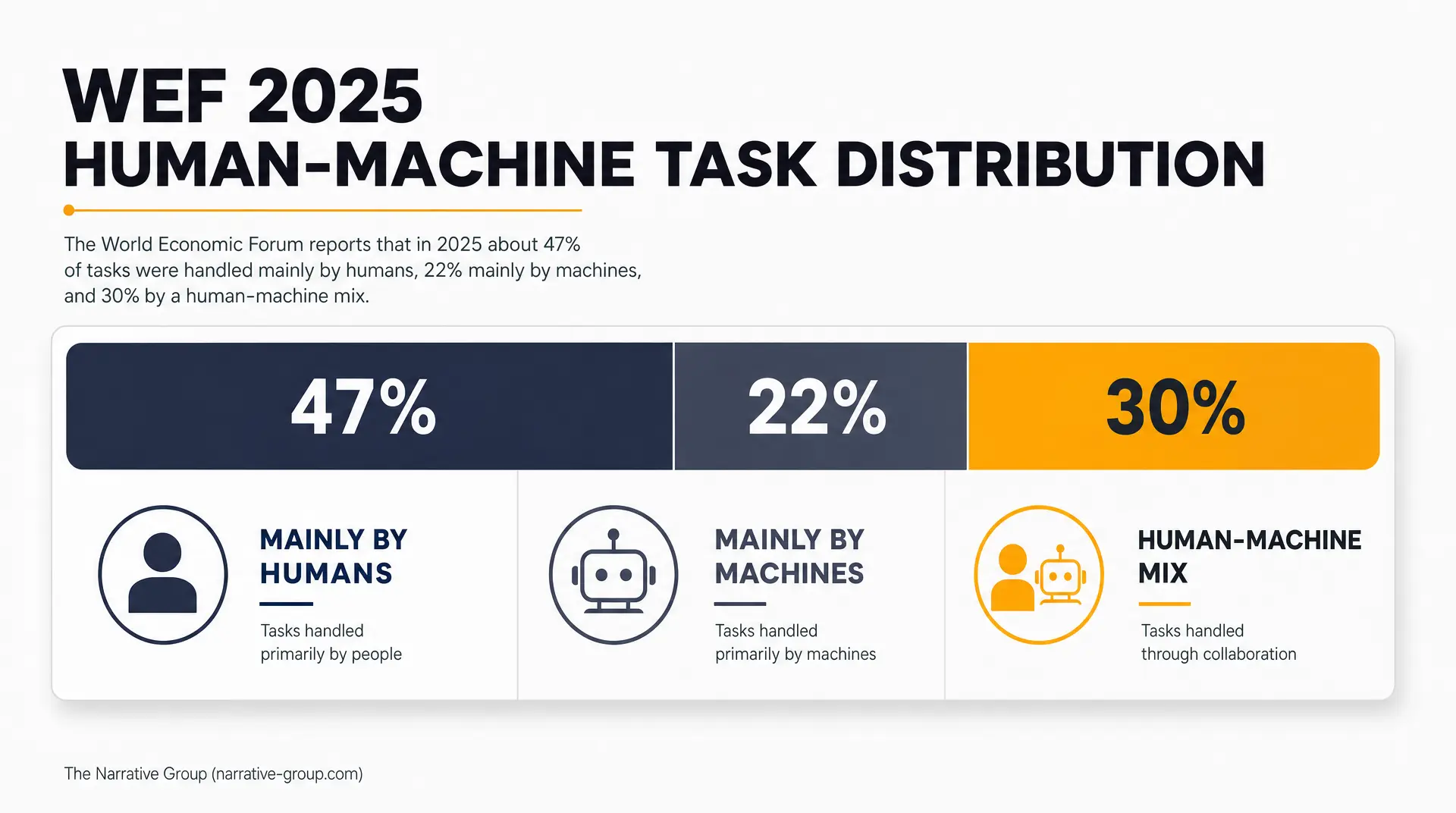
The data is moving exactly this way. The World Economic Forum reports that in 2025 about 47% of tasks were handled mainly by humans, 22% mainly by machines, and 30% by a human-machine mix, and employers expect that split to be nearly even by 2030. This is augmentation, not a clean swap.
That’s why I don’t buy AI as a headcount-cutting tool. The combination of people plus AI is what creates the value. A study of more than 5,000 support agents found a generative-AI assistant lifted productivity 14%, with the biggest gains going to the newest, lowest-skilled workers. It raised the floor. But the same technology has a hard edge. In a controlled experiment, consultants leaning on AI for a task outside its strengths were 19% more likely to land on a wrong answer. AI still needs a set of eyes to make sure its output is consumable. People plus AI is what makes it special.
What Is the Typical ROI Timeline for Enterprise Intelligent Automation Pilots?

Last thing. Expectations. Two clocks are running, and you need to watch both.
The first clock is fast. You can prove an operational metric inside a 60-to-90-day pilot. Take one process, baseline how long it takes today, automate it, measure the new cycle-time.
Before you baseline anything, decide what you’re building on, because the choice between enterprise RPA and a low-code platform sets your cost floor for the entire program.
That’s your proof, and you never skip it. A lab tells you what should happen. A pilot tells you what does. There’s nothing like real-world experience.
The second clock is slower. The financial leverage, revenue climbing, expenses lagging behind it, trends in over six to twelve months, not overnight. Deloitte found the average payback period on intelligent automation had stretched to 22 months. But it also found that the organizations that pushed past the pilot stage and scaled properly hit an average 32% cost reduction. Prove it fast with a tight pilot, then have the patience to let the financial leverage compound.
A pilot that works on day one can still lose money by month six, because bots break when the systems underneath them change, and that maintenance cost lands squarely inside your payback window.
That’s how you take ROI to a CFO. You trend the numbers over that window and show the lines pulling apart, revenue rising faster than operating expense. That widening gap is leverage, and leverage is what builds enterprise value.
How Can Executives Identify Hidden Operational Friction to Measure True Automation ROI?

If you take one thing from all this, take this. What gets measured gets managed. So stop measuring automation by what the dashboard says, and start measuring what the operation actually does.
There’s nothing like a flashlight on an issue to show an executive that their current approach can’t get them where they want to go. So go shine it. Walk the floor. Talk to the people doing the work. Watch the friction with your own eyes. Then put hard numbers on it: hours removed, errors cut, cycle-time compressed, capacity created, margin protected.
The more friction you pull out, the more everybody wins. Your people get less mind-numbing work, your customers get a smoother experience, and you get a P&L that finally reflects what you spent. That’s the real ROI of automation. It was never on the dashboard. It was always in the operation.
Start with the measurement you can do in the next three minutes: the Automation Readiness Scorecard scores your business across the five dimensions that decide automation ROI, including how well your decisions connect to your P&L. Or if you’d rather talk it through, book a 15-minute alignment call and we’ll shine the flashlight together.
Frequently Asked Questions
Why do most AI investments fail to improve bottom-line profitability?
Because savings relocate to columns you aren’t measuring. Despite the hype, only 12% of CEOs report AI actually decreased costs and increased revenue. Leaders automate broken processes without standardizing them first, creating a faster mess rather than true operational leverage.
Why do intelligent automation pilots so frequently stall before scaling?
Pilots die when they hit bad governance. According to Deloitte’s research, the top barriers to scaling aren’t technological. They are process fragmentation, poor IT readiness, and resistance to change. If you skip standardizing the underlying business process, your pilot hits a wall.
How does poor employee engagement financially impact manual operations?
Friction doesn’t just kill morale. It bleeds your P&L. Forcing smart people into repetitive, low-value work destroys output. Gallup estimates low engagement costs the global economy $10 trillion in lost productivity. Automating the mundane re-engages your workforce and reclaims that lost margin.
Can executives expect immediate cost reductions from intelligent automation?
No. Financial leverage trends in over time. The average payback period for intelligent automation has stretched to 22 months. You can prove operational metrics like cycle-time compression in a 90-day pilot, but you must have patience to let the financial leverage compound on your P&L.
How do executives effectively measure generative AI’s impact on knowledge workers?
Measure capacity created, not headcount reduced. An NBER study of over 5,000 agents showed generative AI lifted productivity by 14%, raising the floor for novice workers. True ROI is measuring your ability to absorb more growth without bolting on expensive fixed labor costs.