
Most mid-market companies wait too long to deal with technology before a sale.
Finance gets organized. Legal gets organized. The data room starts filling up. Then somebody asks for the application inventory, the system owners, the recovery plan, the change logs, the cyber controls, the data-flow map, and the roadmap for integration. That is when the room gets quiet.
I see this all the time. Leaders still treat technology as background infrastructure. Buyers do not. They read it as a signal. Can this business scale? Are the margins durable? Is management in control? Will integration be smooth, or will it become a long, expensive distraction?
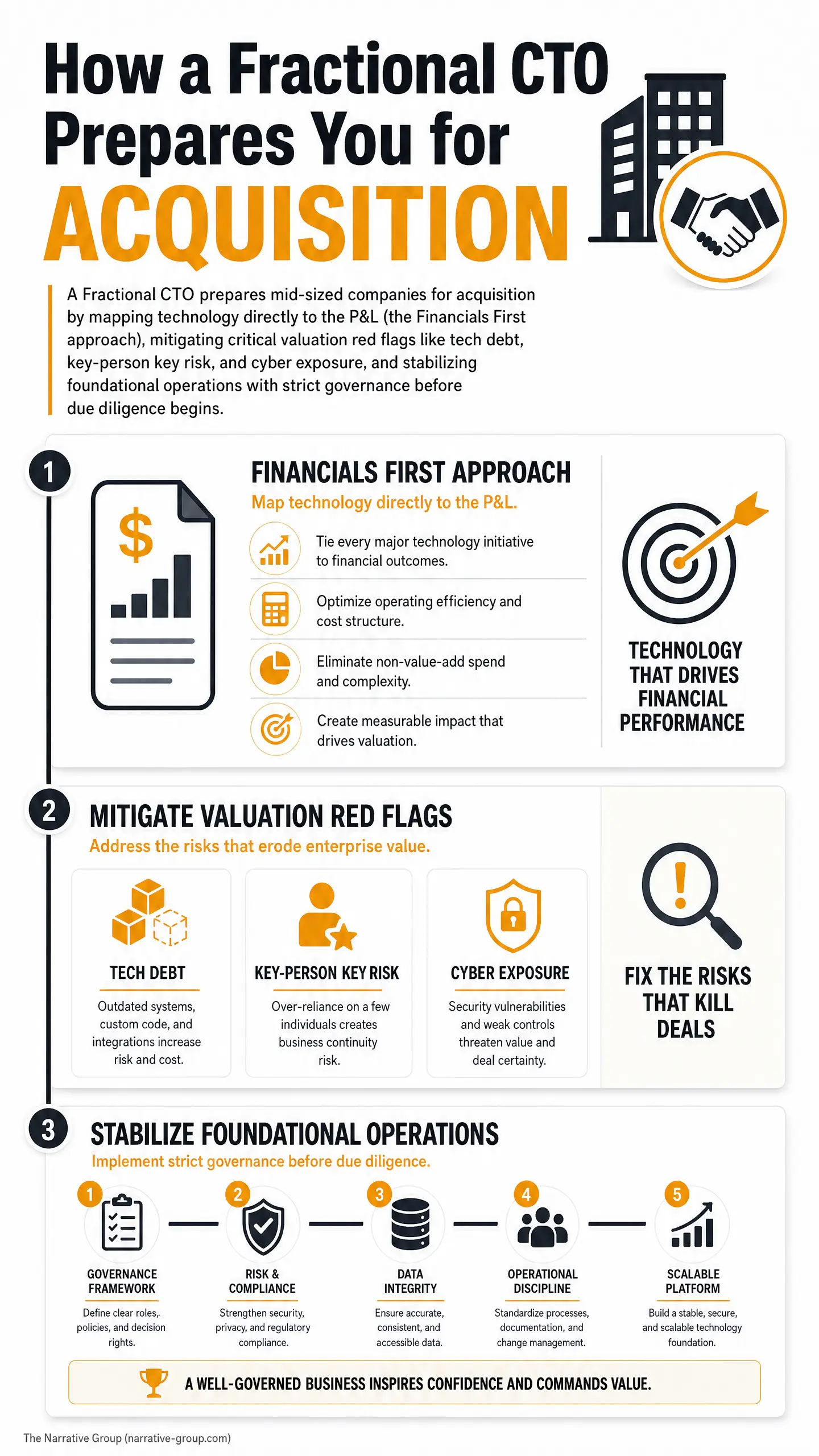
A fractional CTO prepares a mid-market company for acquisition by identifying technology risks before diligence, mapping systems and data flows, improving governance, reducing cyber exposure, and turning technology into a clearer part of the value story.
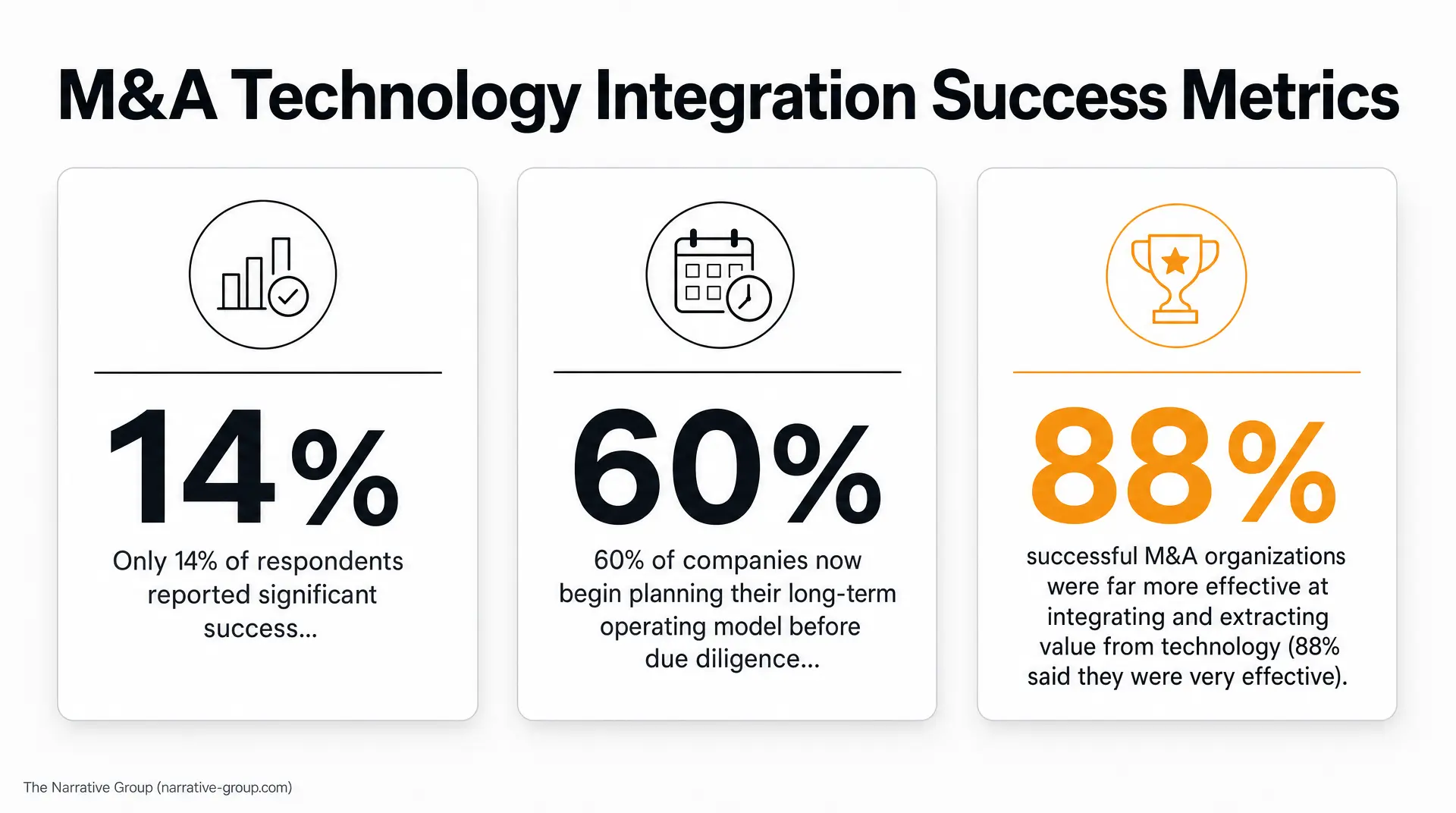
A good fractional CTO helps answer those questions before the buyer asks them. That matters, because only 14% of respondents reported significant success across strategic, operational, and financial integration measures in PwC’s 2023 M&A Integration Survey. Deal success at that level is rare. It takes discipline.
The same survey shows the market has learned that lesson. PwC’s 2023 M&A Integration Survey found that 60% of companies now begin planning their long-term operating model before due diligence. In 2019, that number was 25%. Among successful acquirers, 41% start during deal screening. I agree with that completely. If you wait for diligence, you are already behind.
Start with the Business, Not the Tools

When I walk into an acquisition-track company, I start with one question.
How do you actually make money?
That question sounds simple. It is the right place to begin. If I do not understand how the business creates value, I cannot tell you which systems matter, which controls matter, or where technology is helping versus getting in the way.
This is where my Financials First approach comes from. Follow the money. Follow it through the primary value chain. Then follow it through the supporting functions around it. Where is the business productive? Where is labor piling up? Where is data being rekeyed? Where are people compensating for weak systems with spreadsheets, emails, and manual checks?
Every business runs on long-running processes. Orders move. Claims move. Products get set up. Payments get reconciled. Inventory gets updated. Data moves between people, systems, and decisions. An acquirer wants to know whether those flows can handle more volume. They also want to know whether growth will force the company to hire at the same pace as revenue.
That point gets missed a lot. Good technology investment often shows up as a slower rate of hiring because employee productivity improves. That is a very positive shift in the P&L. Buyers care about that. PE firms care about that. CFOs should care about that.
Why Technology Changes Valuation
Technology due diligence is really a test of confidence.
A buyer wants confidence that the numbers are real. They want confidence that the operation can scale. They want confidence that they are not inheriting a pile of rework, hidden cost, or unmanaged risk. In KPMG’s 2024 Technology Sector M&A Survey, accuracy and completeness of financial and operational data ranked as a top-two due diligence challenge for both corporate acquirers and private equity investors. That should tell you something.
The same survey found platform scalability was the top PE diligence challenge. For corporate buyers, data privacy and cybersecurity compliance came out on top. Again, none of this is surprising. Buyers are trying to understand whether the business can keep growing without a rebuild and whether the risk profile is under control.
Technology also shapes integration outcomes. PwC found that successful M&A organizations were far more effective at integrating and extracting value from technology. 88% said they were very effective. Among the rest, only 42% said the same. That gap is huge.
So when people say technology is an operational issue, I push back. It affects margin. It affects execution. It affects speed. It affects enterprise value.
What Buyers Want to See
A buyer wants to see a company that understands its own environment.
They want clear ownership. They want to know which systems are critical, who supports them, what data moves through them, and how changes are controlled. They want to know whether the company has a rational technology footprint or whether it has grown through years of one-off decisions, cheap fixes, and vendor sprawl.
That sprawl is real. Okta reported that the average customer now runs 101 apps. Mid-sized companies can get there faster than they think. A few acquisitions, a few business-unit decisions, a few “quick” SaaS subscriptions, and suddenly nobody can draw how information actually flows. When that happens, diligence gets messy very quickly.
Buyers also want to see measured performance. What gets measured gets managed. I want leadership teams to be able to show total IT spend against revenue and expense, the ratio of IT labor to non-labor spend, service uptime, recovery performance, and the productivity gains from major initiatives. I also want those gains described in business language. Time saved. Errors reduced. Throughput improved. Hiring slowed. Margin improved.
And I want management to explain all of that without talking in ambiguity. When the rubber hits the road, a buyer needs plain English.
The Red Flags That Cut Value
Cheap Technology That Creates Expensive Labor
One of the biggest mistakes I see is treating IT purely as a cost center.
Leaders cut licenses. They defer upgrades. They choose the low-cost provider. They postpone infrastructure work because the environment seems to be “working.” The cost does not disappear. It moves. It moves into manual effort, slower execution, frustrated staff, upgrade pain, and missed opportunities.
I have seen this directly. Cutting software costs often shifts the expense into human labor. More people touch the process. More workarounds appear. More tribal knowledge gets embedded in the operation. Innovation slows down because the business gets stuck in old patterns of behavior.
The same thing happens in cloud spend. Flexera found that 27% of cloud spend continues to be wasted. Margin leakage hides in environments that nobody is governing properly.
Custom Software Around Commodity Processes
Another red flag is custom development around work that is fundamentally common.
I say this all the time. Specifically and ruthlessly figure out where exactly are you different. If a process is a true competitive advantage, protect it. If it is economic parity, be smart about it. If it is a commodity, treat it as a commodity.
Unless your value proposition is technology itself, what makes the business unique is the people, not the technology. That is why I push hard toward vanilla software for common processes. Standard platforms come with security, scale, robustness, and performance already built in. They are easier to support. They are easier to explain in diligence. They are easier to integrate after a transaction.
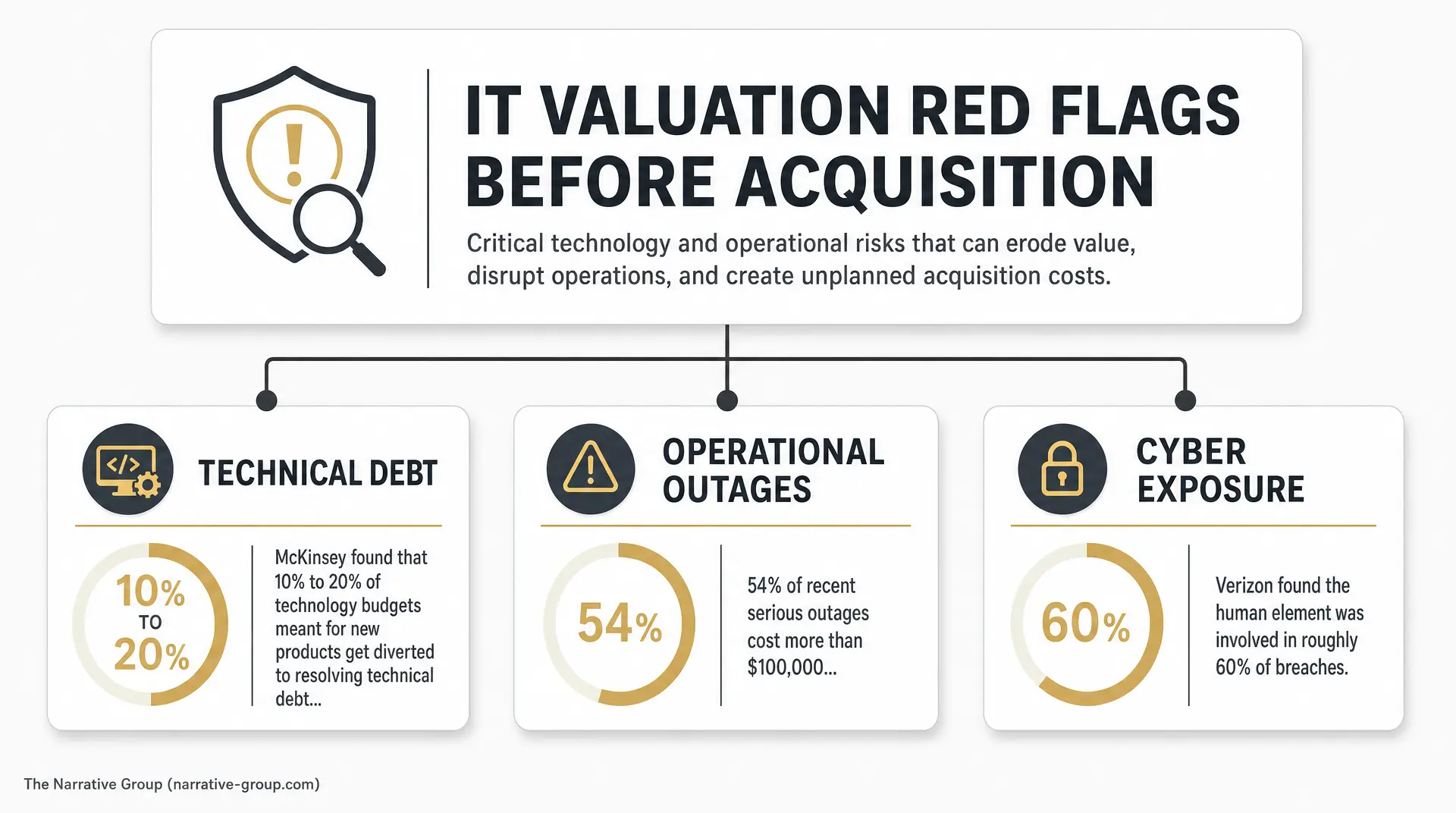
Technical debt is where this gets expensive. McKinsey found that 10% to 20% of technology budgets meant for new products get diverted to resolving technical debt issues. It also found tech debt can equal 20% to 40% of the value of the entire technology estate before depreciation. Buyers know what that means. Future capital gets consumed by cleanup before it produces growth.
Hero Culture and Weak Governance
A company full of IT heroes can look busy. It can even look admirable. Buyers read it as fragility.
If one or two people know how to keep the place running, you have key-person risk. If production changes happen informally, you have governance risk. If outages are handled by whoever happens to be awake and available, you have operational risk.
Outages are not cheap. Uptime Institute found that 54% of recent serious outages cost more than $100,000, and one in five cost more than $1 million. Even more important, four in five serious outages were preventable with better management, processes, or configuration. That is a governance story. It is also a valuation story.
Cyber and Compliance Exposure

Mid-sized companies sometimes assume they are too small to be a material target. That is a dangerous assumption.
IBM put the global average cost of a data breach at $4.44 million. In the United States, the average hit $10.22 million. Verizon found that ransomware-related breaches reached 88% among SMBs. Buyers are paying attention to that. They will ask about identity controls, patching, vendor access, recovery, logging, privacy obligations, and ownership.
They should. Verizon also found the human element was involved in roughly 60% of breaches, and third-party involvement doubled to 30%. That means process, training, and vendor discipline matter just as much as tools.
AI Hype Without Process Discipline
Right now, AI can become the next big distraction in a deal process.
I am optimistic about AI where it improves workflow engines, helps standardize data, and supports better decisions. I am very cautious when leaders want it to paper over weak business process understanding. You can’t just codify broken business processes. And when you are trying to get AI to make up what the business process is, you lose control.
IBM found that 63% of breached organizations lacked an AI governance policy or were still developing one. Among organizations that reported breaches involving AI models or applications, 97% lacked proper AI access controls. That is not ready for prime time.
What a Fractional CTO Does Before the Transaction
I Build the Story from the P&L Up
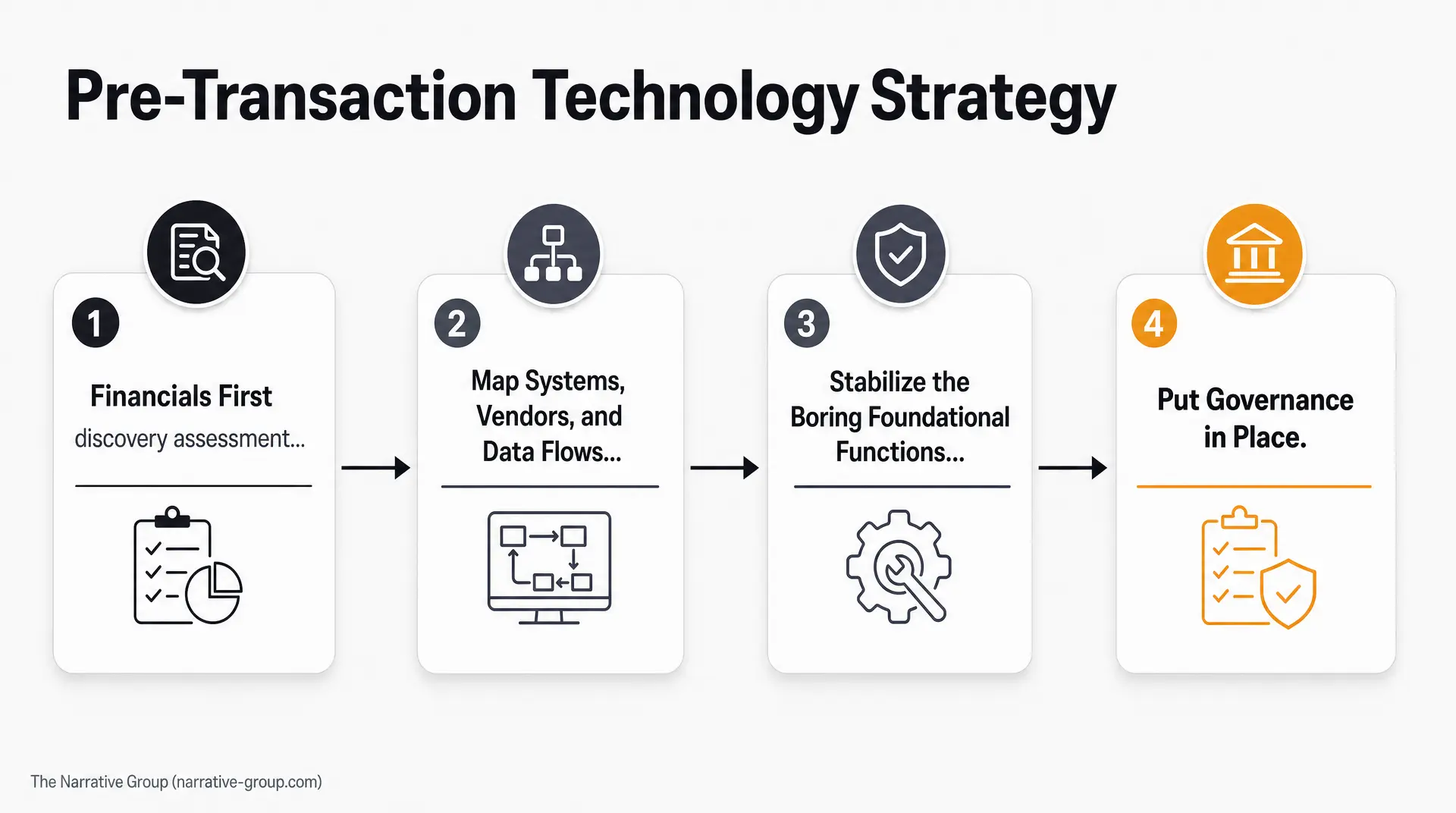
At The Narrative Group, we start with a Financials First discovery assessment.
I want to understand how the company spends money on IT, how it deploys capital, what service levels look like, and how all of that connects to the business model. I divide the analysis into two parts. First, the primary value chain. Second, the supporting functions that affect the overall cost structure. That gives me a clean view of where technology is improving execution and where it is simply adding cost.
Then I go into the operation itself. Show me the day in the life. Show me where the friction is. Show me where people are waiting, rekeying, reconciling, chasing approvals, or calling IT because the technology is letting them down. Most of the time, the problems sit in one of two places. Role definition is unclear, or the technology is not doing what the company is asking it to do.
I Map Systems, Vendors, and Data Flows

After that, I draw it out.
What systems are in play? Who is talking to who? How often do they interact? Where are the handoffs? Where are the business rules? Where is the technical architecture in conflict with the value chain? The picture tells a thousand words.
This part matters a lot in acquisition prep because fragmented systems and fragmented vendors create hidden dependencies. Once those are visible, I can organize the work into three, four, maybe five strategic themes. That becomes a practical roadmap. It also gives executives a way to speak about the environment with clarity.
I Stabilize the Boring Foundational Functions
Find the boring foundational functions first.
Identity. Devices. Patch discipline. Backup. Recovery. Core infrastructure. Security. End-user experience. Meeting-room reliability. Vendor accountability. None of that is glamorous. All of it matters. A weak foundation contaminates every strategic initiative above it.
I also believe the core operational IT function is a commodity. You should be paying commodity-oriented prices for that work. Take the pieces that do not represent a competitive advantage and outsource them. Keep your internal focus on the workflows, decisions, and data that actually drive enterprise value.
I Put Governance in Place and Make It Explainable
Before a transaction, I want documented ownership, documented business rules, documented change approval, documented recovery, and documented vendor relationships. I want leadership to know which processes are a competitive advantage, which sit at economic parity, and which should run on standard software with standard controls.
Governance has to exist in practice, not only in a slide deck. A buyer will test whether the company actually operates the way management says it does.
I have seen this affect enterprise value directly. In my work with Canada’s leading reverse mortgage lender, we focused on improving project execution so work landed on time, on scope, within budget, and with quality. One project alone significantly added to enterprise value and contributed to valuation at a five-times multiple to one of Canada’s largest private equity funds. That is what happens when technology execution gets tied back to value creation.
What a Fractional CTO Does After the Deal Closes

The work does not stop after close. It gets more visible.
This is where a lot of companies make the mistake of trying to integrate everything at once. Leadership wants speed. Vendors want to show progress. Teams get pushed into a big-bang plan. That is how operations get disrupted.
I take the same approach after close that I take before the deal. Start with the business model. Start with the deal thesis. What is the new organization trying to achieve? More revenue? Better margin? Shared services? Faster fulfillment? Expanded geography? Until that is clear, the integration plan is just noise.
Then sequence the work. Do the quick wins where you can. Pilot where you can. Test where you can. Keep the business running while you move toward the target state. Real-world experience matters here more than lab assumptions.
I am doing exactly that with a travel payments provider. The payment platform has PCI, GDPR, and PIPEDA issues around it. We did not tear the whole thing apart on day one. We addressed the scope that mattered most to the business first. We tolerated what could be tolerated for the moment. Then we built the path to come back and deal with the payment platform properly. You never stop. You just sequence intelligently.
That realism matters because overestimating growth trajectory is one of the biggest reasons synergy targets get missed, according to KPMG’s 2024 survey. Underestimating integration costs is another. Strong post-close technology leadership helps control both.
And then there is the people side. It always starts at the top of the house. The senior executives have to own the change. Front-line teams need to see empathy and follow-through. When they show you a problem, you need to hear it, understand it, and do something with it. That is how trust gets built.
The Questions to Ask Before a Transaction

If you are twelve to twenty-four months from a transaction, ask a few blunt questions.
Can your leadership team explain how the business makes money and how technology supports that value chain? Can they draw how data moves through the company? Can they show which processes are truly differentiating and which ones should run on vanilla software? Can they quantify downtime, manual work, service levels, and cyber exposure? Can they show who owns production change, who owns the core systems, and what the target state looks like after a transaction?
If those answers are fuzzy, now is the time to fix them.
A fractional CTO gives a mid-market company enterprise-level discipline without full-time executive overhead. More important, they turn technology into a clear part of the deal story. Buyers pay for clarity. They pay for control. They pay for scalability.
I have always believed that innovation is making the operation of a business model elegant. That applies here too. Make the operating model elegant. Make the systems support it. Make the governance real. When you do that, technology becomes a valuation lever.
Need to Prepare Technology for a Sale, Acquisition, or Integration?
If your company is twelve to twenty-four months from a transaction, technology readiness should not wait until diligence. Buyers will evaluate systems, data, cybersecurity, vendors, governance, and integration risk as part of the value story.
Narrative Group provides fractional CTO services built around Financials First: helping mid-market companies connect technology execution to enterprise value, risk reduction, operational scale, and post-close integration.
Explore Fractional CTO Services or book a 15-minute discovery call.
Frequently Asked Questions
How far in advance of an M&A exit should we bring in a fractional CTO?
Start at least twelve to twenty-four months out. If you wait for the data room to open, you are already behind. Buyers need to see a track record of stable governance, clear technology ownership, and a defensible roadmap. A fractional CTO needs enough runway to stabilize foundational functions, map systems and data flows, reduce obvious risks, and build a clearer integration narrative.
How does a buyer quantify the financial penalty of accumulated technical debt during diligence?
Buyers treat technical debt as a direct hit to future capital. They know cleanup consumes growth dollars. McKinsey estimates technical debt often equals 20% to 40% of the technology estate’s value. A buyer may discount valuation if they inherit unmanaged rework, fragile integrations, undocumented systems, or operational risk that will require post-close investment.
Why shouldn’t we just let the acquiring firm’s IT diligence team map our systems?
Because you lose control of the narrative.
When a buyer’s diligence team finds hidden dependencies, undocumented data flows, vendor sprawl, or weak governance, they will not fix it for you. They will usually flag it as operational risk.
By bringing in a fractional CTO to map systems early, you protect enterprise value and negotiate from a position of confidence.
How do we manage software vendor sprawl before opening up our data room?
Start with a ruthless audit. Mid-sized companies can accumulate shadow IT quickly. Okta reports the average customer now runs 101 applications. Buyers view application sprawl as margin leakage, integration friction, security exposure, and governance weakness.
A fractional CTO can help align your technology footprint to the primary value chain, consolidate unnecessary tools, clarify ownership, and document which vendors are truly critical.
What are the hidden technology costs that most frequently destroy post-close synergy targets?
The biggest margin killers are unrealistic timelines and hidden integration friction. KPMG data shows 59% of corporate acquirers miss synergy targets by underestimating integration costs. If your core systems are built on custom workarounds rather than standard platforms, buyers may incur significant cost untangling the mess after close.
The earlier those issues are visible, the easier they are to price, sequence, and control.