

The vendor pitching your next transformation could have very good intentions. They have to pick an entry point. In sales training, we call it a top-down vs a bottom-up approach.
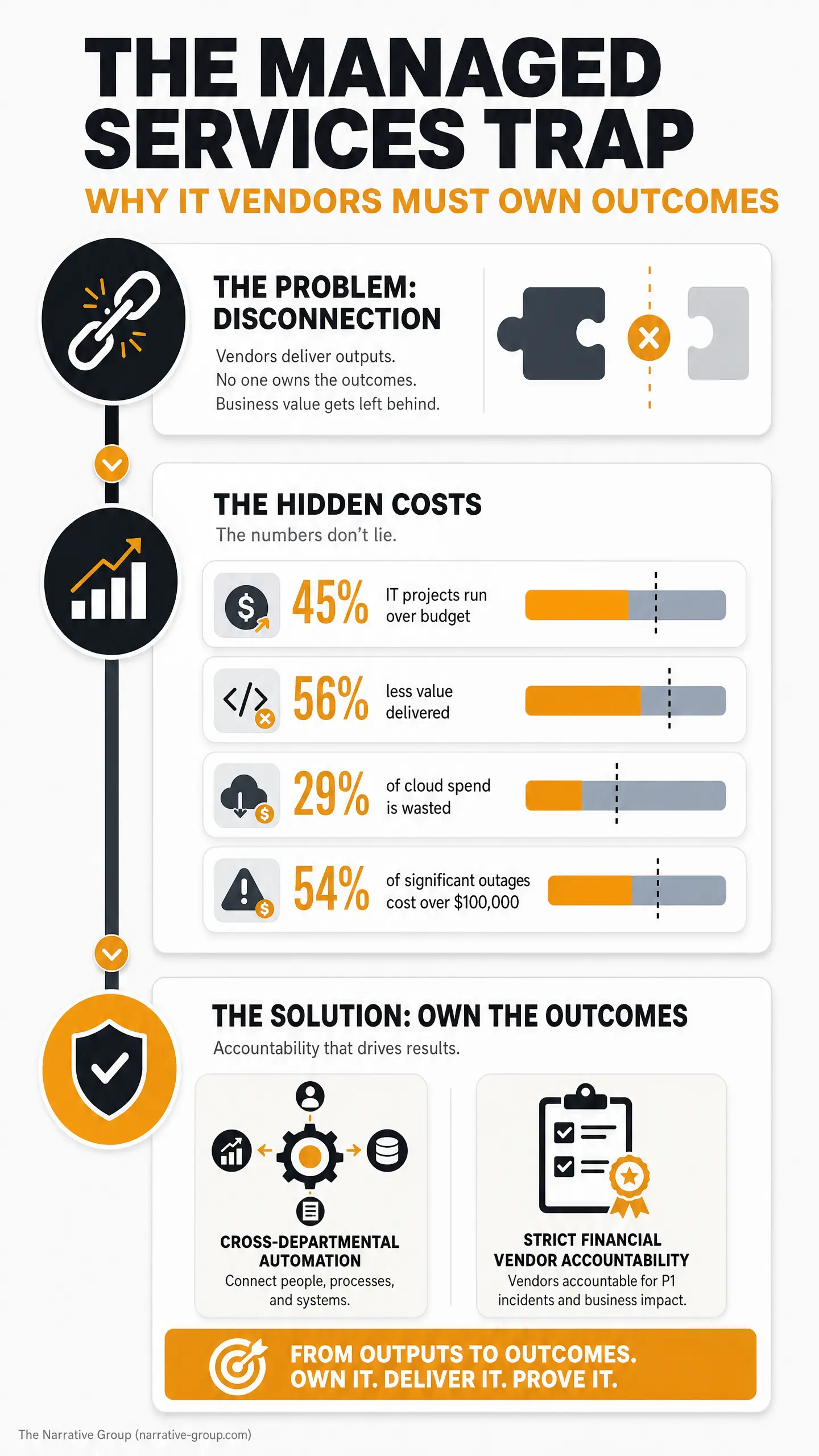
When a company takes a top-down approach, they will sell a concept that dazzles the C-suite from 100,000 feet, but it may be hard to transition into operations. McKinsey and Oxford found large IT projects run 45% over budget and deliver 56% less value than predicted. None of that shortfall shows up in a report – it sits in operations, quietly eating margin after the vendor has been paid.
I sold IT projects and managed services knowing my team would still be standing there when the dust settled, running whatever I closed. That single constraint made me a better seller than any quota ever did.
Why Do Top-Down Managed IT Services Sales Create Operational Risks and Cloud Cost Overruns?

Most vendors sell to the C-suite with a concept that looks brilliant at the hundred-thousand-foot view. Then your operations team inherits it. I’ve heard the same words on the ground more times than I can count: “I had no idea this was coming. We don’t even have the infrastructure to sustain this. Did anyone account for the cloud costs to maintain it?”
When the vendor has no stake in maintaining what they implement, that disconnect carries risks nobody priced in. McKinsey and Oxford found that large IT projects run 45% over budget and deliver 56% less value than predicted. I saw where that gap lives. It lives in operations, after the vendor’s plane has left.
I’ll admit something. We fell for the trap ourselves once. A vendor charmed our executives, knowing full well the initiative would be brutally expensive to sustain. The maintenance cost was a genuine shock. After that, operations sat in every vendor presentation with one job: poke holes in it.
Why Do Custom Enterprise Software Implementations Lead to IT Sprawl and Compliance Risks?
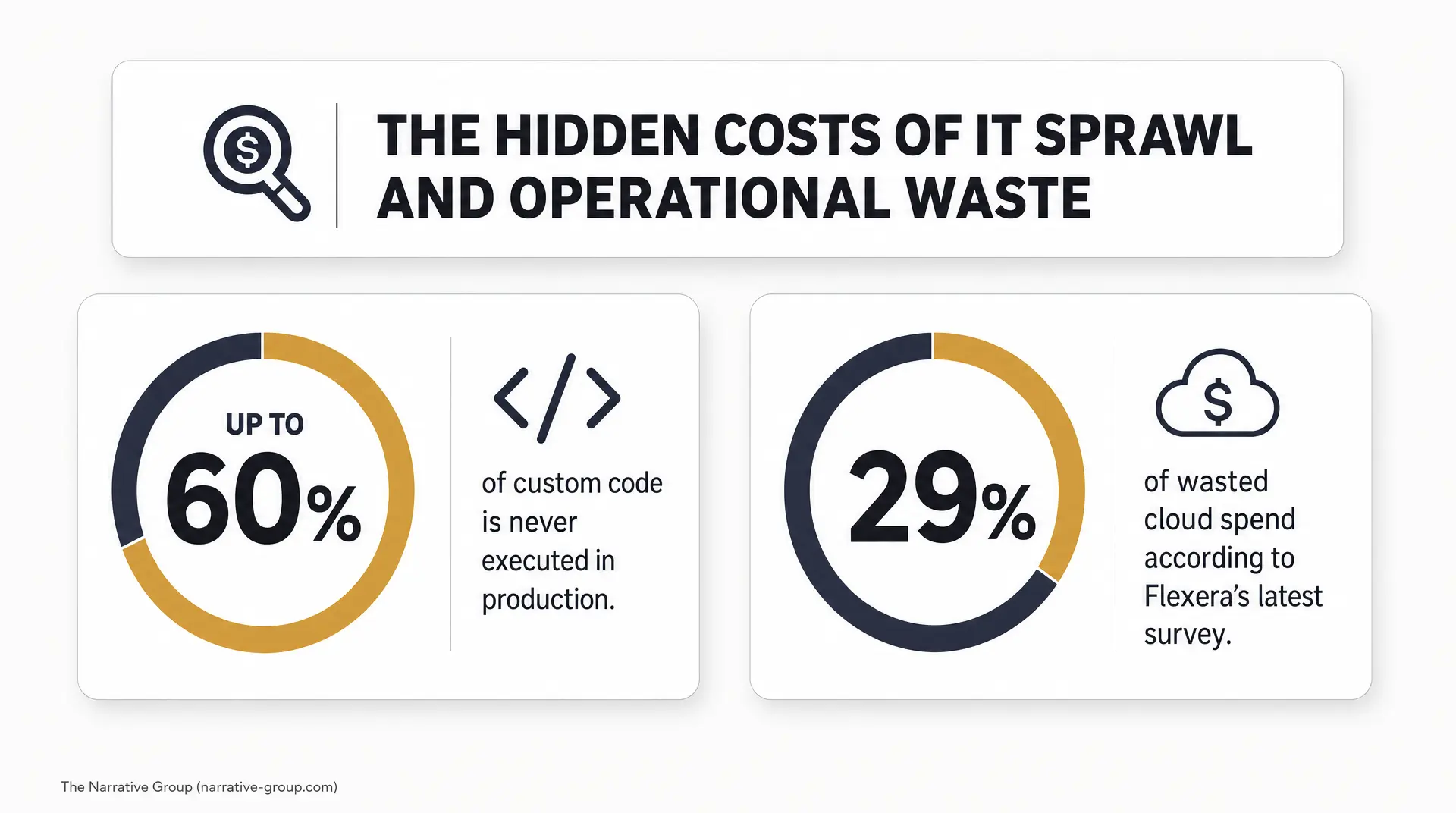
The old SAP era taught me the vocabulary for this. A standard implementation was already expensive. But once companies started customizing, costs went into sprawl fast. SAP’s own clean-core analysis shows 30% to 60% of custom code is never even executed in production. Had those customers known their customizations couldn’t be supported well after the fact, they never would have gone so deep.
Software has evolved past the monolith. The lesson hasn’t. Be operationally minded, or inherit someone else’s short-sightedness.
Ownership also means seeing around corners. At Red Hat, I knew SAP HANA support was consolidating to only two operating systems by 2027. Hydro One’s footprint was so large that waiting would have meant a compliance crisis, so we built a work-back plan years in advance. A vendor who plans to be there in 2027 warns you about 2027. A vendor who owns only the pitch is long gone by then.
How Do Cross-Departmental IT Gaps and Lack of Workflow Ownership Cause Margin Loss?

The trap has an internal twin, and it hides in your org chart.
A leader at a large Ontario utility ran IT operations for years. Only after a promotion into their Center of Excellence did they feel safe telling me, as their trusted advisor, what was actually broken. The bottleneck I see everywhere is fear of transparency. It’s rarely about competence.
What they finally revealed: spinning up a server took two weeks. Every department owned its own tasks, but the handoffs between them kept breaking down. Classic swivel chair issues. Nobody owned that gap. We implemented automation that let the workflow move across departments with different leadership, and two weeks became five minutes.
No report ever surfaced that delay. No vendor billed for it. No manager claimed it. It just sat between departments, quietly eating margin every single day.
What Operational Accountability Clauses Should Companies Demand in Managed IT Services Contracts?

Bring your operations team into the vendor’s sales presentation and tell them to poke holes in it. Make the vendor defend infrastructure limits, maintenance burden, and the cloud bill in year three. Flexera’s latest survey puts wasted cloud spend at 29%, and almost none of that waste was visible on signing day. A vendor who owns outcomes welcomes the interrogation. A vendor selling a deck squirms.
Then watch who inside your company is championing that vendor. You have to make sure a provider isn’t getting picked because it’s somebody’s cousin’s brother. Blunt, I know. But the ACFE lists being unusually close with a vendor as a fraud red flag carrying a $300,000 median loss. Find the people on the ground who genuinely want things to improve and bring them into the vendor conversations instead. You have to go where the enthusiasm is within the organization.
Finally, put teeth in the contract. Our $150M managed services contract at Suncor Energy carried financial consequences for P1 incidents. When the vendor loses money on your downtime, uptime stops being a marketing word. Uptime Institute found 54% of significant outages now cost over $100,000, so those penalty clauses are cheap insurance. A vendor who resists measurable consequences has just told you how confident they are in their own delivery.
Through all of it, I always ask, so what? Every promise should translate into margin, risk, or productivity. Everything else is just a wrapper.
How Do Narrative’s Managed IT Services Align Strategy With Operational Business Outcomes?

Our founder, Bruce Fairley, ran technology at Loblaw and Shoppers Drug Mart. When strategy disconnected from operations, he was the executive who suffered. So everything we present has to make sense at the 5,000-foot view, not just in the boardroom.
We start with a Financials First assessment. We figure out exactly how your business makes money before we touch a single system. Instead of just using flaky language, we give you numbers. Our managed services then include CTO-level oversight on retainer, with quarterly benchmarking sessions hunting for security risks and missed opportunities. We stay accountable for what we recommended six months ago, on a random Tuesday, when something breaks.
Two rules have carried me from Calgary oil patch hallways to the mid-market. Start with the client’s problem, not what you want to sell. And never sell anything you wouldn’t want to operate.
If you suspect your MSP’s accountability ends at the go-live party, ask them who runs this when it fails. Their answer tells you everything. And if you want a second set of eyes on how your IT spend actually behaves in operations, book 15 minutes with me. I’ll bring numbers, not a deck.