

Somewhere in a leadership meeting right now, someone is looking at two or three working bots and saying, “Let’s do this everywhere.”
It sounds like ambition. More often than not, it’s the first step into a very expensive mess.
I’ve seen this movie. I spent six years building an automation team at Loblaw. We delivered over 200 bots and 20-plus apps across 2,500 locations and 10,000 users. We freed up over $20 million in capacity, and not a single person lost their job because of it. That result didn’t come from moving fast. It came from refusing to scale until the foundation could carry the weight.
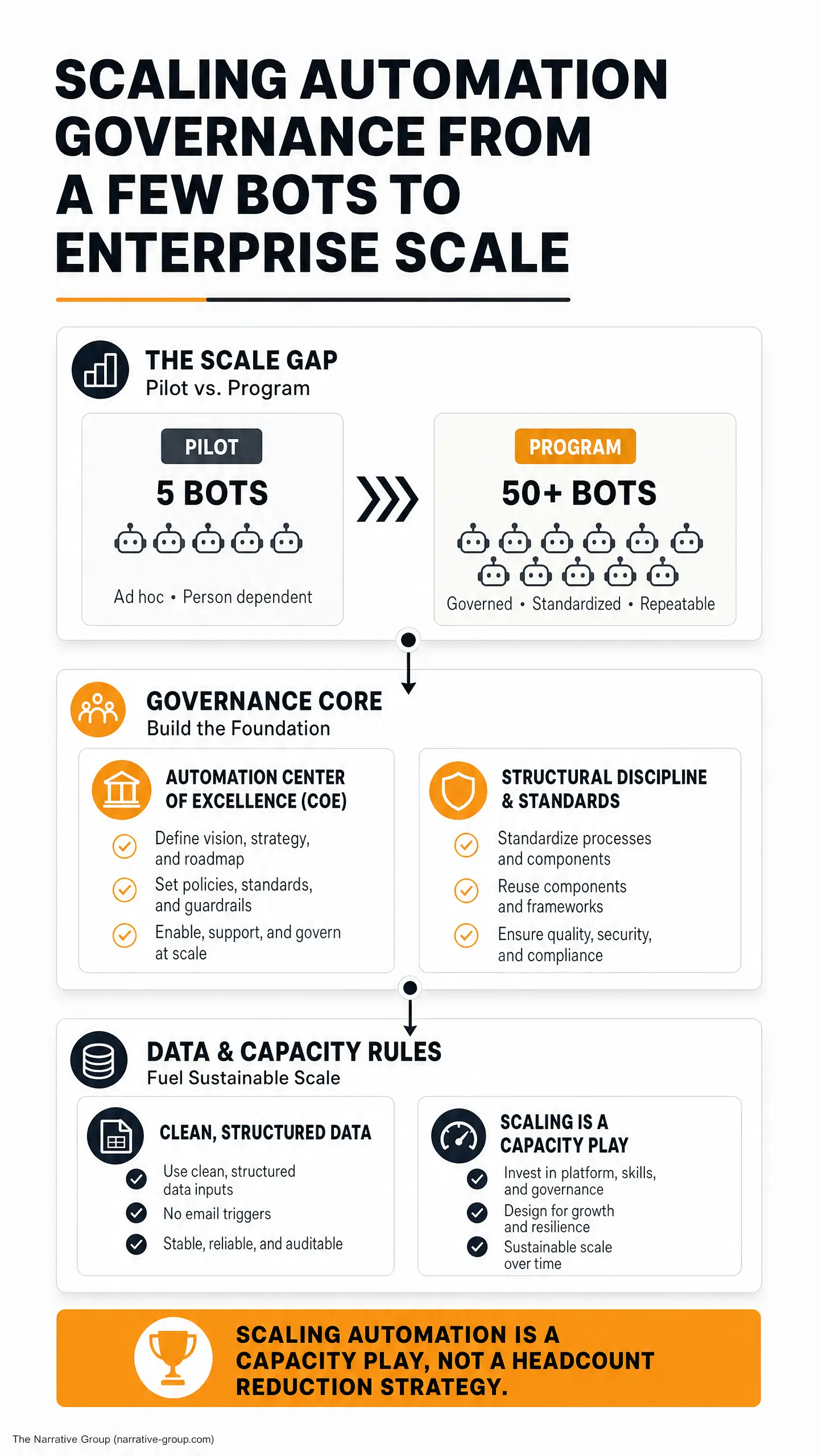
The leap from five bots to fifty isn’t a volume problem. It’s a governance problem, and governance is the part of an intelligent automation strategy most companies build last. Most learn that the hard way, on the P&L.
You can get a heads-up on planning by using this automation readiness scorecard and show up to your leadership meeting with some solid speaking points.
Key Takeaways
- By requiring strict governance before scaling, a large retail automation team deployed over 200 bots across 2,500 locations and recovered $20 million in operational capacity without eliminating any human jobs.
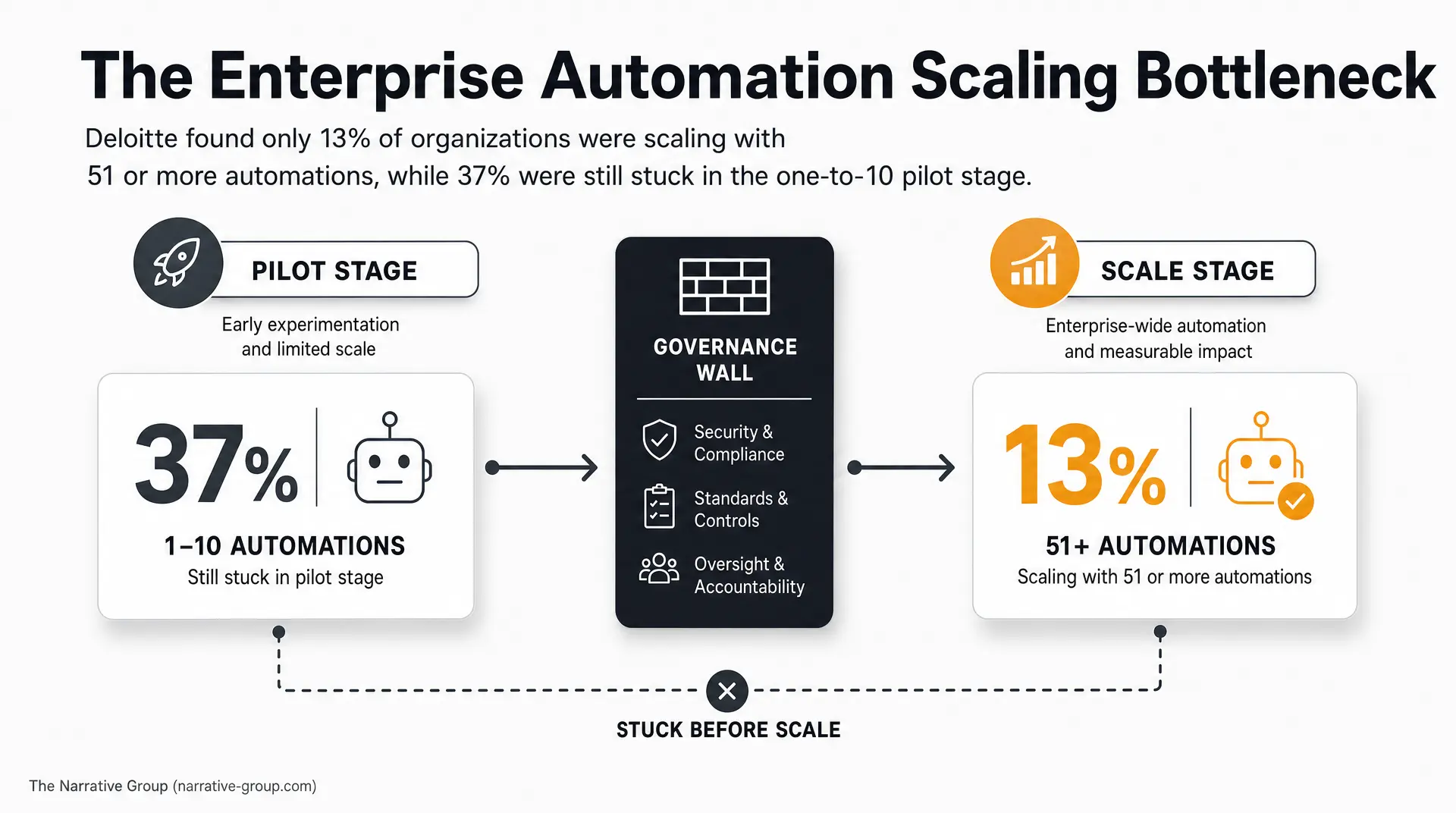
- According to Deloitte, only 13% of organizations successfully scale past 50 automations, as most programs stall due to key-person risk, missing ownership, and a lack of standardized governance.
- Unmonitored digital inventory like cloud compute and software licenses generates hidden exponential costs, with Flexera reporting 85% of organizations now rank cloud cost management as their top challenge and roughly 29% of that spend going to waste.
- Building reusable enterprise automation components, such as system connections and data-cleansing routines, is what turns a pile of one-off projects into a program with compounding returns.
- A governed, documented automation program is an asset in a data room; a pile of undocumented bots maintained by one person who could leave tomorrow is a liability.
- Safely implementing citizen development requires treating business users as an extension of the IT department by enforcing centralized guardrails, mandatory training, and strict code reviews to prevent disjointed automation sprawl.
Why Does Scaling RPA From Five to Fifty Bots Require Governance?
When you’ve got a handful of automations, the person who built them remembers everything. They know which website the bot logs into, which spreadsheet feeds it, and what to do at 2am when it stops. The whole program lives in one head.
At five bots, that’s fine. At 50, it’s key-person risk wearing an innovation costume.
This is exactly where companies stall. Deloitte found only 13% of organizations were scaling with 51 or more automations, while 37% were still stuck in the one-to-10 pilot stage. The wall between a pilot and a program is real, and it isn’t built out of technology. It’s built out of missing standards, missing ownership, and missing discipline.
In Formula SAE, we built race cars on a student budget. You learn fast that a part can pass every bench test and still grenade under load. If you overstress the system without properly assessing it, you’re gonna blow up the engine.
Automation behaves the same way. A bot runs beautifully on a quiet Tuesday, then dies the morning someone changes their website.
That isn’t a freak accident; it’s the job. ISACA warns flat-out that screen-scraping bots can’t handle changes to an application’s screen layout. EY estimates 30% to 50% of initial RPA projects fail outright. Bots are not build-and-forget assets, and the full picture of why they break and what it costs to keep them alive is its own subject.
How Do Ungoverned Automations and Digital Inventory Impact Company Profitability?
Here’s where I want every CFO reading this to lean in.
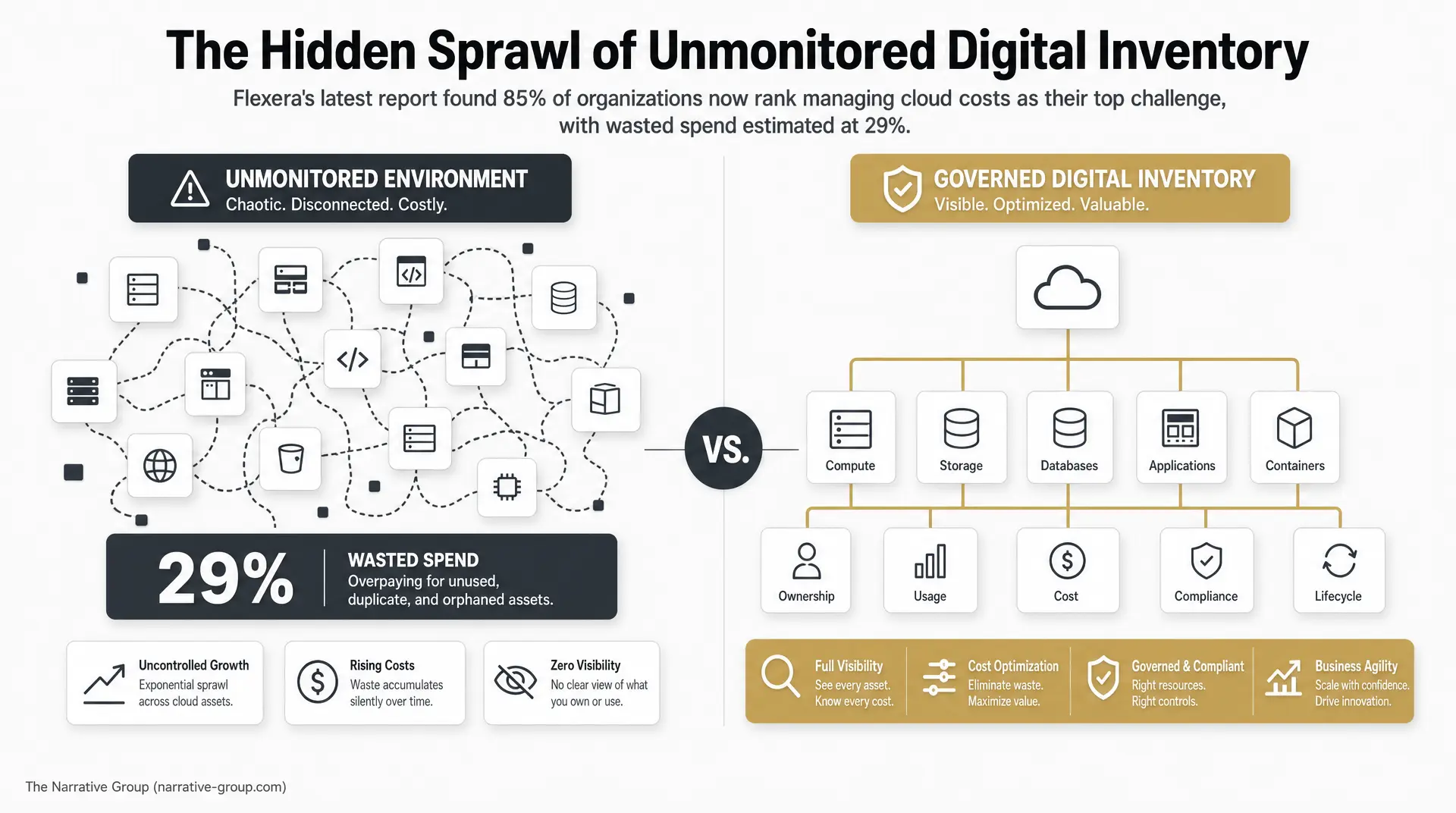
In the physical world, inventory is the devil. It ties up cash. It hides problems. It grows when nobody’s watching. In the digital world, your inventory is your consumption: cloud storage, compute, API calls, licenses. And digital inventory is more dangerous than the physical kind, because it grows invisibly and exponentially.
You can walk a warehouse and count the pallets. Nobody can walk a cloud bill. So 50 ungoverned bots, built by different people on different platforms to no shared standard, never announce themselves as a problem. They show up as a number on the P&L that nobody can explain.
Flexera’s latest report found 85% of organizations now rank managing cloud costs as their top challenge, with wasted spend estimated at 29%. That waste doesn’t come from one big mistake. It comes from a hundred small, unmonitored decisions nobody owns. Govern your consumption the way you’d govern a warehouse, or it becomes the new inventory devil on your books.
There’s a valuation angle too, and it matters if you ever plan to sell or raise. A pile of undocumented bots, maintained by a contractor who could vanish tomorrow, is a liability in a data room. A documented, governed, automated process is an asset a buyer will pay for. Governance is what turns your automation from a science experiment into something that survives diligence.
What Are the Core Structural Components of Automation Governance?
People hear “governance” and picture forms, approvals, and everything grinding slower. That’s the wrong picture. Speed is nothing without structure. Governance is the structure that lets you go fast without putting the car in the wall.
Strip it down, and it comes to a few unglamorous things. Every automation needs a named owner, a real human who gets the call when it breaks. Every bot follows the same rules a person would: documented process, code review, testing before it touches production, a support path. Whether the worker is human or digital, they have to meet the same standards. You’d never let a new hire run finance with no manager and no documentation. Don’t let a bot do it either.
The harder discipline is intake. Not every problem deserves a bot, and the fastest way to drown a young program is to say yes to everything. Lay out a Pareto chart of your work. Your high-skilled people belong on the left, where complexity is real and the payoff is big. The long tail on the right, lots of effort for small return, is where you get ruthless. Some of that tail is perfect for low-code. Some of it shouldn’t be automated at all. And some processes are so broken that automating them just lets you do the wrong thing faster.
That’s why the one thing you should never automate is automation. If your intake is chaos, scaling it only buys you organized chaos. Deloitte has flagged process fragmentation as the top barrier to automation for four straight surveys, and still found 41% of organizations had no enterprise-wide strategy. The bottleneck was never the bots. It was the lack of a plan for which work deserved one.
Why Is Component Reuse Critical for Scaling Enterprise Automation Programs?
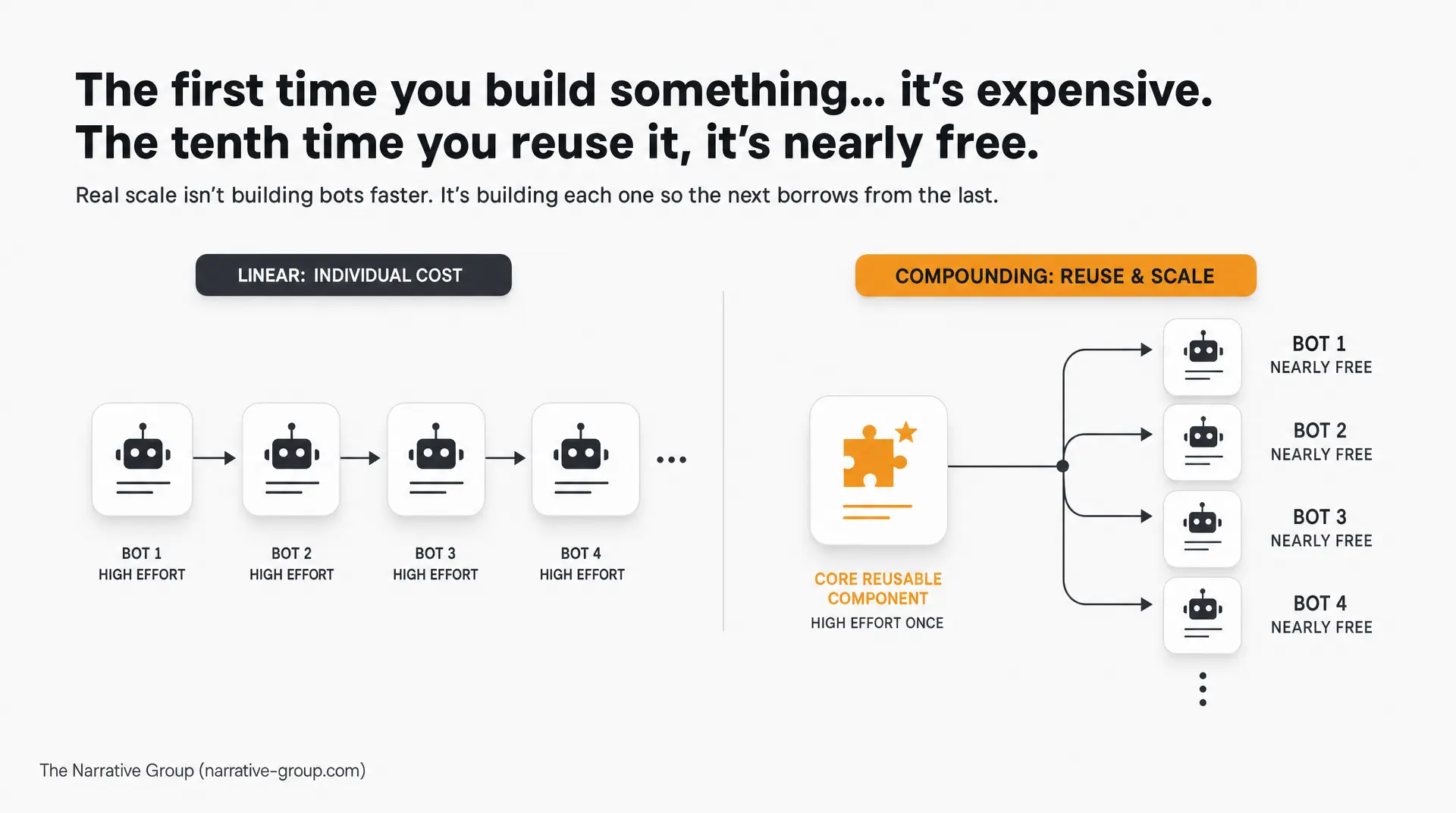
Here’s the lever almost nobody talks about. The first time you build something, whether a connection to a system, a data-cleansing routine, or a notification flow, it’s expensive. The tenth time you reuse it, it’s nearly free.
Real scale isn’t building bots faster. It’s building each one so the next borrows from the last. That’s how you get compounding returns instead of compounding costs. A program with no reusable parts isn’t a program. It’s 51 one-off projects sharing a budget line and pretending to be a strategy.
This is also where the benefits actually show up, or fail to. Organizations that push past the pilot stage report meaningful cost reduction, but most never calculate it, which is how programs run for years without anyone knowing whether they worked. If you cannot articulate what good looks like, there’s no point starting. I open every program with four questions: what’s the problem, what does good look like in numbers, how much will it cost, and what’s the timeframe. If you can’t answer those, you’re not ready to scale. The metrics that actually belong in that answer are in our guide to the ROI of automation.
What Is the Role of an Automation Centre of Excellence?
When I founded the automation Centre of Excellence at Loblaw, I built a team of 30 and ran the entire lifecycle: intake, process design, solution design, development, delivery, training, vendor selection, and support.
That last word is the one companies forget. They fund the build and starve the maintenance. Then they’re stunned when the program quietly falls apart in year two.
A CoE isn’t a bureaucracy. It’s the central nervous system of your digital workforce. It holds the standards, owns the reusable parts, decides what’s worth doing, and makes sure the work getting done is the right work, done to a standard you’d defend in an audit.
If you’re running a $20 million to $100 million company, you don’t need 30 people. You don’t have 30 people, and you shouldn’t. But somebody has to hold that function before you scale, even on a fractional basis. The role matters far more than the headcount. The market already agrees. Flexera found 71% of organizations now run a cloud center of excellence. Centralized governance stops being optional the second consumption starts to scale.
How Can Organizations Safely Implement Citizen Development in Automation Programs?

This is where executives get excited, and I get cautious.
Someone reads that citizen developers, your own business people building their own apps and bots, can take pressure off IT. It’s true. A person who knows the business, knows the exceptions, and is technical enough to build will outrun a developer you have to teach the business to. We piloted exactly this at Loblaw with 20 to 25 business users.
But citizen developer does not mean people go off and build in isolation. Without governance, policy, and auditing, it’s a security nightmare. You can’t just give them the keys to the car and say, go for a Sunday drive. So you build the foundation first: central standards, mandatory training, defined guardrails, code review. Citizen developers operate as an extension of IT, not a rogue cell outside it.
And don’t flip the switch on day one. Give it a year of trial and error with a few early adopters to learn where the guardrails actually need to sit. Deloitte found one in six organizations already doing citizen-led development, then warned plainly that it’s
not a replacement for a CoE. Do it without one, and you get nonhomogeneous automation sprawled across the business. Which is a polite way of describing the exact mess you were trying to avoid.
Why Is Clean Structured Data Essential for Successful Automation Workflows?

Nobody likes hearing this one. Successful automation is impossible without clean data and well-defined business rules. Full stop.
People resist it, and I get why: fixing the same errors by hand every week feels like adding value, which is one of the quieter reasons manual operations survive.
But you cannot build a reliable digital workforce on a shaky foundation, and most data leaders already know theirs is shaky. We covered the full diagnosis in why automation initiatives stall in mid-sized companies.
Two hard rules I’d put on any program scaling up.
First, no email triggers. That was a very hard rule on my team: no bot triggered by email, ever. Email is unstructured chaos, and it’s dangerous. The FBI logged $2.77 billion in losses to business email compromise in 2024 alone. Before a bot touches anything, a human uses an app or portal to turn that mess into clean, structured data.
Second, build a place to run the work from. Give your program a command center where manual work and bots intersect, so setup is centralized, and triggers are proper triggers instead of a swamp of email chains. Once that foundation held for us, scale got serious, and a single digital worker could take on data volume no human team would ever touch by hand. That volume is only possible on top of governance. Run it on a shaky foundation, and you don’t scale your output. You scale your failures.
How Do Digital Workers Impact Human Headcount in Automation Programs?

Let me kill the fear that drives bad decisions here, because there’s usually fear behind poor decision-making.
Scaling automation is not a headcount play. You are not eliminating roles; you are transferring the work to a digital worker. We delivered 200-plus automations and freed up $20 million in capacity, and not one job was lost as a result. The work moved up.
Let the digital workforce do the heavy lifting so your human workforce can focus on the complex, decision-making work. The full numbers behind that, and what the research says about which tasks actually automate, are in our guide to the ROI of automation.
What Is the Correct Order of Operations for Scaling Enterprise Automation?

So you’ve got a few bots and you want a real program. The order is the entire game.
Govern before you accelerate. Lock in ownership, standards, intake control, and reusable parts while the program is still small enough to fix. Clean your data before you point a bot at it. Stand up the central function, even a lean fractional one, to hold the line. Then open the throttle.
Do it backwards, and you’ll spend more digging out of 50 fragile bots than you ever saved building them. Backwards is also exactly what a bad vendor relationship counts on: get you committed on a small quote, then grow it one change request at a time until nobody wants to admit they should have started over.
At The Narrative Group, we bring the enterprise discipline that built a 200-bot program, sized and priced for a company that doesn’t have, and shouldn’t need, a 30-person internal team. We start with your financials and your real workflows, find where the waste actually lives, and build a roadmap that compounds instead of collapsing.
If you’re sitting in that “let’s do this everywhere” moment, talk to us before you accelerate. Score your program first with the Automation Readiness Scorecard, or book an alignment call. I’d rather help you pour the foundation now than help you dig out of the rubble later.
Frequently Asked Questions
How should we measure the financial return of an automation program if headcount remains flat?
You measure capacity creation and revenue velocity, not layoffs. Deloitte found that 70% of organizations haven’t calculated expected revenue increases from automation. Governance forces you to track how reallocated labor accelerates order processing, reduces compliance fines, and prevents costly human errors.
What percentage of our automation budget should be allocated to ongoing maintenance?
Never fund the build and starve the upkeep. EY reports that 30% to 50% of initial RPA projects fail, largely due to neglected maintenance. Expect to allocate 20-30% of your development costs annually for support. Bots require infrastructure planning and operating discipline to survive.
How do we objectively identify which business processes are actually worth automating?
You leverage data, not gut feelings. While 80% of leaders agree process intelligence identifies high-value processes, only 23% actually use it. Process mining maps your workflows objectively and reveals where bottlenecks actually exist, which prevents you from wasting capital automating broken, low-yield processes.
What are the primary cybersecurity risks when scaling a digital workforce?
Bots hold credentials, access sensitive data, and can be compromised. ISACA warns that RPA risk spans the full lifecycle, including security and incident management. Ungoverned bots create massive vulnerabilities. Strict governance ensures every digital worker follows the same identity management and logging protocols as human staff.
How do mid-market companies avoid vendor bloat when purchasing automation tools?
By establishing a strategy before signing contracts. Deloitte found 41% of organizations had no enterprise-wide automation strategy at all. Without centralized governance, departments buy redundant tools. Stop vendor bloat by forcing all automation intake and vendor selection through a single, disciplined approval path.