

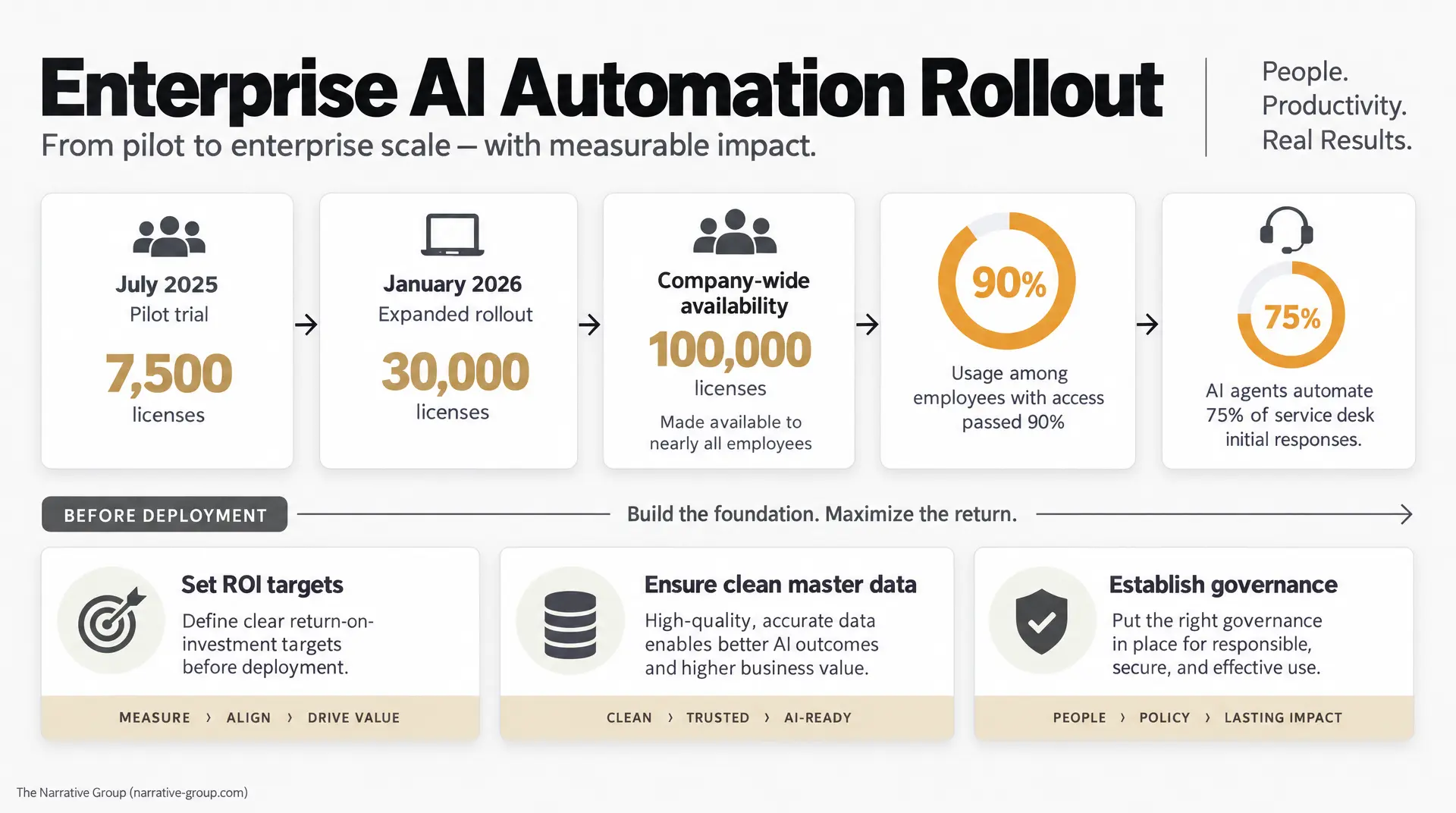
Fujitsu made roughly 100,000 Microsoft 365 Copilot licenses available to nearly all of its employees worldwide in April 2026, according to a Microsoft customer story dated October 9, 2026. It got there in stages. A 7,500 license trial started in July 2025, and it expanded to 30,000 licenses in January 2026. Microsoft reports that usage among employees with access passed 90% in June 2026. It also reports that AI agents now handle 75% of service desk initial responses and triage.
Shunsuke Sawamura heads Fujitsu’s DX Division. He said the company chose to adopt quickly and judge the value through real-world use, rather than set return on investment targets before deployment. Microsoft’s story also says ROI targets were discussed during the trial.
I’d copy the staged rollout. I’d also copy the Fujitra (Fujitsu Transformation) network, a company wide program involving executives and frontline employees, which Sawamura said helped drive adoption. I want the same mix in a process mapping session: an executive sponsor in the room with the people doing the work.
I wouldn’t copy the call on ROI in a company your size, though. Speed is nothing without structure. Fujitsu had a DX Division and a Corporate Digital Unit to lean on while it worked out the value. When IT is you and maybe two other people, you’ve got to know what good looks like, in dollars, before you buy the seats.
Why Is Microsoft 365 Copilot Usage Insufficient for Measuring Enterprise ROI?
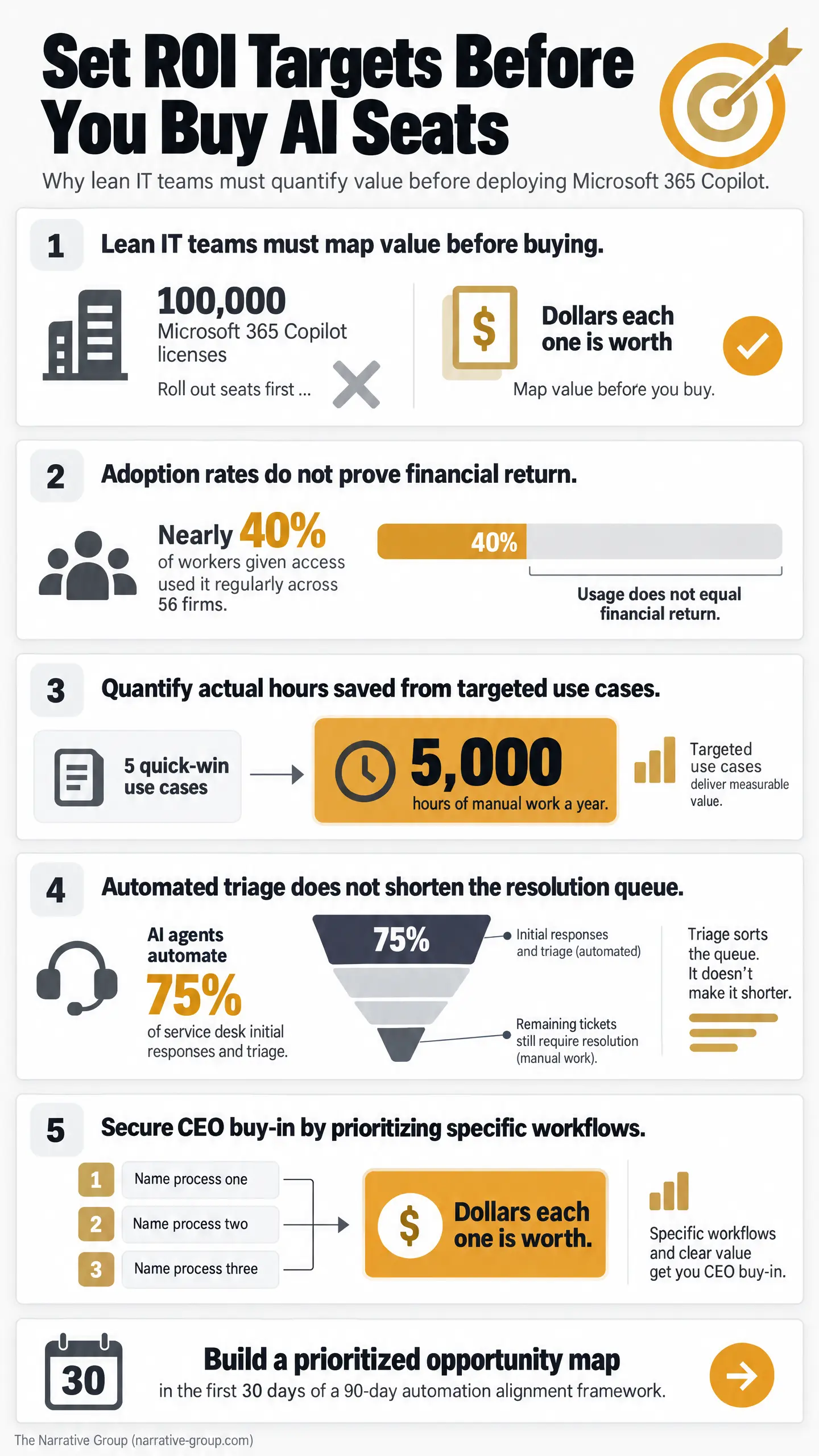
Fujitsu’s 90% is unusual. In a randomized study of Copilot across 56 firms, nearly 40% of workers given access used it regularly over six months. Getting to 90% takes a push like Fujitra.
Even 90% won’t answer your CFO’s questions, though. Usage can’t show which work got faster, how many hours came back, or what it did to EBITDA. Before anything gets built, I want four answers:
- What’s the problem?
- What does good look like, in numbers?
- What will it cost?
- How long will it take?
At The Narrative Group, discovery workshops with a package distribution client turned up 20 operational bottlenecks. Automating five quick win use cases saved 5,000 hours of manual work a year. A CFO can put a dollar figure on capacity like that.
How Does AI Agent Triage Impact IT Service Desk Ticket Resolution?
The 75% figure covers initial responses and triage. The story doesn’t claim agents resolve 75% of inquiries. When you’re the service desk, faster routing still puts the ticket in front of you. If the fixes live only in your head, an agent can sort the queue without making it any shorter. Microsoft’s own guidance for help desk agents calls for a baseline before launch, including contact volume by channel and intent, handle times and fully loaded cost per hour. Those numbers will tell you whether triage is even where your hours go.
My team at Loblaw had a hard rule: no email triggers. We’d been told an Outlook plugin could read an email and kick off a bot. It’s not that simple, and for us the ongoing maintenance wasn’t worth the effort. So we put a canvas app at the front of the process to cleanse the data first. We got quicker solutions, better data and less maintenance. What drives AI is data, and an agent reading messy tickets has the same input problem my bots had.
How Does Master Data Quality Impact AI Agent Integration Into ERP Systems?

Fujitsu says it’s working to expand integration between its agents and systems like ERP, CRM and workflow platforms. Building a Formula SAE race car at the University of Toronto taught me a great driver can’t make up for a bad part. Wire an agent into your ERP and the parts become your master data and business rules.
In grocery retail, a master data automation tool looked broken until we proved it was correctly rejecting bad vendor files. The company educated its suppliers and ended up processing clean data. An agent will run into your bad data the same way, and part of your job will be showing leadership where the problem sits.
How Should IT Govern Employee-Built Automations and AI Agents?
Fujitsu also says it recognized use cases through its AI & DDM Award and Teppan Agent Contest. It’s good to celebrate quick wins, but you can’t just build, deploy and forget. I once investigated a merchandising capacity planner that stopped working after an ERP upgrade. An employee had built it with the record macro button, without knowing how to code. I fixed the macro and used it as a teaching moment to prove the need for centralized automation governance.
Modern, unvetted low-code tools are more dangerous than that macro, because they can quietly expose financial data. In a company your size, anyone building automations or agents needs a central team, code review and testing behind them.
How Should IT Leaders Use Process Mapping to Justify Enterprise Automation Investments?

A headline like Fujitsu’s can get a CEO asking IT why the company isn’t there yet. Asking for seats won’t get you far in that conversation. Naming three processes and what each one is worth in dollars will.
That’s what the first 30 days of our 90-day automation alignment framework at The Narrative Group produces: a prioritized opportunity map with ROI targets. Bring us the processes eating your week. We’ll work out which three pay back first. Not sure you’re ready for that conversation? Start with our automation readiness scorecard.