

Automation doesn’t fix a broken process. It just makes the broken parts move faster.
Take messy inputs, fuzzy exceptions, and a fragile workflow, drop a bot on top, and you’ve built a faster, more expensive way to make the same mistakes at scale. Every one of those mistakes lands on your P&L. I’ve watched it cost companies millions.
I’m not anti-automation. I spent six years building an automation Centre of Excellence at Loblaw where we delivered over 200 automated solutions across multiple business units. Not one person lost their job because of it. So when I tell you most automation candidates aren’t worth touching, understand where I’m coming from. I’m anti-waste.
The whole game is knowing which processes to automate and which ones to leave alone. It’s the part of an intelligent automation strategy that decides whether everything downstream works. Let me walk you through how I actually make that call.
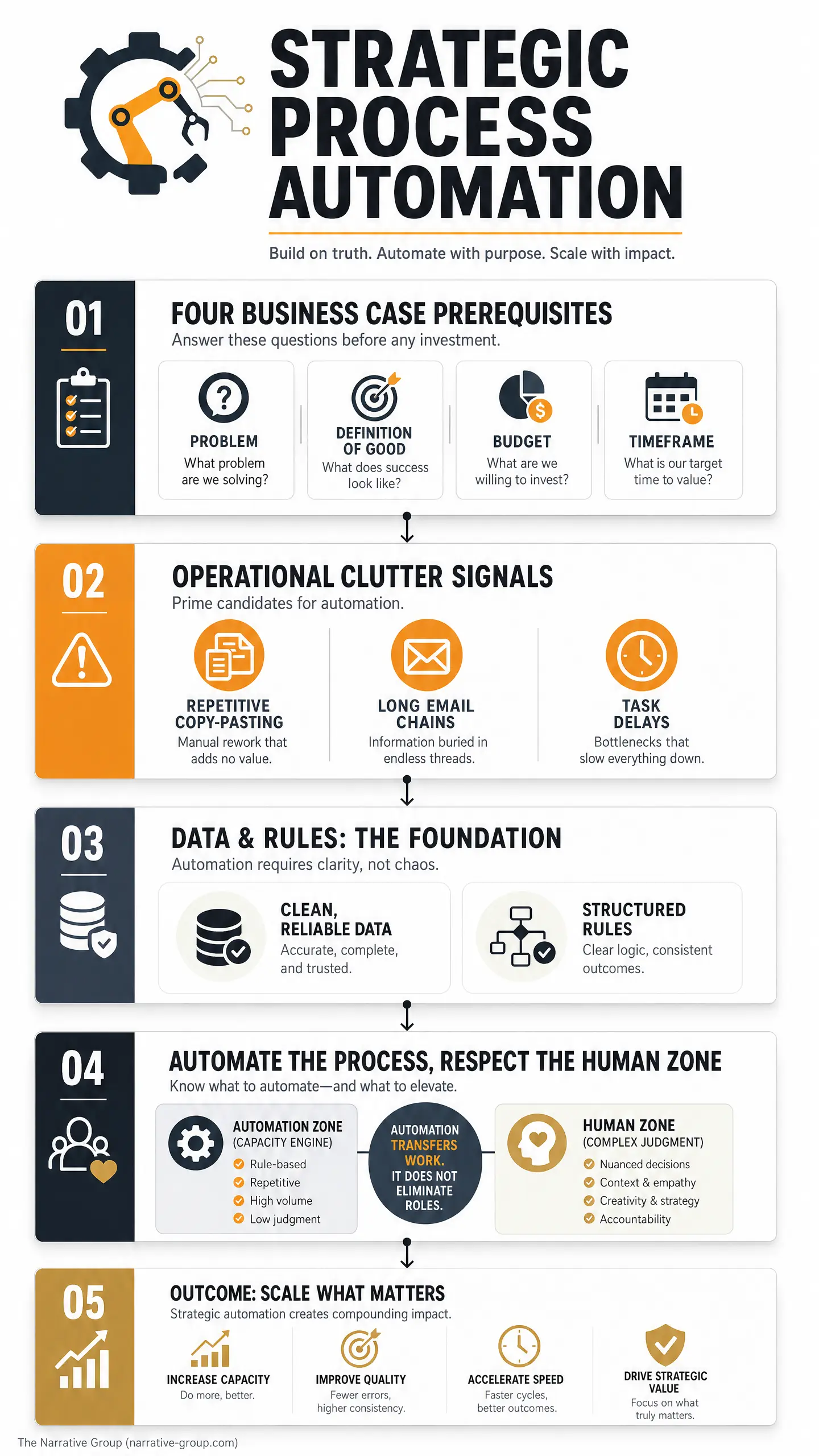
Key Takeaways
- Automating a broken process scales the errors rather than removing them, which is why candidate selection matters more than platform selection.
- The three clearest signals a process is worth automating are visible copy-pasting between systems, processes that take more than three emails to finish, and tasks taking far longer than they reasonably should.
- Data collection and data processing consume roughly a third of all workplace time in the U.S., and both carry automation potential above 60%.
- High-complexity work should stay manual: managing and developing people has just 9% automation potential, and applying expertise to decisions, planning, and creative work sits at only 18%.
- Volume and business impact are where the money lives. A digital worker handling a 500,000-record daily report can correct tens of thousands of errors a day, which no human team can match.
- You will not find your highest-value automation candidates in a boardroom or in a deck prepared by your senior team.
What Four Business Case Questions Must Be Answered Before Investing in Automation?
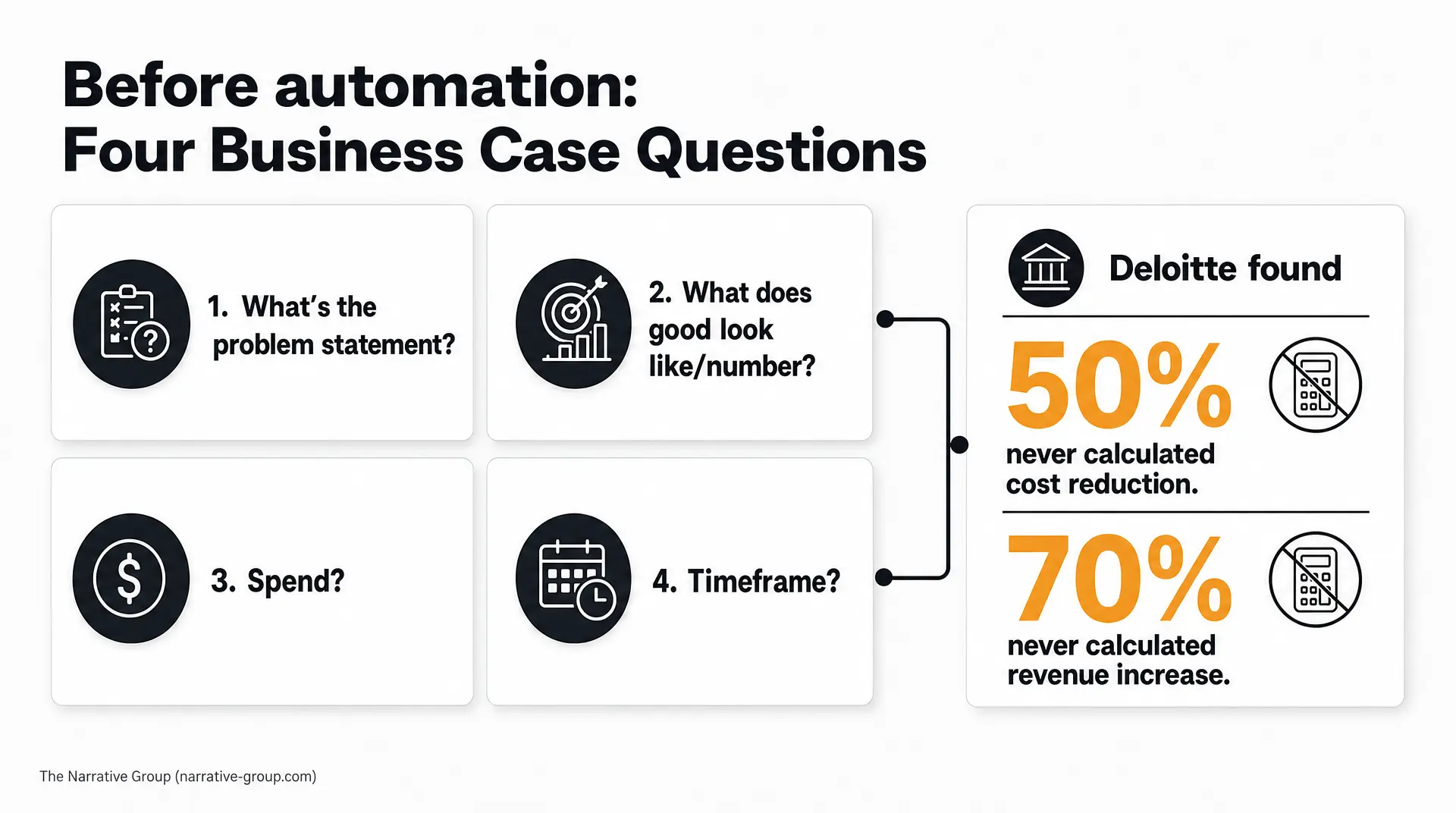
Before I look at a single process, I need to know what winning means in numbers. What’s the problem, what does good look like, what will you spend, and by when? These are the four questions we answer before any build.
Here’s why it matters for candidate selection specifically: without a number, every process looks like a reasonable candidate.
“Good” has to be something you can defend to your board. Hours given back. Errors removed. Days off the month-end close. If the only way your team can describe the win is with adjectives, you don’t have a business case. You have a wish. And most companies are automating on faith rather than arithmetic, which we took apart in our guide to the ROI of automation. You’d never approve a new forklift or a warehouse lease without knowing the payback. Automation deserves the same rigor.
How Can Frontline Operational Clutter Reveal the Best Robotic Process Automation Candidates?

You will not find your highest-value automation in a boardroom. And you definitely won’t find it in a deck prepared by your senior team.
People aren’t going to tell you where the dirty laundry is. You’ve got to go looking for it.
So I go to the floor. I walk the warehouse, the receiving dock, the back office. I talk to the receivers, the clerks, the people actually doing the work. The receivers alone will tell you everything about the quality of what’s coming in and the manual labor it takes to deal with it. Don’t ask senior management where the pain is. Don’t ask middle management either. They’ve got too much riding on everything looking clean. And if you want the unvarnished version, call a few of your own vendors. A vendor will give you a bigger, more honest picture of your internal mess than your own people ever will.
While you’re out there, look for the clutter. Disorganized docks. Blocked aisles. Stacks of paper that should be data. Tension in how people talk to each other. Clutter sits on top of broken, undocumented processes that nobody owns. It’s a tell, every time.
What Are the Three Primary Signals That a Business Process Should Be Automated?
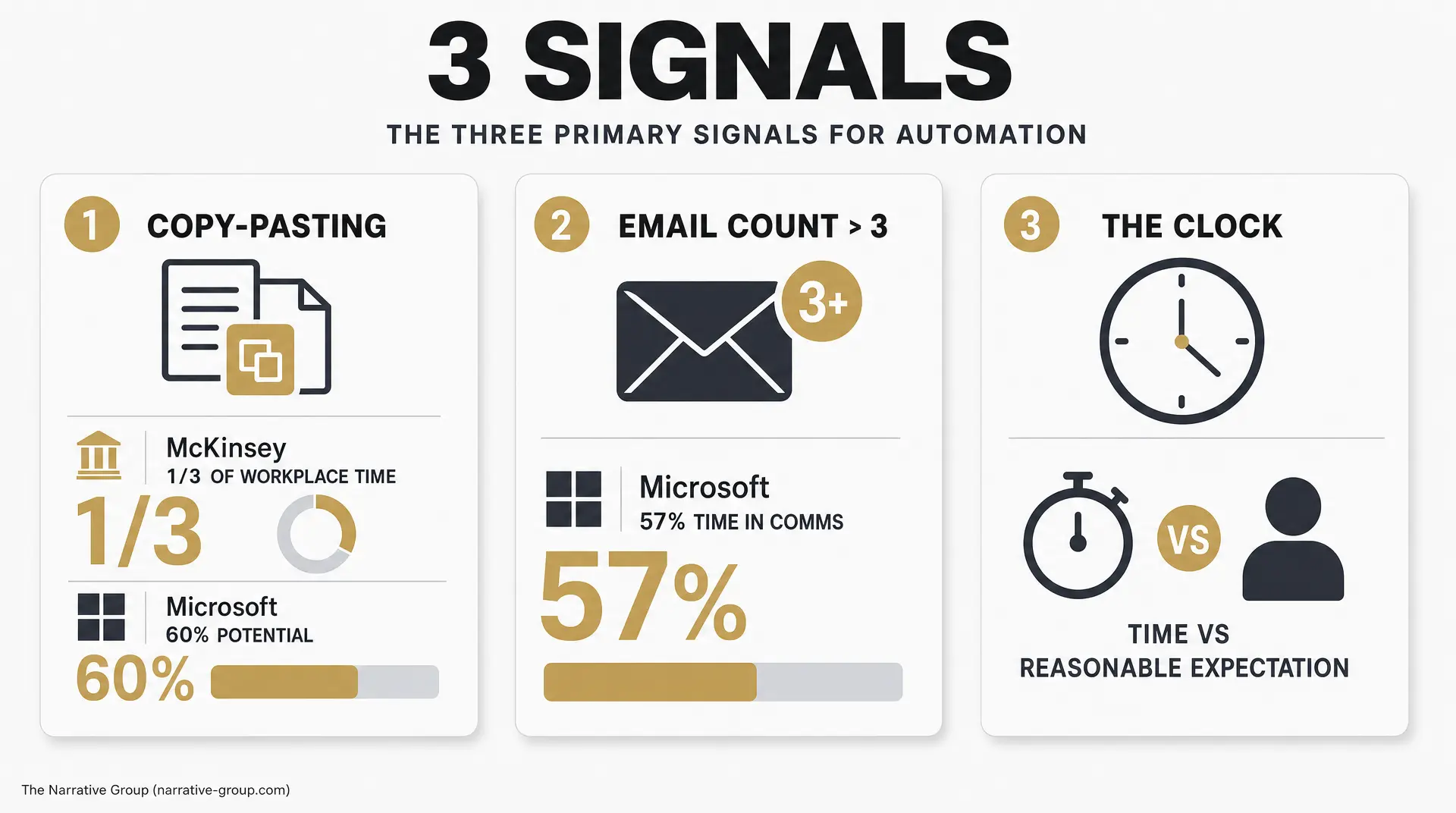
Once I’m watching the actual work, three things jump out at me.
The first is copy-pasting. When I see someone pulling numbers out of one screen and hand-keying them into another, over and over, that’s a digital worker waiting to be built. This isn’t a small slice of your business either. McKinsey found that data collection and data processing eat up about a third of all workplace time in the U.S., and both have automation potential above 60%. A human acting as the glue between two systems is pure, expensive friction.
The second is the email count. If a process takes more than three emails to complete, there’s probably something worth looking at. Long email chains are where accountability goes to die and where work quietly stalls. It adds up. Microsoft found that the average worker spends 57% of their time communicating in meetings, email, and chat, and 68% say they can’t get enough uninterrupted focus time. That’s a lot of payroll spent forwarding messages.
The third is the clock. I’ve done this long enough to know roughly how long a task should take. A task that takes five minutes in a clean SAP environment can eat an hour in a tangled legacy system. When reality is that far off from reasonable, you’ve found something. The cost of that gap is bigger than most executives realize, and we put numbers on it in the hidden cost of manual operations.
What Metrics Should You Use to Rank Automation Candidates?

People always want the magic checklist. The one-page framework they can run themselves. But a checklist is nothing without the context and experience behind the items on it.
I’ll tell you what matters, though, because the dimensions aren’t a secret. There’s no cookie-cutter approach here. No two companies are alike, and no two processes are alike. I lean on Lean Six Sigma, build a fishbone diagram to find the bottlenecks, talk to a handful of people, and then rank the candidates on four questions:
- How often does it run?
- Is it the same steps every time, or is every transaction a special snowflake?
- How often do people get it wrong, and where do those errors flow?
- And the one that kills most ideas: does fixing it move a number you actually care about?
Volume and impact are where the money lives.
The best example I can give you is a digital worker we put on a daily assortment report. Half a million records a day. It automatically actioned tens of thousands of data errors every single day, which took products that were stuck, unavailable to order because of data issues, and made them available in stores again. Tens of thousands of corrections, daily. No human team was ever going to keep up with that, and the revenue impact of an item nobody can order is real and immediate.
That’s what a candidate worth building looks like: high volume, fully repeatable, and wired directly to a number the business cares about. We’ve also replaced weekly spreadsheet rituals with live dashboards for a fraction of that scale and gotten an easy yes, because the same test applied.
Want a structured read on whether your business is positioned to make these calls well? The three-minute Automation Readiness Scorecard scores your process ownership and data quality alongside three other dimensions that determine whether your candidates will actually pay off.
Why Are Clean Data and Structured Rules Mandatory Before You Automate?
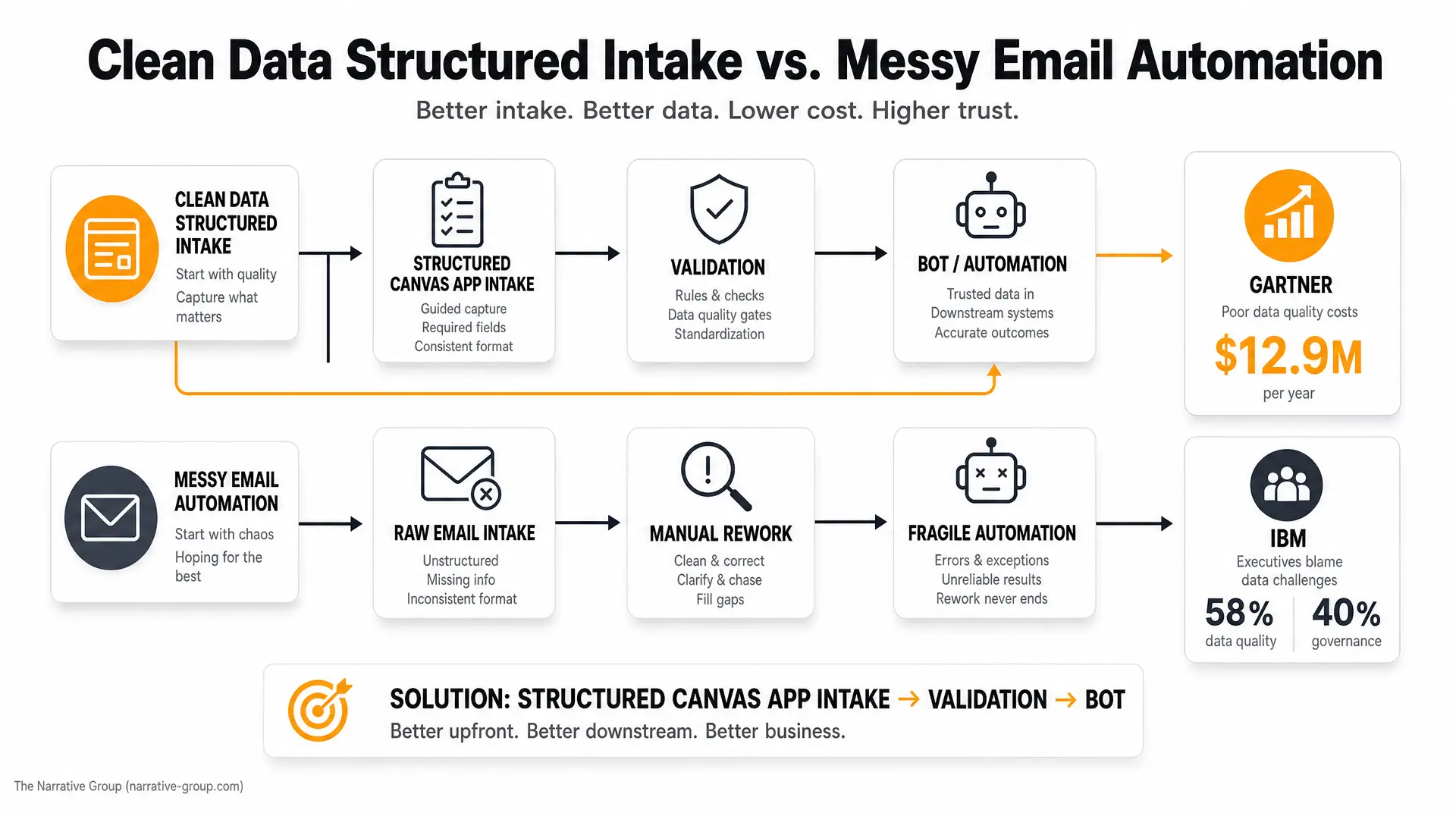
This is where most automation projects die, and it’s the part nobody wants to hear.
Successful automation is impossible without two things first. Clean data and well-defined business rules. No exceptions.
And your own people often prefer the mess, because cleaning up errors by hand makes them feel like they’re adding value. I understand the instinct. It’s also the single biggest thing standing between you and real efficiency. We put real numbers on the hidden cost of manual operations.
The numbers back this up hard. IBM found that more than half of organizations blame data for their stalled AI projects, with 58% pointing to data quality and 40% to governance. The full cost of building on a shaky foundation is why automation initiatives stall in mid-sized companies. Automate on top of dirty data, and you’re not gaining efficiency. You’re scaling your errors faster than ever.
The clearest lesson I ever got on this was email triggers. Vendors will tell you a bot can ingest data straight from an email. It sounds great in a demo, and in practice the maintenance to keep it limping along isn’t worth the effort. So we made a hard rule on my team: no email triggers, ever. Instead, we put a simple structured form at the front of the process so the data gets validated before a bot ever sees it.
The whole lesson fits in one line. Don’t automate the broken version of the process. Fix the intake, clean the data, clarify the exceptions, then automate.
What Should Never Be Automated?

The “no” list matters as much as the “yes” list.
Some work belongs in what I call the human zone. Leave it alone. The data agrees with me here. McKinsey found that managing and developing people has just 9% automation potential, and applying expertise to decisions, planning, and creative work sits at only 18%. The judgment calls your best people make are exactly what a bot can’t replicate. Don’t try.
Then there’s the long tail: a ton of effort for almost no return. Be careful out there. Not everything in that tail is worth the build, and chasing it just to say you automated something is ego, not strategy. Don’t deliver something to support someone’s ego. Where to draw that line, and how to enforce it as your program grows, is the intake discipline we cover in automation governance.
And my favorite rule of all. The one thing you should never automate is automation. The decision of what to automate needs a human who understands your business, your exceptions, and your risk appetite. A digital worker can give you the assist on that decision. It doesn’t get to make the call.
Why Does Picking the Wrong Candidate Cost So Much More Than It Looks?

You can’t just build, deploy, and forget. A bot is a digital worker, and it needs oversight and maintenance the same way a human employee needs managing. I’ve watched a target website push a routine update and break a bot mid-operation, months after a flawless launch. The build was solid. The outside world moved underneath it.
That’s why the wrong candidate is so expensive. You don’t pay for it once. You pay for it every year it stays alive.
So when a vendor hands you a clean one-time number, be suspicious. They’re showing you the first few feet in front of you so you can’t see the miles down the road. What looks like a simple $50,000 process turns into scope creep, edge cases, enhancements in the tens of thousands, and eventually a redesign, and we’ve broken down that arithmetic in our comparison of enterprise RPA and low-code platforms.
There’s a quieter cost too. In the digital world, inventory doesn’t disappear, it changes form, and your physical inventory becomes digital consumption that grows invisibly while everyone’s still celebrating the efficiency win. Governing that consumption matters as much as governing the builds.
How Does Disciplined Selection Improve Margins and Extend Legacy System Life?

For a company doing $20 to $100 million in revenue without a deep IT bench, this discipline isn’t optional. You can’t afford to waste a transformation budget on the wrong targets. You don’t have the slack the giants do.
When you pick the right processes, automation stops being a cost line and becomes a capacity engine. And done right, it doesn’t cost people their jobs. That’s exactly what I saw across 200-plus automations: you are not eliminating roles, you are transferring the work to a digital worker so your people can do the more complex work that hits your targets. The research behind that, and the metrics that prove it, are in our guide to the ROI of automation.
There’s one more financial gift hiding in here that most owners miss. Smart automation extends the life of the legacy systems you already paid for, which buys you time before the big capital decision.
That’s the difference between treating technology as an expense and treating it as a strategy.
At The Narrative Group, we start with the financials first. We map how your money moves, how your data moves, and where the friction hides, before we recommend automating anything. We find the quick wins to build momentum, and we build the governance so those wins outlast any single project.
If you’re getting pitched automation and you can’t tell which projects are real and which are just a faster way to bleed, start with the Automation Readiness Scorecard or book an alignment call. I’ll help you tell the dirty laundry from the dollars.
Speed is nothing without structure. Pick the right processes, fix them first, and only then let the bots run.
Frequently Asked Questions
Should we invest in process mining software to find automation candidates?
Yes, if operations are already digitized. Data validates your gut check. Deloitte found 82% of executives agree process mining drives better outcomes. It mathematically maps the invisible workflow variations your middle managers hide, making your ROI projections bulletproof before you fund any bot builds.
How long should discovery take before we approve an automation build?
Long enough to watch the work happen, which is usually weeks rather than months. You need enough time to see the exceptions, because the exceptions are what break bots and blow up quotes. A discovery that only interviews managers and reads process documentation hasn’t found anything yet. If a vendor offers to skip discovery entirely, that’s the tell.
What if the process we want to automate isn’t documented anywhere?
Then documenting it is the project, and automating it comes second. An undocumented process usually means the real rules live in one person’s head, exceptions included. Automating that just encodes one person’s habits at machine speed, including the parts nobody ever validated. Write it down, agree on the rules, then decide whether a bot belongs anywhere near it.
How do we prevent departments from building fragmented, siloed bots?
Centralized governance with decentralized execution. IT owns security, vendor standards, and infrastructure, while business leaders own the process logic and P&L outcomes. Without that split, you get shadow IT and orphaned automations nobody maintains.
Should we use OCR to automate data extraction from paper records?
Only if you mandate human validation. While OCR is popular, studies show scanning produces a 0.74% error rate – much higher than double data entry. If you automate data extraction without a structured intake validation step, you are simply paying vendors to digitize your errors faster.