

I’ve built more than 200 bots over my career. I’ve also taken a handful of them offline and shut them down for good.
The technology didn’t fail. The math did. A few of those bots cost more to babysit than they ever saved.
You won’t find that line in any vendor’s pitch deck. When a CFO calls me about an automation program that isn’t paying off, they almost always blame the technology first. The platform. The vendor. The bot itself.
In my experience, the bot is rarely the problem. Automation stalls on the things wrapped around it. Dirty data. Processes nobody owns. Governance that can’t keep pace with ambition. And a maintenance bill that shows up six months after everyone celebrated go-live.
You’re not alone if your program is stuck. In one McKinsey study of companies that had actually deployed or scaled automation, only 61% hit their targets. Getting unstuck starts with an honest intelligent automation strategy for mid-sized companies, and that starts with knowing exactly where programs go wrong. Let me walk you through the gotchas I see over and over, and what each one quietly costs you.
Key Takeaways
- Automation programs rarely stall because of the technology; they stall on dirty data, unowned processes, weak governance, and maintenance nobody budgeted.
- Only 61% of companies that deployed or scaled automation hit their targets, and organizations with successful AI initiatives invest up to four times more in data and governance foundations.
- Gartner puts the cost of poor data quality at $12.9 million a year for the average organization, and most of it stays invisible until you try to scale on top of it.
- Process fragmentation is the top barrier to enterprise automation because seemingly simple manual tasks often contain undocumented human exceptions that break strict bot logic.
- Unbudgeted maintenance quietly destroys ROI; bots are cheap to build and expensive to keep.
- Across more than 200 enterprise automations that freed up $20 million in capacity, zero human roles were eliminated.
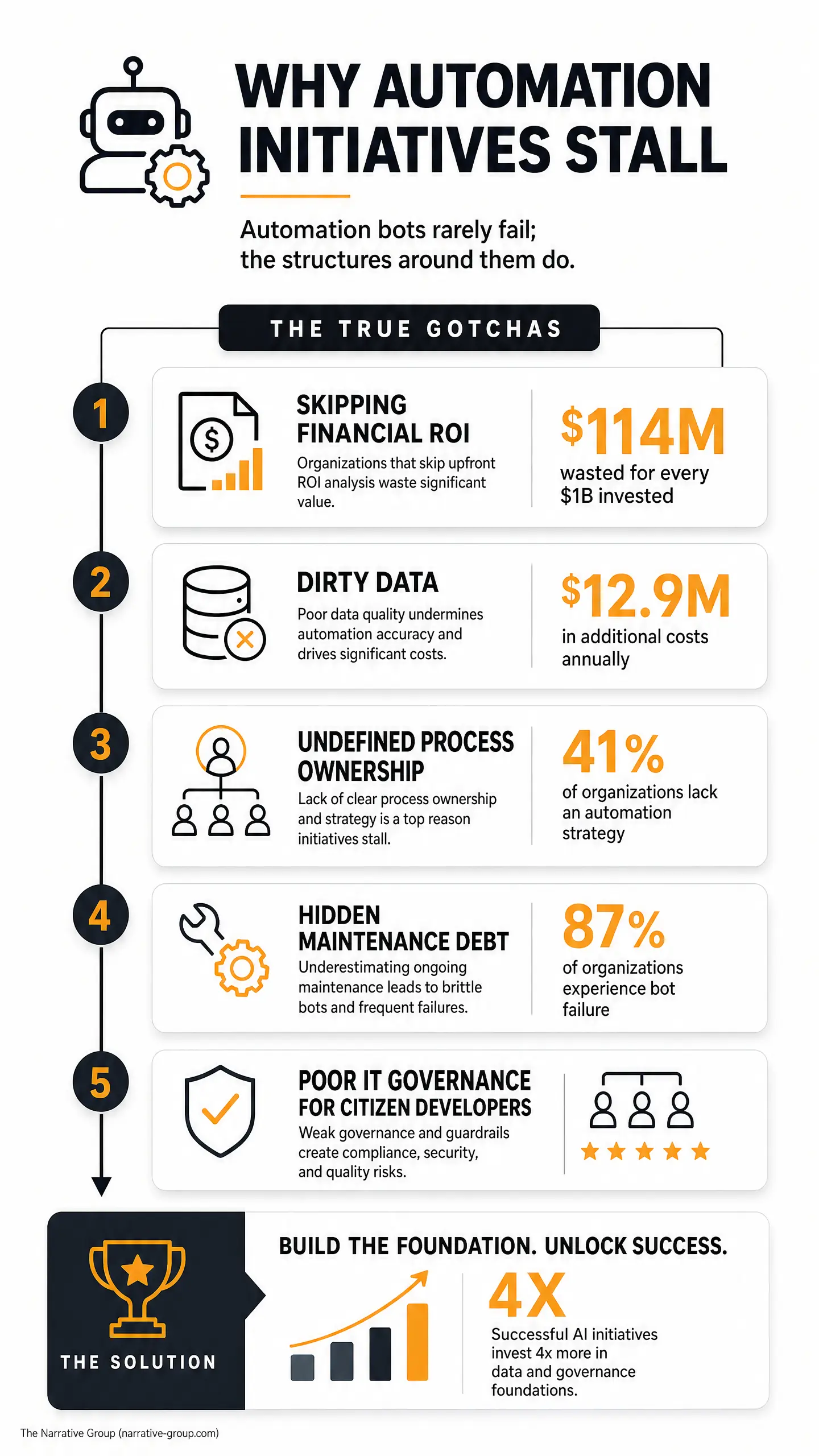
Why Is Financial ROI Measurement Crucial Before Starting IT Automation Projects?
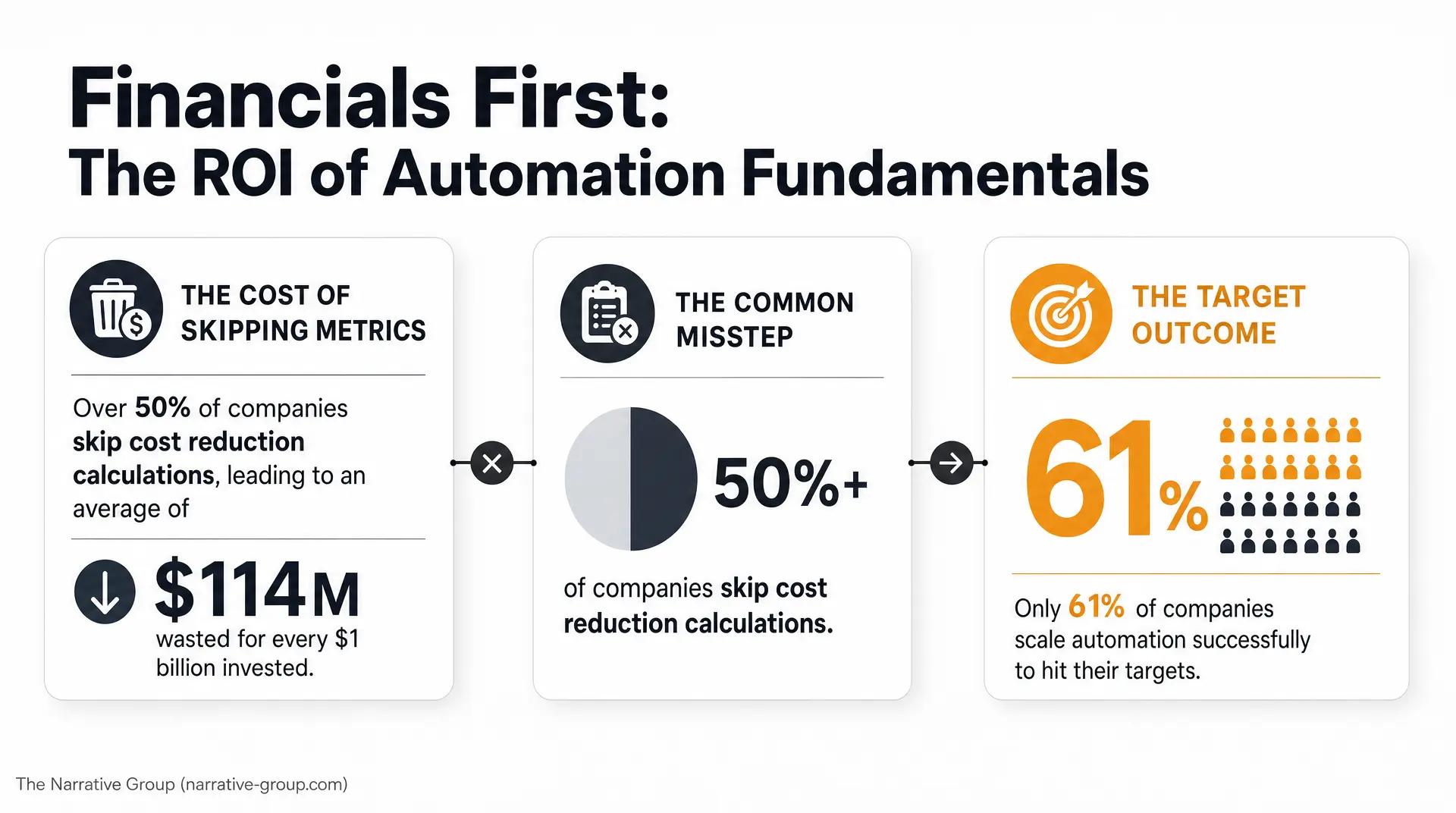
Before I touch a single process, I ask what problem we’re solving, what “good” looks like in real dollars, what we’re willing to spend, and by when. If you cannot articulate what good looks like, there’s no point starting. I mean that literally, and these are the four questions we answer before anything gets built.
Still, most companies skip it. Deloitte found that most companies running intelligent automation never calculated the cost reduction or the revenue they expected to gain. They’re spending money to save money they never measured.
That’s also how a $50,000 automation quote quietly grows past $200,000. A few changes at ten grand here, twenty there, and once the cost is sunk you’re committed. The whole mess starts the day nobody pins down the numbers up front.
This is what we call Financials First. Before we recommend anything, we look at how you actually spend on IT, where your capital goes, and how value moves through your business. Automation is an investment. It ties back to revenue, margin, or risk, or it’s a science project. And the cost of skipping that discipline is brutal. Companies waste an average of $114 million for every $1 billion invested, most of it bleeding out through poor project performance.
How Does Poor Data Quality Cause IT Automation Programs to Fail?
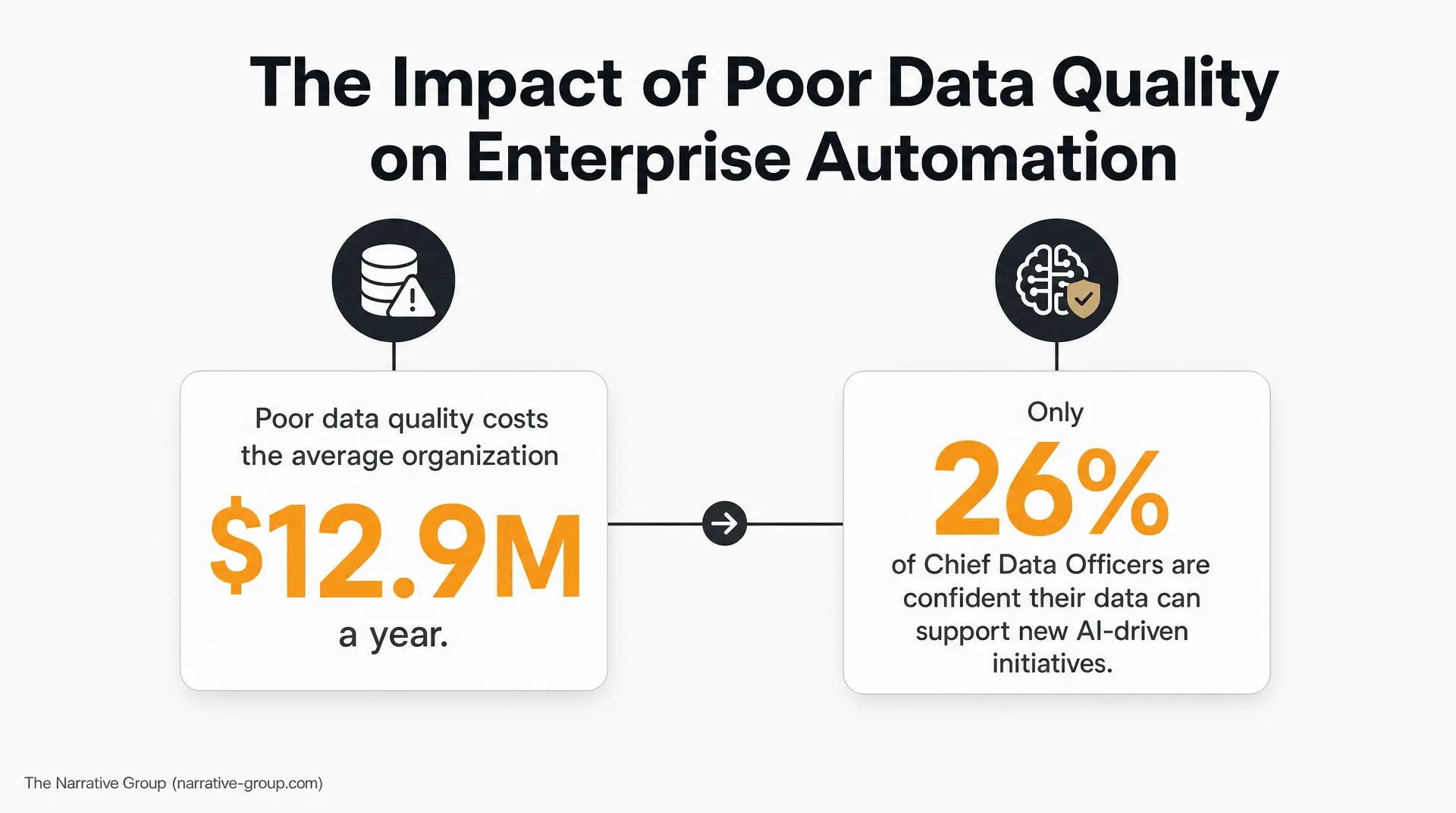
Hard rule. You cannot build a reliable bot on bad data and undefined rules. The bot does exactly what you told it, at machine speed, including all the wrong things.
So why is your data dirty in the first place? In most companies, people prefer it that way, because cleaning up the same mess every week feels like adding value. That’s a big enough subject that we gave it its own breakdown in the hidden cost of manual operations.
A bot has no judgment. It can’t guess that this vendor code really means that one. Gartner puts the cost of poor data quality at $12.9 million a year for the average organization. Most of that stays invisible until you try to scale on top of it.
Now flip it around. Get the data clean and the rules tight, and a digital worker becomes a monster. The right high-volume candidate can action tens of thousands of data corrections a day, volume no human team touches by hand, but only when the business rules underneath it are airtight.
Most leaders already sense their foundation is soft. In IBM’s 2025 survey of chief data officers, only 26% were confident their data could support new AI-driven revenue. Three out of four know the ground is shaky, and they’re chasing AI anyway.
The good news is you don’t always need a full ERP overhaul to fix it. LLMs can now contextualize master data across scattered legacy systems without a multi-year migration, which is one of the ways smart tooling buys you time before a big capital decision.
Why Does a Lack of Process Ownership Stall Enterprise Automation Initiatives?

People aren’t going to tell you where the dirty laundry is. You’ve got to go looking for it, on the floor, with the people doing the actual work. We’ve written a full field guide to identifying which processes are actually worth automating.
Spotting the waste is the easy part, though. The gotcha is ownership. If nobody owns a process end to end, automating it just makes a bad process run faster and break in more places.
The devil really is in the details. A task you swear takes 30 seconds turns out to carry 11 exceptions that live entirely in one person’s head. No bot fixes that for you. That’s a business problem, not a technology problem, and it has to be solved before the code gets written. This is the number one reason programs stall. Deloitte has named process fragmentation the top barrier to automation across four straight surveys. In the latest one, 41% of organizations had no enterprise-wide automation strategy at all.
Not sure where you stand? Take the three-minute Automation Readiness Scorecard and get a score across all five of these dimensions.
How Do Hidden Maintenance Costs and Bot Failures Impact Automation ROI?
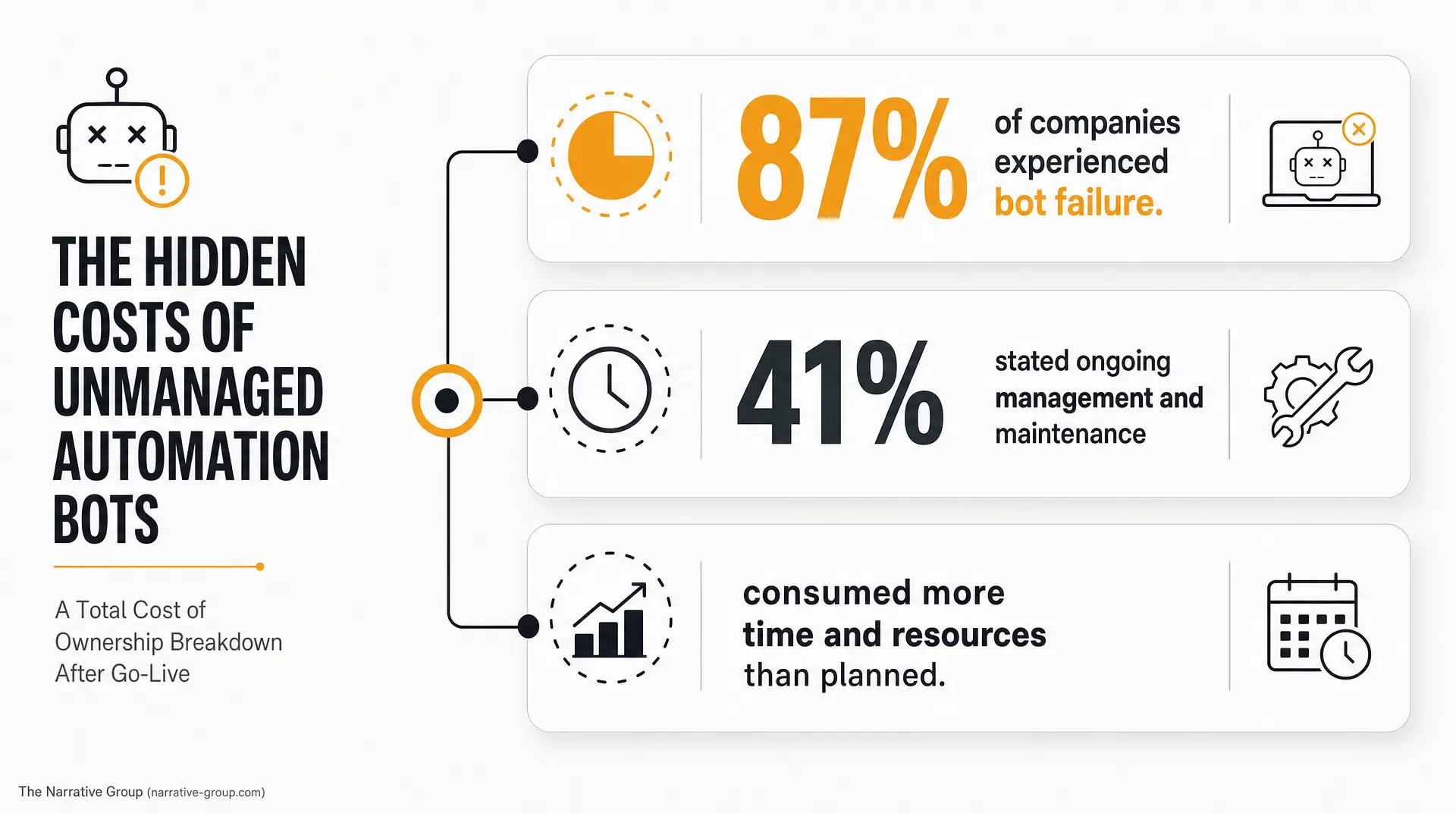
Now the broken bots. This is the gotcha that quietly murders ROI.
A bot is not a “build it and forget it” asset. You can’t build, deploy, and walk away. Websites change. Upstream systems change. A process that tested clean on Friday can die mid-run on Tuesday over something completely outside your control, and I’ve watched it happen in the middle of a multi-day financial close. That’s not a hiccup. It hits your reporting, your compliance, and your numbers. We wrote a full breakdown of why bots break and how to build ones that don’t.
The pattern is the rule, not the exception: the large majority of companies running RPA have experienced bot failure, and the ones missing their targets almost never understood the program’s total cost of ownership going in.
So I’ll say it plainly. Some bots aren’t worth keeping. We’ve pulled bots offline because the maintenance outran the capacity they freed up. A digital worker has to meet the same standard as a human worker. If it’s not earning its seat, you make the call and you shut it down.
Why Is IT Governance Necessary for Citizen Development and Low-Code Automation?

Speed is nothing without structure. I’d hang that on the wall of every company sprinting into automation right now.
When automation starts working, everyone wants more of it. Good. But ambition outruns governance, and that’s exactly where it gets dangerous. Citizen development with no governance is the Wild West: no shared standards, no reviews, no testing, and a growing pile of apps nobody remembers how to maintain. Gartner expects developers outside formal IT to make up 80% of low-code users by 2026. Without guardrails, that’s most of your automation getting built with zero oversight.
The fix isn’t slowing down. It’s building the guardrails before you hand out the keys: centralized standards, code reviews, testing, training, and hard rules about what bots are allowed to touch. One of ours: no email triggers, ever, because a bot reading an unstructured inbox is a bot waiting to make confident, expensive mistakes. We cover the full playbook, from intake standards to scaling a program without chaos, in our guide to automation governance.
Why Does Scaling Enterprise Automation Too Quickly Destroy Long-Term ROI?

Ambitious leaders make one expensive mistake again and again. They want the full return on day one.
When I built a 30-person automation Centre of Excellence, the early bots weren’t really about the savings. They set the foundation. Rush the benefits before your support structure can handle the volume and you overwhelm the team. You kill the very ROI you were chasing.
Real scale comes from a roadmap where you reuse code across the next builds, so the benefits compound instead of fragmenting. That’s how we consolidated an entire stack of disconnected systems for one client into a single governed platform, a story we tell in full in our RPA vs. low-code comparison.
Does Business Process Automation Eliminate Jobs or Increase Human Workforce Capacity?

Let me kill the biggest misconception, because it drives behavior in exactly the wrong direction and it’s often what stalls a program before it even starts.
You are not eliminating roles. You are transferring the work to a digital worker. Across 200-plus automations and more than $20 million in freed-up capacity, not one person lost their job because of what we built. The full numbers on what automation actually does to headcount are in our guide to measuring automation ROI.
Think about the 1990s Chicago Bulls. Your digital workforce is Scottie Pippen, the assist. Your human workforce is Michael Jordan, the one who puts the ball in the net. The bot doesn’t score. It sets up the person who does. Frame it that way and your team stops fearing automation and starts using it, because there’s usually fear driving the bad decisions around this stuff.
For a mid-market company squaring off against competitors 10 times your size, that’s the whole point. Automation lets you push more volume through the same space, with the same people, without blowing up your cost base.
What Foundational Investments Are Required for Enterprise AI and Automation Success?

If your automation has stalled, I’d put money on the bot not being the problem. It’s the data underneath it. The process nobody owns. The governance that never got built. The maintenance nobody budgeted for.
The companies pulling real margin out of this didn’t move the fastest. They built the structure first. Gartner found that organizations with successful AI initiatives invest up to four times more in foundations like data quality, governance, and change management than the ones with poor outcomes. The structure is the investment.
When you get it right, the numbers move. We’ve helped clients drop IT spend from 3.5% of revenue to 1.5%, shift labor from 70% of the IT budget toward 30%, and cut software costs by 40%. For context, Deloitte pegs the cross-industry average at 3.64% of revenue. We didn’t get those wins by buying more tools. We got them by fixing what sat underneath the tools.
The Narrative Group isn’t an MSP, and we’re not a tool vendor. We’re a strategic advisory firm that also executes. We’ll tell you the truth about where your money is actually going, and then we’ll build the fix.
So before you spend another dollar reviving a broken bot, start with the money. Let’s get on an alignment call and define what “good” actually looks like for your business and what it’s worth.
How ready is your business, honestly?
Fifteen questions, three minutes, instant score across the five areas where automation programs actually stall. Take the Automation Readiness Scorecard now!
Frequently Asked Questions
Do we need to upgrade our legacy ERP before launching an automation or AI initiative?
No, a multi-million-dollar ERP overhaul isn’t a prerequisite. Today, 81% of data leaders bring AI directly to their existing data. By leveraging LLMs, we can contextualize your legacy data across silos without the brutal expense of a three-year migration.
How long does it realistically take to see measurable financial returns from a new automation program?
Expect a marathon, not a sprint. While vendors promise quick wins, Pega found it takes an average of 18 months to push bots into production. Meaningful ROI requires upfront strategy and data cleansing. Rushing simply scales your hidden maintenance costs.
Which KPIs should mid-market executives track to ensure automation isn’t draining profitability?
Track total cost of ownership (TCO) and capacity hours returned. McKinsey found 55% of successful smaller companies establish strict KPIs tracking impact. Never fund a bot without a baseline metric tied directly to margin improvement or risk reduction.
How much of our annual revenue should be allocated to IT to support enterprise-grade automation?
Cross-industry IT budgets average 3.64% of revenue, but successful automation reduces this over time. By fixing process fragmentation first, we help clients drive IT spend toward 1.5%. You don’t need a massive budget. You need disciplined execution.
How can we prevent third-party vendors from locking us into escalating maintenance contracts?
Demand a Financials First approach and lock in total cost of ownership upfront. Poor project oversight wastes 11.4% of enterprise investments. Force vendors to explicitly baseline post-deployment maintenance, or you’ll pay premium hourly rates to babysit broken bots.