

A team builds a bot. They demo it. It logs in to a system, pulls the data, runs the transaction, and finishes in 10 seconds what used to take an hour out of someone’s day. The room claps. Somebody says, “game changer.” The sponsor is thrilled. Everyone goes home a hero.
Day two, the bot is dead.
Not because the code was bad. Because the world moved and the bot didn’t.
I’ve lived this exact moment. We once built a bot that pulled data off a target website. It worked beautifully on launch. After a few months of running smoothly, it stopped mid-process. The website it was using pushed a routine anti-spam update on their end. Our bot hit something it had never seen and stopped cold.
Nobody puts that part in the demo. And for a CFO, that part is the whole game. Durability is what separates an automation program from a pile of science projects, and it’s a core piece of any real intelligent automation strategy.
Key Takeaways
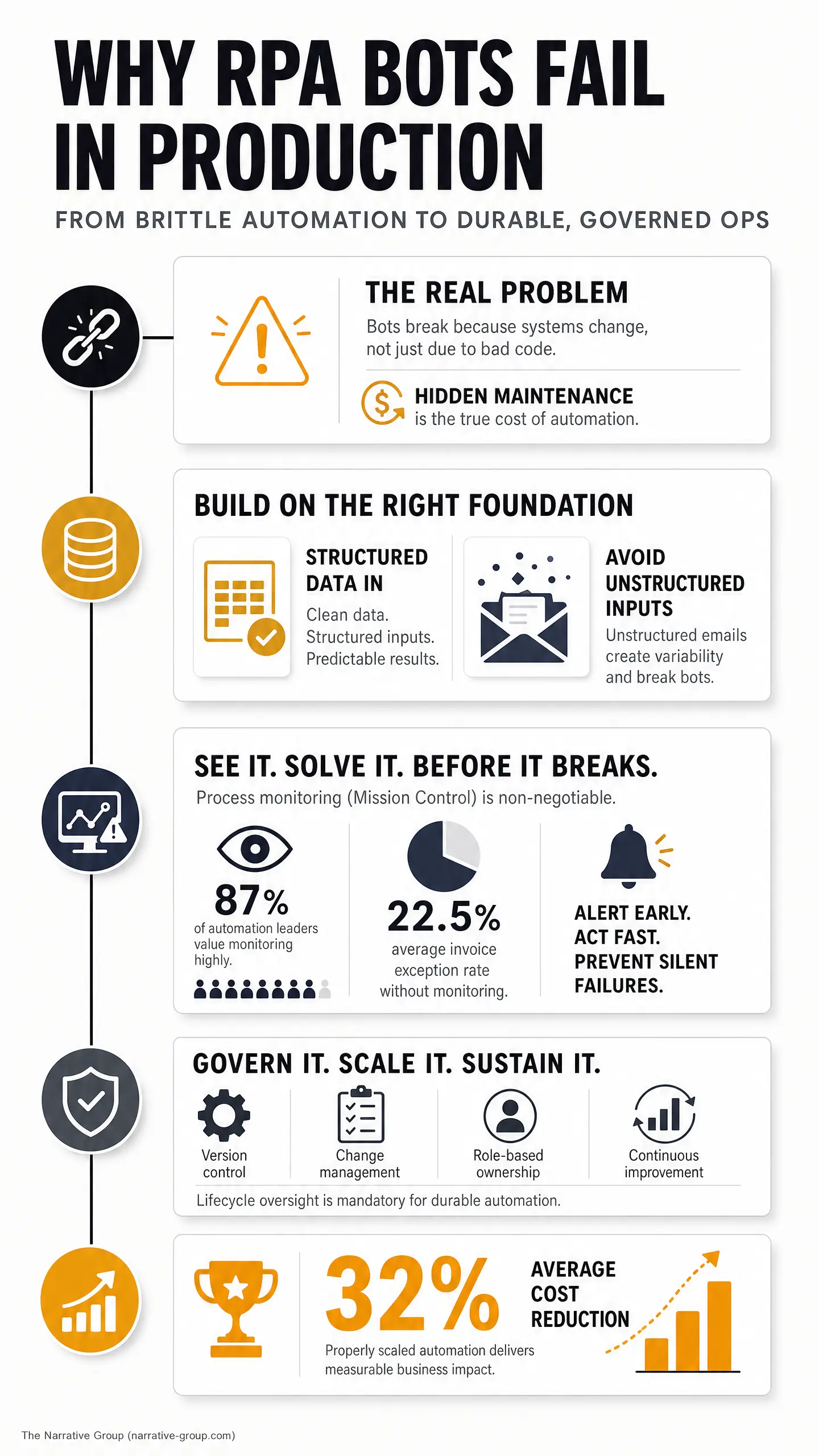
The build is the cheapest part of an automation. Maintenance, monitoring, and day-two surprises are where the real money lives, and most companies never budget for them.
Bots rarely break because of bad code. They break because a vendor changed a file format, a website redesigned a login page, or someone renamed a field two departments over.
Replacing unstructured email triggers with structured canvas apps forces data validation upstream and prevents unpredictable inputs from breaking workflows.
Directing bots to process raw email invoices creates severe maintenance liabilities, as Ardent Partners reports only 30.2% of invoices process straight through and exception rates average 22.5%.
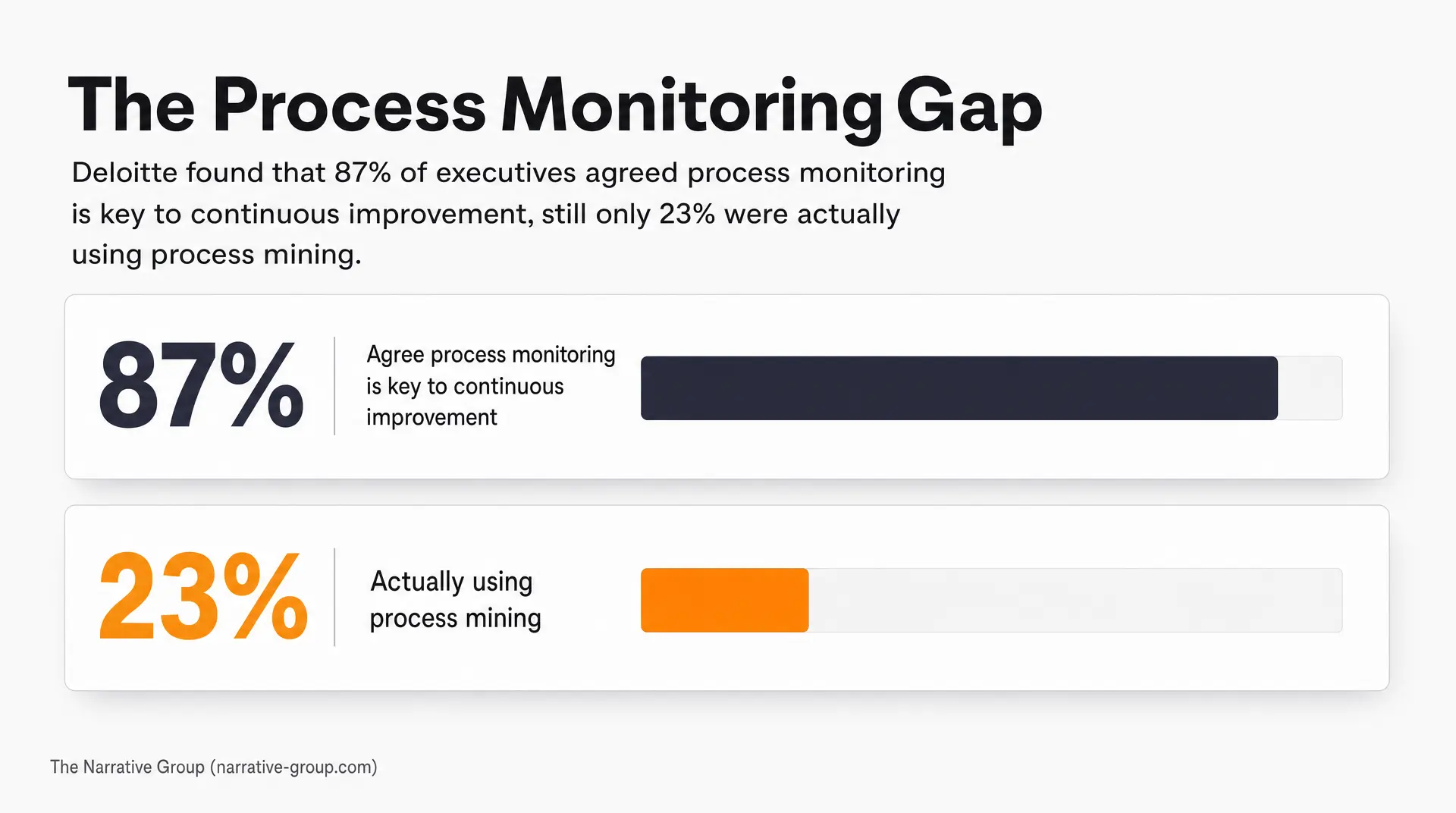
Despite 87% of executives acknowledging the importance of continuous process monitoring, only 23% actively use process mining, and only a third of federal RPA programs have management dashboards.
Federal RPA guidance mandates human approval gates for digital workers moving large sums, because the efficiency gain is never worth the liability of a bot firing wrong.
The expensive failure isn’t the bot that stops. It’s the bot that breaks quietly and keeps half-running while you make decisions on its output.
What Are the Hidden Maintenance Costs of Bot Automation?
When someone pitches you an automation, they hand you a build cost. Forty grand. Sixty grand. Whatever the number is, it feels clean. A project with a start and a finish.
The build is the cheapest part of the entire thing. Maintenance, monitoring, enhancements, and the day-two surprises are where the real money lives. You can’t just build, deploy, and forget. A bot is a digital worker, and digital workers need managing the same way human ones do.
When that website bot died, somebody had to notice. Somebody had to figure out why. Somebody had to rebuild the broken piece and test it again. That’s labor. That’s cost. And if nobody’s watching, the bot sits there failing quietly while everyone assumes the work is getting done.
Most companies never even measure any of this. They’re buying these things on faith: build, deploy, cross your fingers, never check whether the math actually worked. The measurement discipline that prevents it is in our guide to the ROI of automation.
Run that same bot against your accounts payable. Or wire it into the report your board sees every quarter. A silent failure can skew the numbers you steer the company with, and you keep making decisions on bad data without knowing it.
What keeps me up isn’t a bot breaking. Bots break. I plan for that. The expensive scenario is the bot that breaks quietly and keeps half-running. You find out three weeks later, when the variance shows up on your P&L.
What Causes RPA Bots to Break in Production Environments?
People assume bots fail because someone wrote bad code. Usually that’s not it at all.
A bot lives in a world it doesn’t control. A vendor changes a file format without telling anyone. A website redesigns its login page. Someone two departments over renames a field in a spreadsheet. A supplier sends an invoice with the date in the wrong spot. None of that is the bot’s fault. A brittle bot treats every one of those as a brick wall and stops.
The federal government learned this the hard way and wrote it down. Their RPA guidance says it plainly: if the program office doesn’t know about a change to a system the bot depends on, the automated process can break. The fix is dead simple. Coordinate with the IT system owners before anybody pushes an update. Most companies never have that conversation. The bot team and the IT team don’t even know they’re supposed to talk.
I’m an engineer, so let me put it in terms I trust. You don’t drive a car off the lot and redline it for 500 miles without checking the oil and the tire pressure. That’s exactly what companies do with automation. Build fast, deploy, never look under the hood again.
Then there’s the happy-path problem. In a demo, everything runs the happy path. Clean input, clean output, 10 seconds, applause. Production is not the happy path. Production is exceptions. The invoice with a typo. The order missing a line. The customer name with an apostrophe that breaks the lookup. A durable bot is built around the exceptions, because that’s where your real volume actually lives.
Why Do Bot Automation Projects Require Clean Data and Defined Rules?

The foundation nobody wants to deal with: you cannot automate your way out of a mess.
Real automation needs two things first, clean data and well-defined business rules. Without them, a bot just moves your garbage around faster.
And the resistance to cleaning it up is real. People quietly prefer bad data and loose governance, because fixing the errors by hand feels like adding value, and we’ve written about why that incentive is so hard to dislodge. The cost of leaving it alone is enormous, and we broke it down in why automation initiatives stall in mid-sized companies.
The people who’d build your automation are already drowning in it, too. Data professionals report spending 37.75% of their time on data prep and cleansing, more than they spend building and deploying the actual models. The cleanup is the job. The bot is the easy part.
This is also why automation projects collapse. Deloitte asked organizations chasing end-to-end automation what actually stopped them. The top three barriers: integration difficulty at 62%, missing skills at 55%, and the inability to change how people work at 52%. That last one is the killer. Technology rarely stops these projects. Habits stop them. Undocumented, broken processes stop them.
Curious how your foundation would score before you build anything? The three-minute Automation Readiness Scorecard rates your data quality and maintenance readiness alongside three other dimensions that decide whether a bot survives its first year.
Why Are Unstructured Email Triggers Unreliable for RPA Bot Workflows?
Let me give you one specific rule that’s saved me more pain than almost anything else I’ve ever done.
On my team, we had a hard rule. No email triggers. Ever.
An email is unstructured chaos. People write whatever they want, however they want, with attachments named whatever they felt like that morning. Build a bot that triggers off an email and works from whatever’s inside it, and you’ve built a machine running on garbage you can’t control. The day somebody phrases the email a little differently, your bot does the wrong thing or quits.
So we flipped the order. Before a bot touched anything, a person entered the request through a canvas app or a portal. The app forced the data into a clean, structured shape with required fields, dropdown boxes instead of free text, and validation before a single thing moved downstream. Then the bot picked up clean, predictable data and ran.
I did exactly this in my last role. We inserted canvas apps at the front of our RPA workflows to cleanse the data upfront, and it replaced the unreliable email triggers completely. We got quicker delivery, better quality data, and far less maintenance down the line. The bots stopped breaking on bad inputs because the bad inputs never reached them.
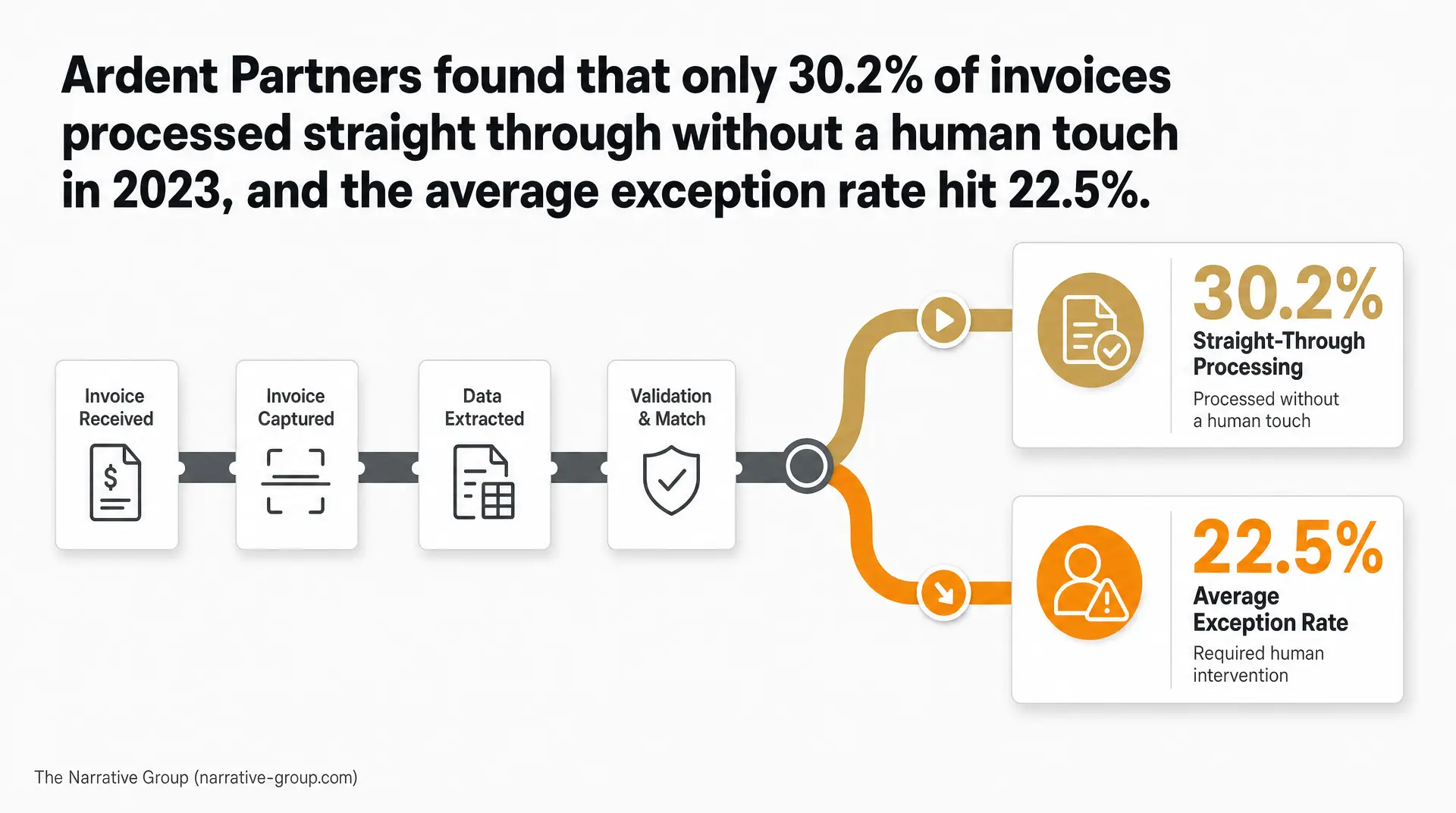
This matters even more in finance, where the exceptions are brutal. Ardent Partners found that only 30.2% of invoices processed straight through without a human touch in 2023, and the average exception rate hit 22.5%. Almost a quarter of your invoices are exceptions. Point a bot at raw email invoices with that kind of exception load, and you’ve signed up for a maintenance nightmare. Structure the intake first, and you’ve designed the failure out before it can happen.
Why Is Continuous Process Monitoring Necessary for RPA Bots?
Here’s the other mistake I see everywhere. Companies build a bot, then have no idea what it’s doing day to day. It’s a black box running in the dark. When it breaks, nobody knows until the work doesn’t show up.
You manage what you can see. So build the visibility in from the start.
In one engagement, I spent a full year building a model-driven app that ran as a command center, mission control for the whole operation. It managed the messy intersection where manual work meets the bots. It killed the email chains and replaced them with structured workflows and automated triggers. From one screen you could see what got done, what was stuck, and exactly where a human needed to step in and handle an exception.
The industry knows it needs this and still doesn’t do it. Deloitte found that 87% of executives agreed process monitoring is key to continuous improvement, and still only 23% were actually using process mining. The federal RPA programs are barely better, with only 33% running management dashboards. Everybody agrees you should watch the bots. Almost nobody builds the room to watch them from.
For a CFO, this is the part that turns automation from a gamble into a controlled asset. It stops being a bet on a black box. You’ve got eyes on the digital workforce the same way you watch the people.
Why Do RPA Bots Require Human Oversight and Lifecycle Management?

People ask me who I’d trust with a critical Friday night process, my best employee or a bot I wrote yesterday.
It’s a trick question, and my answer never changes. Whether the worker is human or digital, they meet the same standards. A new bot, like a new employee, earns the low-risk jobs first while it proves itself. A bot that’s tried, tested, and true earns the important work over time.
This reframes the whole maintenance question. You don’t onboard a person and then ignore them for three years. You review their work. You retrain them when the job changes. When something breaks, you sit down and do a deep dive: what happened, what do we fix, what do we change going forward.
Your bots need the identical treatment. And honestly, the bot is usually the easier of the two to review. It’s more accurate. It doesn’t hide its mistakes to protect its ego. A nervous employee buries a bad number and hopes nobody notices. A bot logs the error and stops.
Experience also tells you where to keep a human in the loop. The federal RPA controls guide makes this point well. When a bot can move millions or billions of dollars, you put a human approval gate in front of it. The efficiency gain isn’t worth the liability if the bot fires wrong. You match the oversight to the stakes, exactly like you would with a person.
This is why I say the one thing you should never automate is automation itself. You don’t get to build a system that spins up and deploys bots with nobody watching. The oversight is the job. Take that away and you’ve built a science project, not a workforce. The standards, reviews, and ownership rules that make this repeatable at scale are in our guide to automation governance.
What Are the Business Benefits of Durable RPA Bot Automation?
Let me bring this back to the only language the boardroom cares about.
Build automation the right way, with a clean foundation, structured intake, a command center to watch it, and real maintenance behind it, and you’re buying down risk. You lower the odds that a silent failure poisons your numbers. You drop the true cost of ownership, because a durable bot costs a fraction of what you’ll spend resurrecting a brittle one over and over.
The upside is real when it’s built right. A well-governed digital worker can process volumes no human team could touch by hand, correcting tens of thousands of data errors a day. A bot like that failing quietly means real revenue sitting on shelves nobody can order. The durability is the whole point of building it.
When the digital workforce is stable, you buy yourself the gift of time. In a tight economy, a solid automation layer squeezes more life out of your legacy systems and lets you push off the cost of replacing an ERP until you actually want to. You do more volume in the same footprint, with the same headcount.
I’ve delivered over 200 automations, and not one person lost their job because of it. We also never had a catastrophic failure. That wasn’t luck. We moved cautiously, built the guardrails, and put the safety measures in before we scaled. The boring discipline is what made the results possible.
One more number for the risk-averse executive. Automation runs on infrastructure, and infrastructure goes down. Uptime Intelligence found that 57% of major outages now cost more than $100,000, and one in five tops a million dollars. A brilliant bot on a shaky foundation is still a liability. The bot inherits every weakness in the systems underneath it.
What Are the Foundational Requirements for Starting an RPA Bot Program?

If you’re an executive sizing up automation, don’t start by asking what you can build. Start with four questions: what’s the actual problem, what does good look like in numbers, what will you spend, and by when. If you can’t articulate what good looks like, there’s no point starting at all.
Then look down, not up. Is your data clean enough to build on? Are your processes documented, or do they live in one person’s head? Can you see what a digital worker is doing once it’s live? And underneath all of it, is your IT operation stable enough to carry the load?
That last one quietly kills more automation than anything else. You can’t run reliable bots on an unreliable foundation. They inherit every flaw below them.
That’s the work we do at The Narrative Group. We start with the financials and the foundation: how much you spend on IT, how your data moves, and where the real friction sits before anyone writes a line of automation code. We build the stable base first, then put durable automation on top of it. Enterprise discipline, sized for a company your size, without the army of consultants who’d rather inflate your scope than tell you no.
If you’ve got bots dying in production, or you’re about to build some and you want them to outlast day two, start with the Automation Readiness Scorecard or book an alignment call. Bring your messiest process. We’ll tell you the truth about what it’ll really take, including the part nobody else puts on the quote.
Frequently Asked Questions
Who actually owns a bot in production – IT or the business unit?
The business unit owns the outcome, but IT owns the infrastructure. If you treat a bot like an IT science project, it fails. The business must dictate the process, while IT coordinates system updates. Federal RPA data shows 68% of successful programs use centralized governance. Without it, departments just point fingers when things break.
How do we accurately measure the true ROI of an automation project?
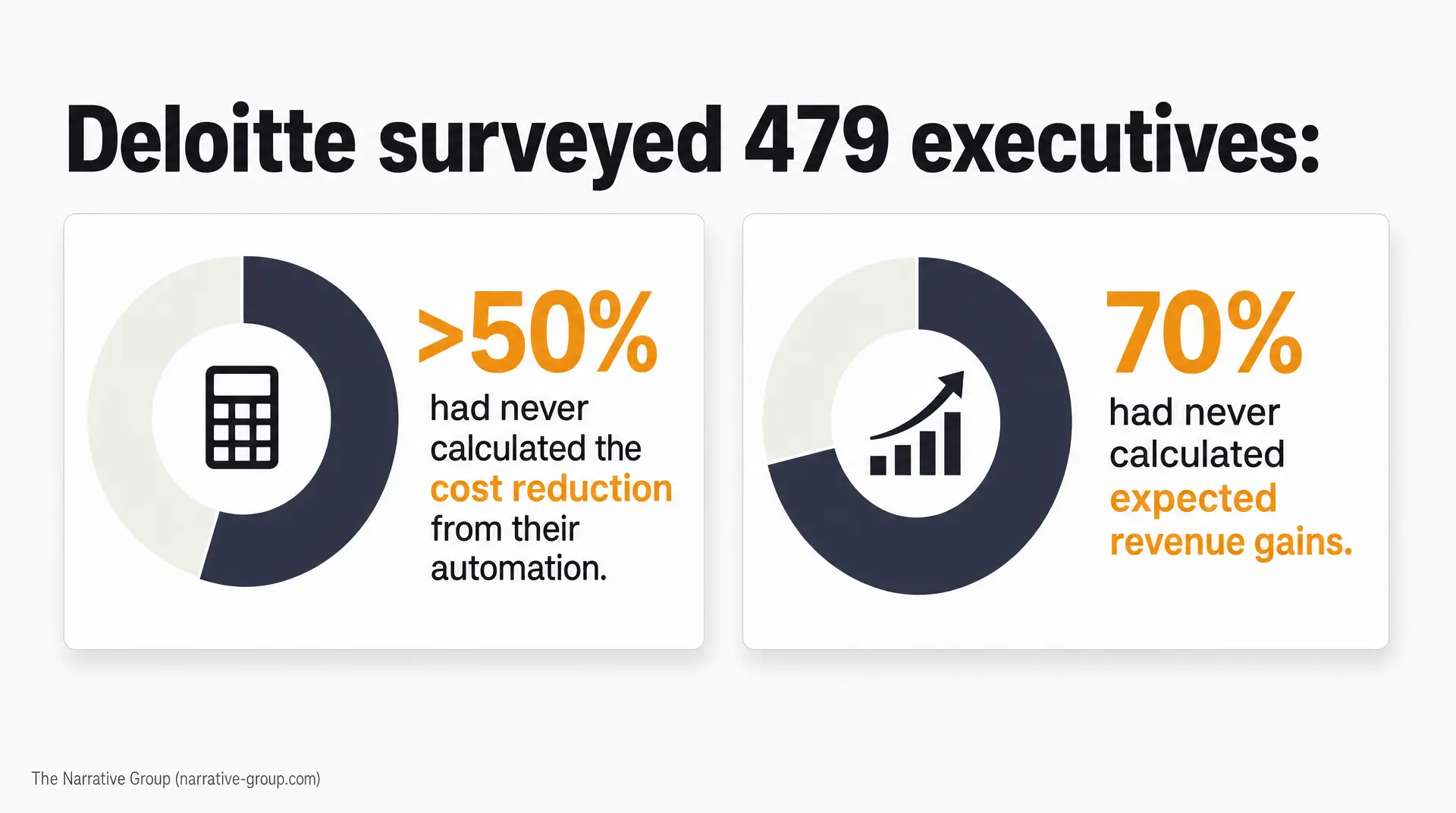
You track ongoing maintenance against actual capacity gained. Most companies fail here. Deloitte found that 70% of organizations haven’t calculated expected revenue increases from automation. Build management dashboards that track exception rates, uptime, and the exact human labor hours recovered, minus the ongoing cost to run the bot. A capacity number with no maintenance number attached isn’t an ROI figure.
How do we ensure financial automation remains audit-ready and compliant?
Treat digital workers exactly like human employees handling company funds. Implement strict error logs, standard operating procedures, and hard fail-safes. The Federal RPA controls guide warns that a single flawed bot can process tens of thousands of bad transactions. Always put human approval gates in front of any automation moving large sums of money.
How much of an automation budget should go to maintenance rather than build?
Enough that the program survives year two, which almost nobody plans for. Treat maintenance as a permanent annual line rather than a contingency, and price it before you approve the build. The companies whose programs fail almost always underestimate upkeep, not the build quote.
Should we automate legacy system workflows or wait for an ERP upgrade?
Automate the legacy system now to buy yourself time. A solid automation layer squeezes more life out of aging infrastructure, letting you delay the massive capital expense of an ERP replacement until you are strategically ready. Just ensure you aren’t automating broken processes. Clean up the data first, then let the bot do the heavy lifting.