
Most executives who call me open with the same question. “Joe, should we buy enterprise RPA, or go with something cheaper like n8n?”
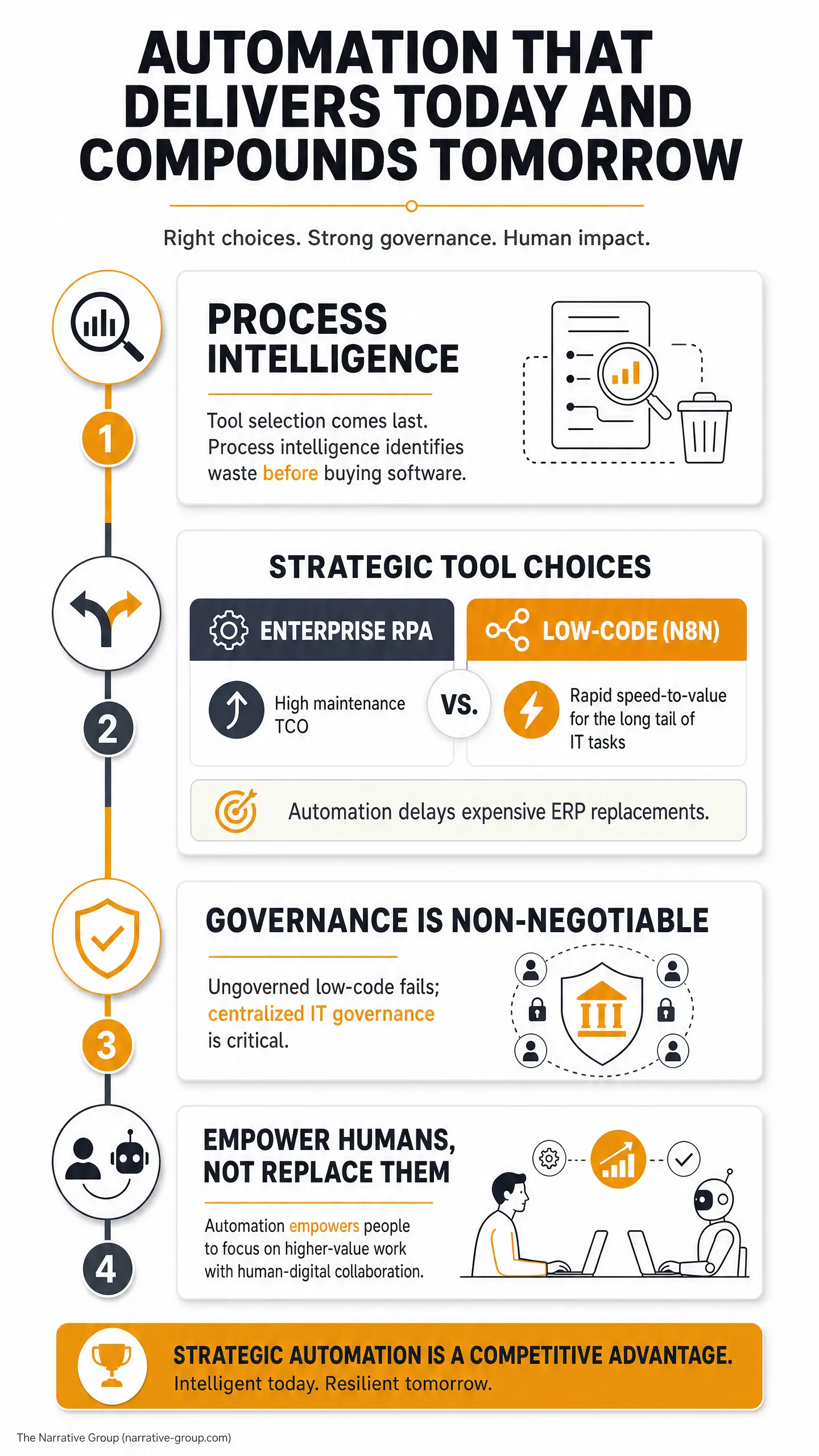
Wrong question. The tool is the last decision you make, not the first. RPA vs. low-code is a real decision, but it’s the fourth or fifth one in the sequence, not the first.
Pick the platform before you understand the work, and you’ve already lost money you’ll never see again.
I ran an intelligent automation program at Loblaw during the latter part of my career. Our team shipped over 200 automated solutions. We ran the heavy enterprise platforms, including Blue Prism and UiPath. We also ran low-code on the Power Platform.
At The Narrative Group, we now also build on n8n. I say the platform comes last because I have experience on both sides of the tool spectrum.
Here’s what a mid-market CEO or CFO actually needs to understand before signing anything.
Key Takeaways
- The platform decision is the last one you make. Understanding the work, the exceptions, and the financial target comes first, and skipping that sequence is what turns automation into sunk cost.
- Across more than 200 automated solutions, not one person lost their job. The work moved and the people moved up, which is the outcome governed automation is actually for.
- While 80% of executives recognize the value of process intelligence, only 23% analyze their operational processes to identify waste before purchasing automation software.
- The total cost of ownership for enterprise RPA platforms stems from continuous maintenance demands caused by routine target system updates rather than initial license fees. Only 46% of successful automation programs truly understood their TCO, versus 10% of everyone else.
- The n8n automation platform operates under a fair-code, source-available model rather than strict open-source, providing over 400 integrations to efficiently automate long-tail business tasks.
- Centralized IT governance for low-code citizen development programs must strictly prohibit email triggers to prevent bots from making expensive errors when interpreting unstructured inbox data.
- If you already own enterprise RPA licenses, the question is rarely rip-and-replace. It’s which workloads justify the platform you’re paying for and which should move to something lighter.
Why Do Mid-Market Companies Stall When Scaling RPA and Low-Code Automation?
This isn’t a “should we automate” conversation anymore. Deloitte found that 74% of executives were already implementing RPA, with low-code adoption jumping from 24% to 40% in a single year. McKinsey found that 70% of organizations are at least piloting automation; still fewer than 20% have actually scaled it.
They stall for one reason: somebody sold them a tool instead of an outcome.
The most expensive three words in this business are “we can do that.” A vendor whose revenue depends on your signature will rarely tell you a project shouldn’t happen, because saying no doesn’t pay.
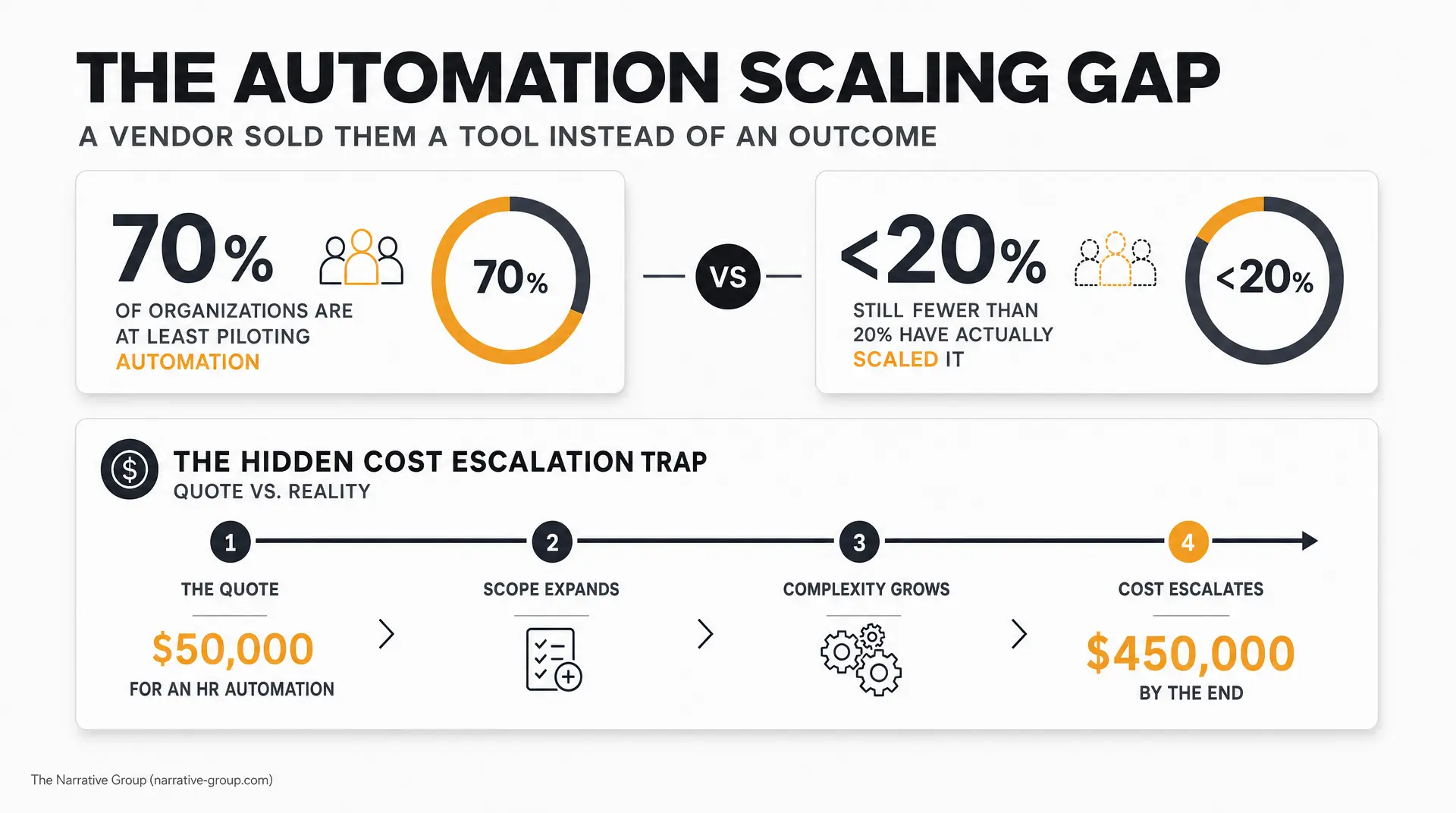
At the start, everything sounds good. Only $50,000 to automate a process that could free up the capacity of multiple full-time employees. Then the change requests come in. Ten thousand more here, twenty there. Before you know it, a $50,000 quote has quietly become $450,000, and what looked like a promising return may not even break even. Once the money is sunk, nobody wants to be the person who says we should start over.
That pattern isn’t a platform problem. It’s what happens when the work was never mapped before the tool was chosen.
How Should You Map the Work Before Buying Automation Software?

You start by finding where the money’s bleeding, not by shopping for software. Deloitte found that 80% of executives agree process intelligence helps them spot the high-value targets, but only 23% actually do that process work first. That gap is where budgets die.
Any company considering automation has come to a point in its life cycle where the math stops working. Keep the current burn rate, and you run out of road. So there’s waste somewhere, and it’s rarely where the org chart says it is. You find it by talking to the people doing the actual work, not by asking management for their version of reality. But don’t expect anyone to volunteer where the dirty laundry is. You have to know what to ask and where to look. We’ve written the full field guide to running that discovery, including the three signals that tell you a task is worth a bot.
Do that first, and the platform question mostly answers itself.
Not sure whether your business is ready to make this decision at all? The three-minute Automation Readiness Scorecard scores you across the five dimensions that determine whether any platform will pay off.
What Is the True Total Cost of Ownership for Enterprise RPA Software?

RPA, robotic process automation, is software that mimics a human at the keyboard. UiPath, Blue Prism, Automation Anywhere. The bot logs in, copies data, pastes it, hits submit. When the work is high-volume, rule-bound, and running against systems with no API to speak of, these platforms are genuinely the right answer, and they come with the orchestration, audit trails, and enterprise support that regulated environments require.
The license is the cheap part. Maintenance is what gets you.
Bots break, and they can break constantly. You can’t just build, deploy, and forget. Every time a vendor changes a screen, tweaks a login flow, or moves a button, your bot can choke.
For a large enterprise with a deep bench, that maintenance load is just another Tuesday. For a $40 million distributor with two people in IT, that same footprint can sink the program.
McKinsey found that only 46% of successful automation programs truly understood their total cost of ownership, versus 10% at everyone else. The companies that fail almost always underestimate the upkeep, not the sticker price.
So the honest way to price enterprise RPA is licenses plus infrastructure plus the human capacity to maintain it, every year, forever. Run that number before you compare anything.
n8n vs. RPA: What Are the Advantages of Low-Code?
Let me correct one thing your legal and security people will catch. n8n isn’t “open-source.” Its own documentation calls it fair-code, or source-available, with over 400 integrations, AI baked in, and the option to self-host or run in the cloud. Get that distinction right in the room.
Low-code isn’t a fringe toy, either. Gartner expects it to hit $58.2 billion by 2029. The mid-market is heading there for good reason.
The real advantage of low-code isn’t the friendly price tag. It’s speed-to-value with someone who actually knows your business. Give me a person who understands your business rules, knows your exceptions, and is technical enough to build, and I’ll deliver meaningful results faster than if you hand me a brilliant outside developer and make me teach them your business from scratch.
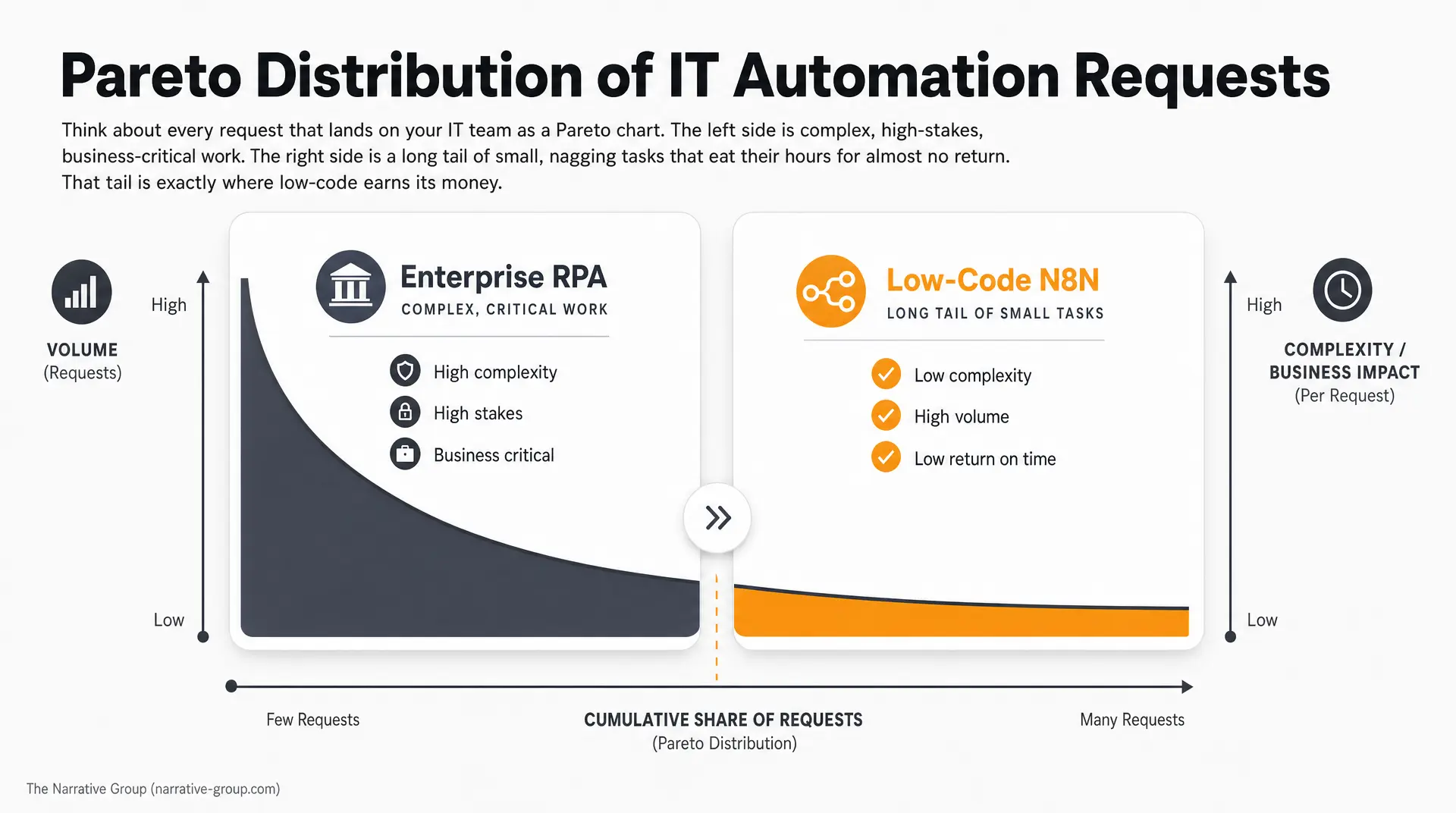
Think about every request that lands on your IT team as a distribution. On one end sits complex, high-stakes, business-critical work. That’s where your expensive, high-skilled people belong. On the other end is a long tail of small, nagging tasks that eat their hours for almost no return. That tail is exactly where low-code earns its money. Just don’t tie automating the tail to trends. Tie it to effort versus benefit.
What Are the Real Tradeoffs of Low-Code Platforms?
I’d be doing you a disservice if I only listed the upside. Low-code has real costs, they’re just different costs.
If you self-host, you own the operations. Uptime, upgrades, backups, and security patching become your responsibility, and “cheaper license” stops meaning “cheaper” the moment nobody’s minding that. Cloud hosting removes most of that burden and adds a subscription line back to your P&L.
There’s a skill floor, too. Low-code is not no-code. The simple workflows are genuinely simple, but complex logic, error handling, and custom nodes need someone comfortable with code and with APIs. Companies get burned assuming the tool eliminates the need for technical judgment. It doesn’t. It just moves where that judgment gets applied.
And the enterprise platforms have things low-code often doesn’t: mature orchestration at high volume, formal support agreements with someone to escalate to at 3 AM, and the audit and compliance tooling that regulated industries have to produce on demand. If your automations touch regulated processes or your auditors will ask questions, factor that in honestly.
In the low code vs RPA decision, low-code wins a lot of mid-market calls. It doesn’t win all of them, and a firm that tells you it always does is selling you something.
RPA vs. Low-Code: How Do You Choose?
|
Enterprise RPA (UiPath, Blue Prism, Automation Anywhere) |
Low-code / fair-code (n8n, Power Platform) |
|
|---|---|---|
|
License model |
Per-bot or per-process subscription, enterprise contracts, annual commitment |
Self-hosted or cloud subscription, substantially lower entry cost |
|
Where the money actually goes |
Ongoing maintenance and specialist skills, not the license |
Build effort and internal ops capacity if you self-host |
|
IT bench required |
Dedicated RPA skills, ideally more than one person |
One capable technical generalist can carry a lot |
|
Hosting and control |
Vendor-managed or on-prem with vendor tooling |
Full control if self-hosted, including your data |
|
Best fit |
High-volume, rule-bound work against systems with no usable API; regulated processes; screen-level interaction at scale |
Integration between systems that have APIs, long-tail workflows, data movement, AI-assisted steps, fast iteration |
|
Exit risk |
Higher: proprietary artifacts and contract lock-in |
Lower, but not zero. Map your exit before you commit |
|
Time to first value |
Longer: procurement, environments, training |
Shorter: often days to weeks |
Read that table with your own constraints in hand. Two people in IT and a stack of modern APIs point one direction. Fifty locations, a legacy green-screen system, and auditors point the other. Most mid-market companies I work with end up running both, deliberately, with clear rules about which work goes where.
What If You Already Own Enterprise RPA Licenses?
A lot of the companies I talk to aren’t choosing from scratch. They already bought enterprise RPA, they’re paying for it, and the program underdelivered. The instinct is to rip it out. That’s usually the wrong move, and it’s expensive.
Start by asking what you’re actually paying for and what it’s actually doing. If your licenses are supporting a handful of automations against systems that now have perfectly good APIs, you’re paying enterprise prices for work a lighter tool would do better. If the platform is running high-volume screen-level work that nothing else handles cleanly, it’s earning its keep and the problem is elsewhere, usually in governance or maintenance rather than the tool.
Three questions sort most of these situations out. What is the annual all-in cost per automation you’re actually running? How many of those automations could run on something lighter without loss of control? And is the reason the program stalled a platform limitation, or a foundation problem the platform can’t fix?
The honest answer in most cases is a portfolio: keep the enterprise platform for the workloads that justify it, move the long tail to low-code, and stop paying premium rates for work that doesn’t need them. That’s an expansion decision and a rationalization decision at the same time, and it’s a lot cheaper than starting over.
How to Delegate Tasks Between Digital Bots and Human Workers.

The decision comes down to fit, not to enterprise versus low-code.
Whether the worker is human or digital, they have to meet the same standards. I’d never hand a critical month-end close to a bot I built yesterday, just as I’d never hand it to an employee who started yesterday. You match the work to the experience and reliability of whoever’s doing it.
An experienced, battle-tested digital worker with a human watching for exceptions? Give it to the bot. A brand-new, untested automation going up against a seasoned employee? Give it to the human. Either way, I’m betting on the outcome, not rooting for the robot or the human.
And to answer the question every leader asks quietly: no, this isn’t a headcount play. Across 200-plus automations, not one person lost their job because of what we built. The work moved, and the people moved up. The full numbers are in our guide to the ROI of automation.
Why Does Low-Code Need Governance Before You Roll It Out?
CFOs, slow down and read this part twice.
Low-code is fast and cheap, which is exactly what makes it dangerous without rules. Letting people build automations on their own, Wild West style, is a recipe for disaster. You can’t just give them the keys to the car and say go for a Sunday drive.
The data backs the fear. A study of citizen-development programs found most organizations were juggling two to three low-code platforms, and some were running as many as six. No central architecture, no shared rules, and that’s how you wake up with six tools, 40 orphaned apps, and nobody left who remembers how any of them work.
The fix isn’t slowing down; it’s building the guardrails before you hand out the keys, and one rule I never bend is no email triggers, ever. Email is unstructured chaos, and a bot trying to read intent out of a messy inbox will make confident, expensive mistakes. The full playbook for intake standards, ownership, code review, and scaling without sprawl is in our guide to automation governance.
And never forget the one thing you should never automate: automation itself. Automate a broken process, and all you’ve built is a faster broken process, now making mistakes at machine speed.
How Does Governed Automation Reduce Operational Costs and Delay ERP Replacements?
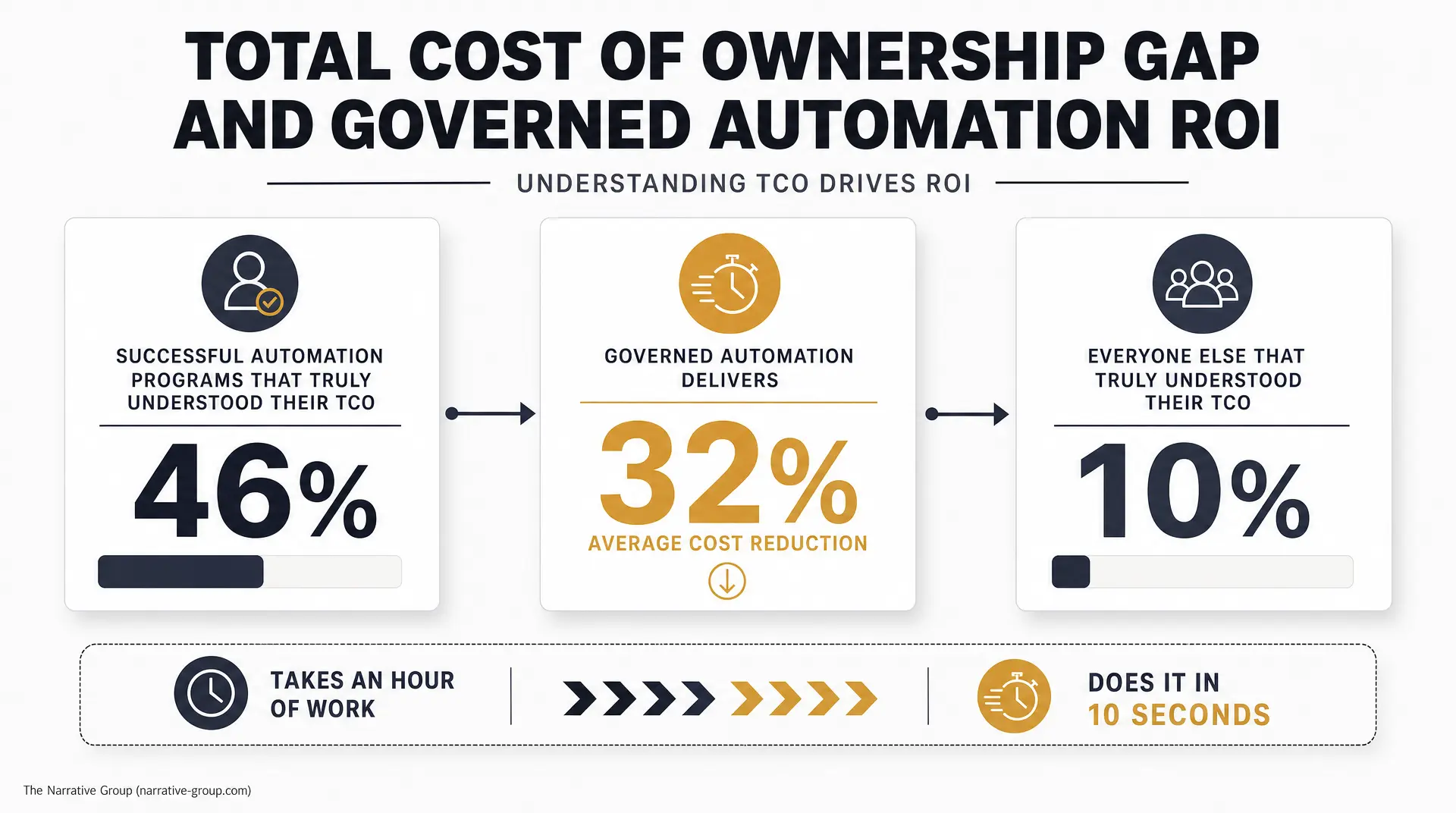
Now the part that hits your P&L directly.
People make mistakes. Mistakes cost money.
And labour is expensive – U.S. software developers carry a median wage of $133,080. When you underinvest in tooling, you don’t save a dime. You just make human labour the most expensive line on your income statement, which is the same cost-relocation trap we’ve written about in detail.
Most mid-market leaders miss the real move here. You don’t need a multimillion-dollar ERP rip-and-replace to fix inefficiency. A five-minute task in a modern ERP can take a full hour in a creaky legacy system, and that gap is precisely where a digital worker pays for itself. Wrap a governed automation layer around your old systems, and you’ve bought yourself time in a tough economy. You push the giant capital expenditure down the road until the cash flow and the timing actually make sense.
This is where platform choice gets practical rather than philosophical. Life-extension work on legacy systems is often exactly the kind of integration and data movement that low-code handles well and quickly.
What Are the First Strategic Steps to Implement Enterprise Automation in 2026?

Forget the tool for one more minute. Start with four questions. What’s the actual problem you’re solving? What does good look like, and how will you measure it in dollars? How much will you spend? And what’s the timeframe? If you can’t articulate what good looks like, there’s no point in starting.
Answer those honestly and the platform decision nearly makes itself. Enterprise RPA where the scale and complexity demand the muscle. Low-code like n8n for the long tail, where speed and cost matter most. Often both, with rules about which is which.
We recently rebuilt an entire disconnected stack for a member-based wine society on n8n, replacing a costly hosted platform and connecting their ERP, finance, and ecommerce systems. That’s proof a right-sized platform delivers real results for mid-market organizations, not just for the giants with bottomless budgets.
McKinsey found the programs that succeed are nearly four times more likely to have treated automation as a strategic priority from the start. That’s the difference between a line item and a growth engine.
We hold relationships across both ends of this spectrum, enterprise RPA platforms and low-code alike, which is exactly why we don’t need to sell you one. We’ll happily supplement the large consultancies rather than pretend we replace them.
Disclosure: Narrative Group holds partner relationships with multiple automation vendors, including n8n. We don’t take a commission on your platform choice.
If you want a straight read on where automation actually fits in your business, and which platform your situation calls for, book an alignment call. We’ll look under the hood together.
Frequently Asked Questions
How do we prevent low-code sprawl from creating new cybersecurity vulnerabilities?
Centralized architecture is non-negotiable. A recent study showed organizations juggle multiple low-code platforms simultaneously. If you let business units deploy without IT guardrails, you’re inviting breaches. Establish strict governance and mandatory security reviews before a single digital worker goes live.
What is a realistic timeline for realizing intelligent automation cost reductions?
Don’t expect an overnight miracle. Targeted pilots deliver fast operational wins, but enterprise-wide financial impact takes time, and organizations scaling intelligent automation report meaningful cost reduction over a multi-year horizon. The timeline depends entirely on upfront process mapping and avoiding the trap of automating broken workflows.
How do we move from automation pilots to full-scale deployment?
You stop treating it as an IT experiment. While 70% of companies pilot automation, under 20% scale it, and the most common reason is the absence of an enterprise-wide strategy. To cross that chasm, align your automation initiatives directly with boardroom priorities and operational P&L goals.
Should our IT department exclusively own the automation pipeline?
No, but they must govern it. Operations should identify where the cash is bleeding while IT enforces the guardrails. Successful scaling requires shared ownership. If IT dictates everything, you lose speed-to-value. If operations runs wild, you get orphaned apps. Build a centralized function that bridges both sides.
Are we exposed to vendor lock-in if we adopt commercial low-code tools?
Yes, if you don’t map your exit strategy early. Commercial lock-in is real, which is why source-available options like n8n are attractive, though self-hosting trades license risk for operational responsibility. Either way, enforce cost governance early, because unmonitored automation drives cloud consumption in ways that surface late on the P&L.