
Most companies do not call me because they want another technology opinion. They call when the spending is up, the systems are messy, and leadership can feel the risk building. The internal IT team is working hard, but the business still does not feel supported.
I founded The Narrative Group because I got tired of hearing people talk about “the business” and “IT” like they were two different companies. They are not. Every company on the planet is here to make money. Period. Technology should help that happen.
I’ve spent more than 20 years in enterprise technology, including leadership roles at PwC, Boehringer Ingelheim, Shoppers Drug Mart, and Loblaw. A lot of mid-market companies need that level of thinking, but they do not need a full-time CTO still. The U.S. Bureau of Labor Statistics puts the median annual wage for computer and information systems managers at $171,200. For many businesses in the $20 million to $100 million range, fractional leadership is the practical move.
My starting point is always the same. How do you actually make money? Follow the money. Look at the value chain. Then look at the people, the processes, and the technology around it. Once you do that, the gaps usually become pretty obvious.
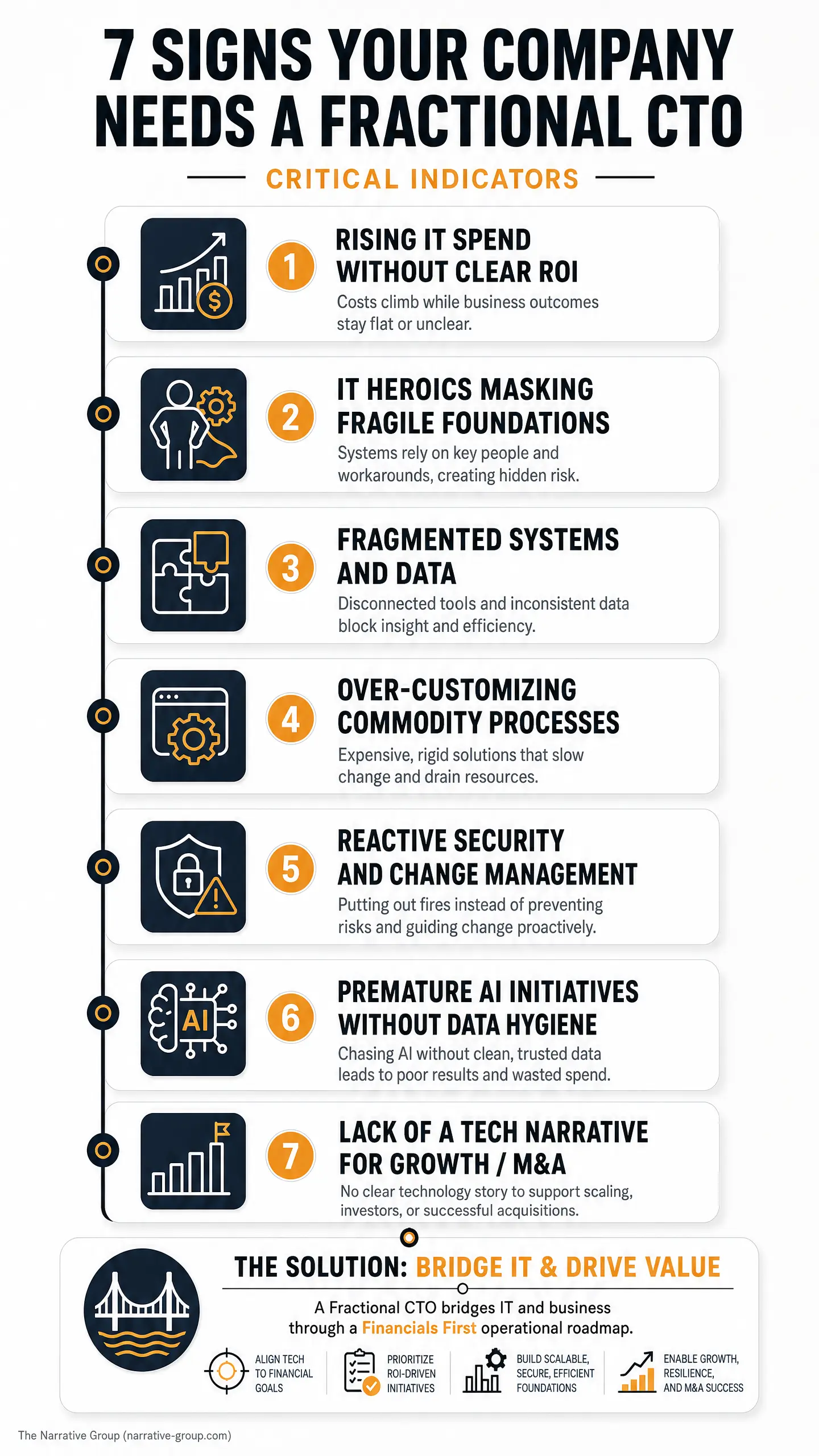
Here are seven signs your company is ready for a fractional CTO.
Key Takeaways
- A fractional CTO is often the right fit when technology decisions have become too important to manage informally, but the company is not ready for a full-time CTO.
- Mid-market businesses generating $20 million to $100 million in revenue can use fractional CTO leadership to access executive-level judgment without carrying the fixed cost of a full-time technology executive.
- Since 57% of technology budgets typically go toward basic operations, fractional technology leadership can help separate foundational infrastructure costs from business enablement investments.
- With only 2% of IT leaders successfully integrating more than half of their applications, fractional CTOs can map end-to-end data flows to eliminate duplicate entry and broken workflows.
- The strongest signal is not “we have technology problems.” The strongest signal is “technology decisions are affecting margin, capacity, risk, or growth, and nobody owns the executive-level roadmap.”
- A fractional CTO can manage execution risk during acquisitions, financing, modernization, and rapid scaling.
1. Your IT Spend Keeps Rising, but Nobody Can Clearly Explain the Return
If your annual IT review feels like a pile of invoices, renewals, contractors, and surprise spend, you have a visibility problem. And if the board asks what the business got for that money and the answer is fuzzy, you have a leadership problem.
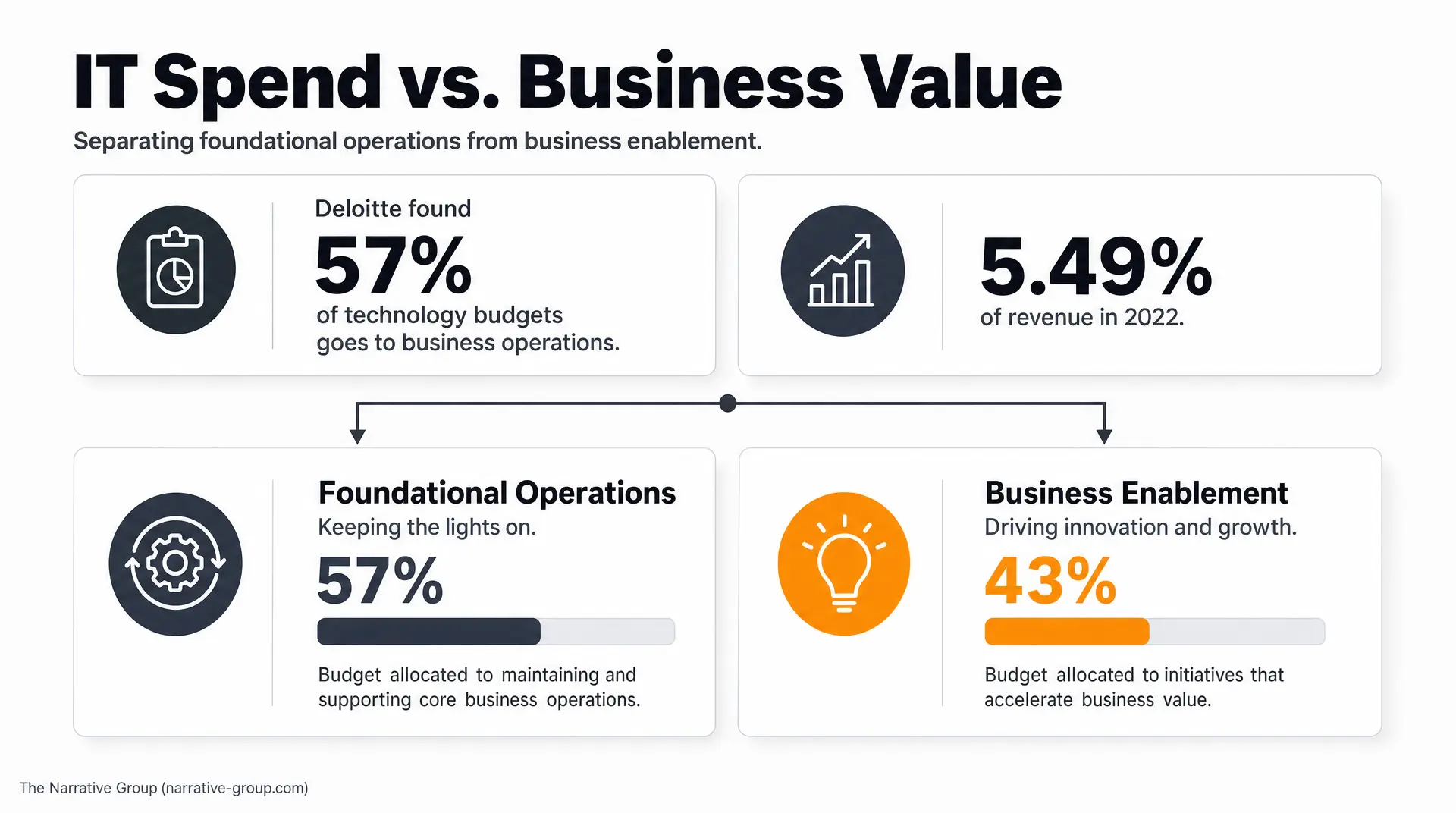
Deloitte put average technology spending at 5.49% of revenue in 2022. That makes IT spend a board-level number. It is no longer some back-office line item that only finance and the IT manager worry about.
The same research found 57% of technology budgets still goes to business operations. That tells you something important. Most of the money is tied up in keeping the lights on.
This is why I say IT is effectively two departments. One part is the boring foundational layer. Infrastructure. Devices. Core security. Service quality. The other part is business enablement. Workflow. Data. Automation. Customer experience. If you do not separate those two things in your thinking, you end up overpaying for the basics and underinvesting where value gets created.
I also see companies try to optimize spend by cutting licenses or choosing the cheapest provider. It feels smart for about five minutes. Then the work shifts into manual labor. People start doing by hand what the system should have done. That slows innovation. It creates friction. It traps the culture in old patterns.
Weak visibility creates cost in other ways too. Flexera found 45% of organizations paid more than $1 million in software audit expenses over a three-year period. That is what happens when nobody really knows what they own, what they use, or what risk sits in the stack.
A fractional CTO brings a Financials First lens to all of this. What are you spending against revenue? How much of that spend protects the foundation? How much improves productivity? Where is labor compensating for weak systems? What gets measured gets managed.
The goal is not simply to cut IT spend. The goal is to make technology spend explainable, defensible, and connected to business performance.
2. Your IT Team Gets Praised for Heroics, and the Business Still Feels Fragile

If you find yourself applauding the 2 AM rescue, pause for a second. Ask the harder question. Why did the server crash at 2 AM in the first place?
I care about KPIs that show business value. I care about uptime, service quality, productivity, and risk reduction. A constant firefighting culture tells me the foundation is weak and the business is paying for it every day.
The pattern is usually predictable. Hardware ages. Incidents rise. People lose confidence. Service slows down. End users get frustrated. Employee engagement drops. It becomes a spiral. I have seen that in big companies and small ones.
Uptime Institute found 54% of serious outages cost more than $100,000. It also found four in five serious outages could have been prevented with better management, process, and configuration. Those are not help desk issues. Those are leadership and governance issues.
One client came to us with six offices. Their people moved between locations and could not reliably connect to the network. The meeting rooms barely worked. Every request seemed to get blocked in the name of security. The technology was letting them down.
So we started with the boring foundational functions. We replaced core switches and network gear. We retired outdated servers. We put devices on a lifecycle plan. We improved the meeting rooms and made sure people understood how to use them. We built credibility by fixing what was in the way.
Three years later, the managing director told me I had created a problem. Everybody wanted the rest of the offices to look exactly like the new one because it worked that well. That is the outcome you want. IT should not be in your way. IT is intended to be an enabler, not a blocker.
If your technology team is always rescuing the business, but never getting the environment stable enough to support growth, you probably do not just need more tickets closed. You need stronger executive technology leadership.
3. Your Systems, Data, and Vendors Are Fragmented
If one customer transaction requires five systems, three spreadsheets, and a few apologetic emails, your business has an operating model problem. The technology stack is just where it shows up.
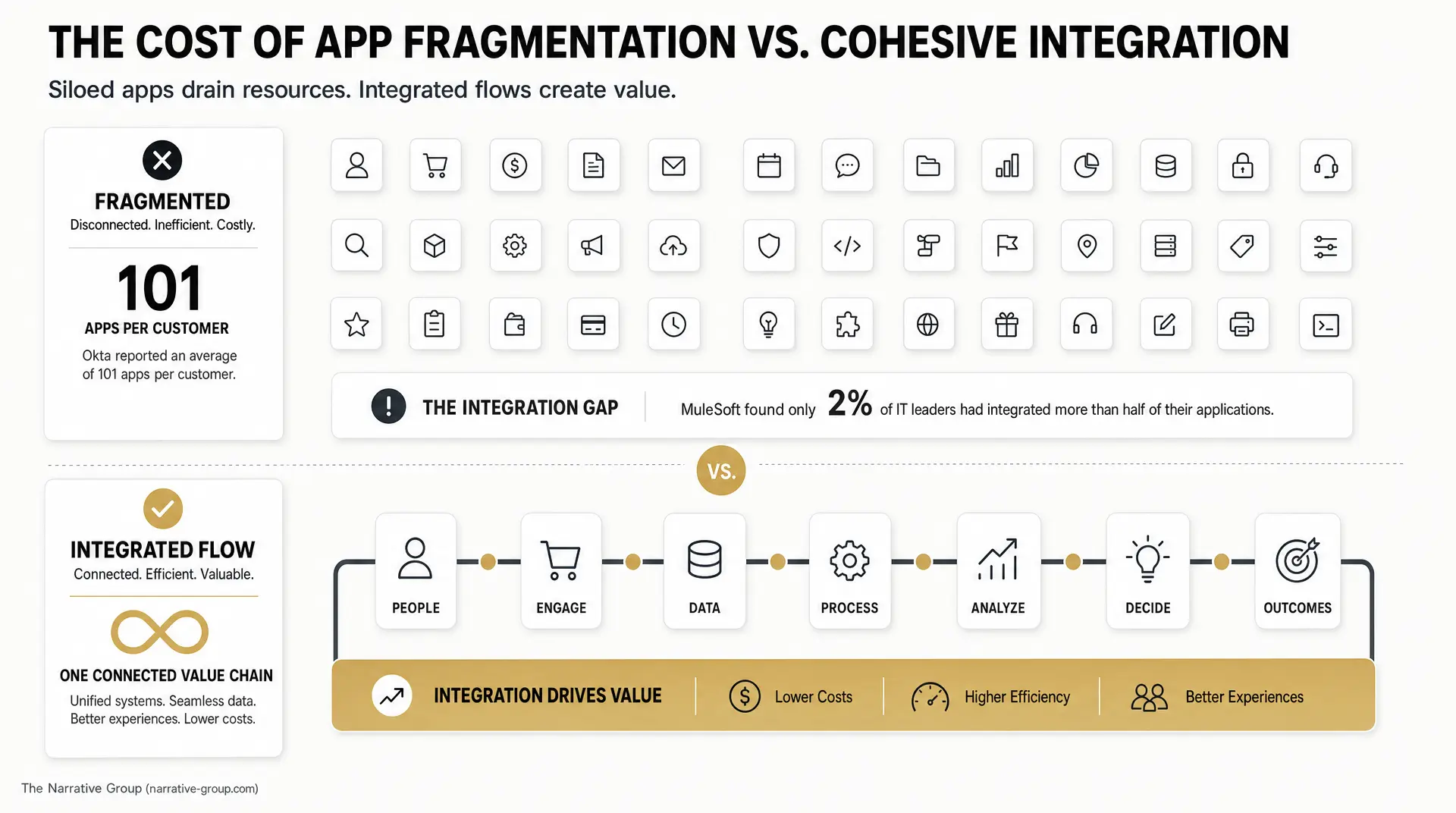
Okta reported an average of 101 apps per customer in 2024. That is a lot of handoffs. MuleSoft found only 2% of IT leaders said they had integrated more than half of their applications.
That is why so many companies live with duplicate entry, mismatched reports, slow closes, broken workflows, and vendors blaming one another.
The business feels the friction long before leadership sees the root cause.
When I walk into that kind of situation, I go back to the business model. How are you fulfilling? Where does the data originate? Who talks to whom? How often?
Draw it out. The picture tells a thousand words.
The frustration usually lands in one of two places. Either role definition is unclear, or the technology is not doing what the company is asking it to do. Both point to the same issue: the technical architecture is in conflict with the value chain.
A fractional CTO gives one person ownership of that end-to-end picture. That means mapping the flows, making the business rules explicit, and forcing the vendor landscape to line up behind a business outcome.
When the architecture is vague, accountability becomes vague. And when accountability is vague, cost and risk spread quietly across the business.
4. Every Major Project Turns Into a Debate About How “Unique” Your Business Is

I hear this all the time: “Our process is different.”
Maybe. Sometimes it is. Most of the time, 95% of the process is the same as everyone else’s and one small area drives the actual differentiation.
You need to specifically and ruthlessly figure out where exactly you are different. If you do not do that, you end up customizing commodity processes. That creates cost. It creates maintenance. It creates security headaches. And later, it creates scale problems.
This is where I want the CFO to be strong. The CEO may have an ego about the business being unique. Fine. Somebody has to talk that down when the company is paying premium dollars for software that should be standard.
For common processes, I want vanilla software. Mainstream, not leading edge, not bleeding edge.
Standardization drives out cost. Standardization drives up productivity. Standardization drives out friction.
I have also seen companies rely on cheap custom tools, temporary contractors, or students to build something “good enough for now.” That becomes a ticking time bomb as the company scales. It may look inexpensive in year one. By year three, it is slowing upgrades, complicating security, and forcing expensive rework.
A fractional CTO protects the business from that trap. The job is to separate real competitive advantage from expensive mythology and keep the company current.
If every project becomes an argument for customization, you need someone at the table who can separate business differentiation from technical indulgence.
5. Security and Change Management Are Reactive

If security only gets attention after an incident, you are exposed. If security gets used as the reason nothing can move, you are also exposed. Both situations point to weak governance.
IBM put the average cost of a data breach at $4.4 million. Verizon says 31% of breaches start with software vulnerabilities. It also says 48% involve ransomware. That is the real price of weak hygiene and slow governance.
I am not a fan of security theatre. We need to protect people. Even when they do not want to be protected, we need to do that. But we also need the business to move. Security has to be built in. It has to be practical. It has to support execution.
Change management is part of the same problem. When business rules are underdefined and production changes are loose, bad things happen. Projects derail. Outages multiply. Trust erodes. Then the board starts asking why every “small” change turns into a mess.
This starts at the top of the house. Prosci found that projects with extremely effective sponsors were 79% likely to meet objectives. Leadership ownership matters. Consultants can support the change. They cannot own it for you.
A fractional CTO helps executives see the trade-offs clearly. Then they help the business put real governance in place, make the decision, and follow through.
The goal is not to make security louder. The goal is to make security, change, and business execution work together.
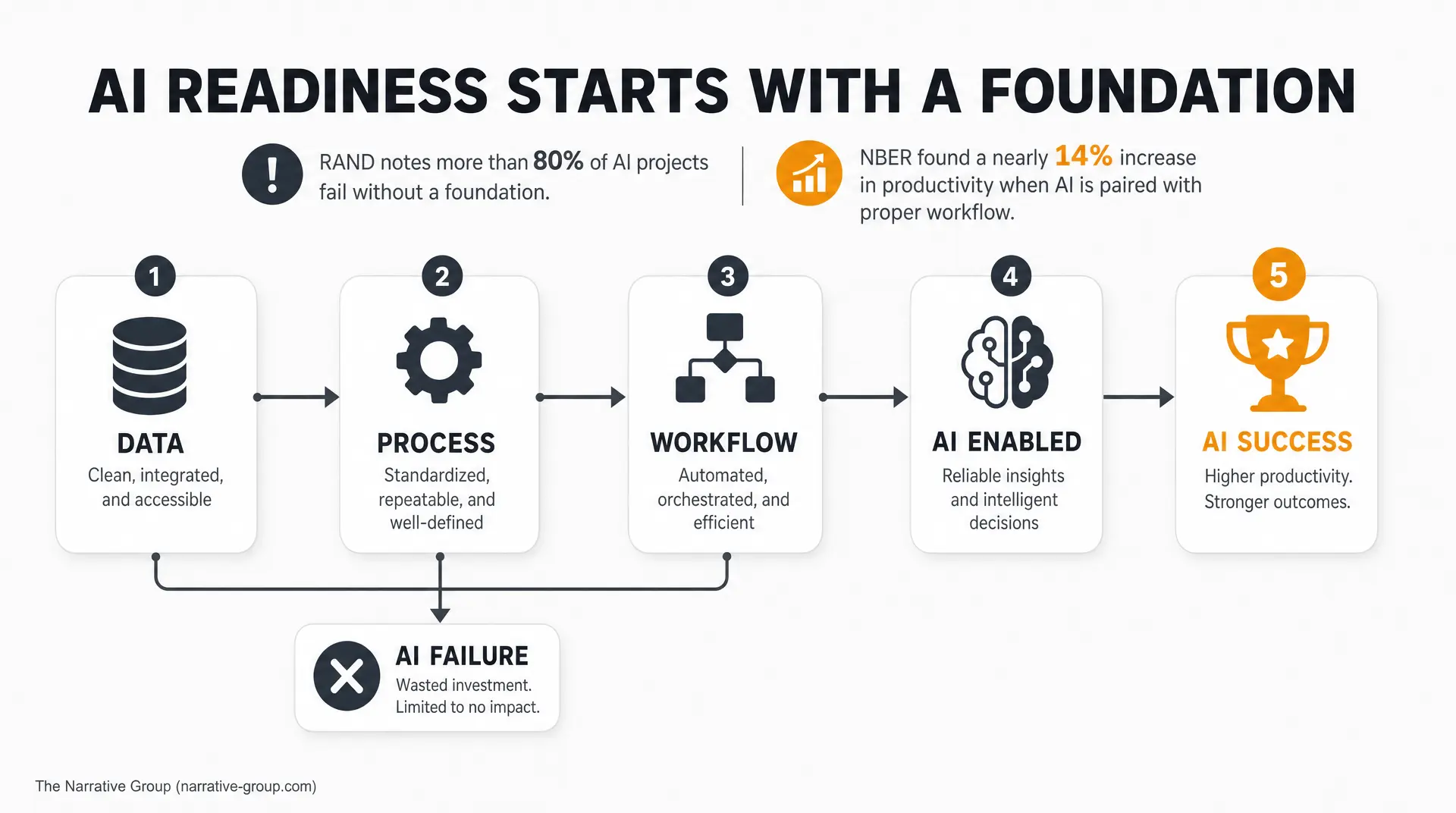
6. You Are Talking About AI Before You Have Fixed Process, Data, and Workflow
I am optimistic about AI. I am also very cautious about the nonsense around it.
AI can help with long-running workflows. It can improve quality of data. It can help level the playing field for mid-market companies going up against larger competitors with more people and more capital. But you cannot build artificial intelligence on a shaky foundation.
RAND notes that more than 80% of AI projects fail by some estimates. MuleSoft found 81% of respondents identified data integration as a major challenge in AI-related systems work. The same report found 41% said old architecture hindered AI.
That lines up with what I see. If your data is weak and your process is fuzzy, AI will amplify the mess. You cannot just codify broken business processes. And AI, left on its own, can produce confident answers without reliable business context. It needs a set of eyes to make sure the output is useful, accurate, and human-consumable.
Start with a better question: Where can AI create capacity? Where can it remove tedious, detail-heavy work? Where can it improve productivity without losing control?
We did exactly that with an e-commerce client. Their product setup cycle took five weeks. One person could spend up to three weeks doing the setup work. With AI and workflow automation, we cut that task down to four hours. That is the kind of leverage that matters.
The wider research backs it up. An NBER working paper found a nearly nearly 14% increase in productivity when customer support agents used an AI assistant.
That is how I frame AI with executives. The people plus the AI is what really makes it special. You build capacity. You improve quality. You slow the rate of hiring. You give the business room to grow.
If AI is being discussed before process ownership, data quality, and governance are clear, your company does not need more AI enthusiasm. It needs executive technology discipline.
7. Growth, Financing, or Acquisition Is Coming, and Nobody Owns the Technology Narrative

This is the point where technology stops being an operating issue and becomes an enterprise value issue.
If you are preparing for a financing, integrating an acquisition, dealing with private equity scrutiny, or trying to scale fast, somebody has to own the technology narrative. What is stable? What is fragile? What is commodity? What actually drives differentiation? How does the roadmap support growth? Where is the risk sitting?
Bain found only about 9% of buyouts get comprehensive technology due diligence. That does not make the technology risk smaller. It just means a lot of buyers still do not see clearly into what they are buying.
And the execution risk is real. McKinsey found large IT projects run 45% over budget on average. It also found they deliver 56% less value than predicted. That is what happens when business-value governance is weak.
This is one of the big reasons I built The Narrative Group. I wanted to make top-tier enterprise advice accessible to small and midsize businesses. In moments like these, a fractional CTO gives you board-ready clarity, executive discipline, and a phased path forward.
If leadership cannot explain the technology story clearly to a board, buyer, lender, or investor, the company is carrying avoidable enterprise value risk.
What I Do First When I Come In
Start with Financials First
I split the analysis into two parts. First, the primary value chain. How do you make money, and how productive is that engine? Second, the supporting functions. How much labor and technology are being used there, and are those areas scaling cleanly or just adding cost?
I want to see spend against revenue, downtime against productivity, IT labor against non-labor, and the foundational cost to operate. Follow the money first. The patterns show up fast.
Go See the Business
Then I go look at the real work. Show me the day in the life. Show me where the technology is letting you down. Show me where the process gets stuck.
Front-line frustration is useful. People may vent. Fine. At the end of the day, they usually want the problem solved. And they are often the best source of truth.
Build the Roadmap and Stay in the Trenches
From there, I organize the work into a few themes. Quick wins first. Bigger moves next. Pilot where we can. Real-world experience matters more than slideware.
For smaller mid-market businesses, my team can even function as the IT department while we stabilize the environment. We fix the foundation, build trust, and then move up into business process improvement. Talk is cheap. Actions speak volumes.
The operating change has to show up in measurable results.
Final Thought
I believe innovation is making the operation of a business model elegant. That is what a good fractional CTO helps you do.
If even two or three of these signs sound familiar, do not wait for the next outage, failed audit, missed quarter, or stalled project. Start with the business. Ask how you actually make money. Then line up your people, your processes, and your technology behind that answer.
The more friction you take out, everybody wins.
Need Help Deciding Whether Fractional CTO Leadership Makes Sense?
If two or three of these signs sound familiar, the question is not whether you have technology issues. The question is whether those issues now require executive technology leadership.
Narrative Group provides fractional CTO services built around Financials First: connecting technology decisions to revenue, margin, productivity, risk reduction, and enterprise value.
Explore Fractional CTO Services or book a 15-minute discovery call.
Still sorting through competing technology requests? Start with the IT Investment Prioritization Scorecard.
Fractional CTO Series
- What Is a Fractional CTO – and When Does Your Business Need One?
- Fractional CTO vs Full-Time CTO: Which Is Right for Your Business?
- How Much Does a Fractional CTO Cost? A Mid-Market Pricing Guide
- 7 Signs Your Mid-Sized Company Needs a Fractional CTO
- How a Fractional CTO Prepares a Mid-Sized Company for Acquisition
Frequently Asked Questions
Does a fractional CTO replace our Managed Service Provider (MSP)?
No. A fractional CTO manages your MSP, holding them accountable to business outcomes. MSPs handle the foundation – keeping the lights on and patching servers. I step in to ensure that foundation aligns with your value chain, removing friction and stopping vendor sprawl before it drains your budget.
How should a CFO measure the ROI of a fractional IT leader?
Look at where your money goes. Deloitte found 57% of tech budgets get trapped in routine operations. ROI is measured by reduced manual labor, consolidated vendor costs, and increased capacity.
Can a fractional CTO salvage a failing enterprise software implementation?
Yes, by forcing executive discipline. McKinsey reports large IT projects run 45% over budget. They fail due to weak business-value governance. I step in to strip away expensive customizations, realign architecture with core processes, and rescue the ROI.
How does a fractional CTO prepare a mid-market company for private equity scrutiny?
We build a defensible narrative. Bain found only 9% of buyouts get comprehensive tech due diligence. Smart buyers will look hard at your stack. I ensure your data is clean, systems scale cleanly, and security hygiene is fully audit-ready.
When does a mid-market business outgrow a fractional CTO?
You need a full-time hire when technology becomes your actual product. The median wage for an IT manager is $171,200. Until your scale justifies that fixed overhead, fractional leadership delivers executive strategic clarity without the bloat.