

If you run a mid-market company, you already have an IT maturity model. You just may not call it that.
It shows up in the work. Sales leaders see one number. Finance leaders see another. Operations keeps a spreadsheet on the side because nobody fully trusts the systems. People get used to the friction. Then growth shows up and exposes all of it.
Most executives do not need more jargon. They need clarity. They need to know whether technology is helping the business grow, or quietly getting in the way. That is the mid-market reality. You are making enterprise-level risk and investment decisions without an enterprise-sized bench.
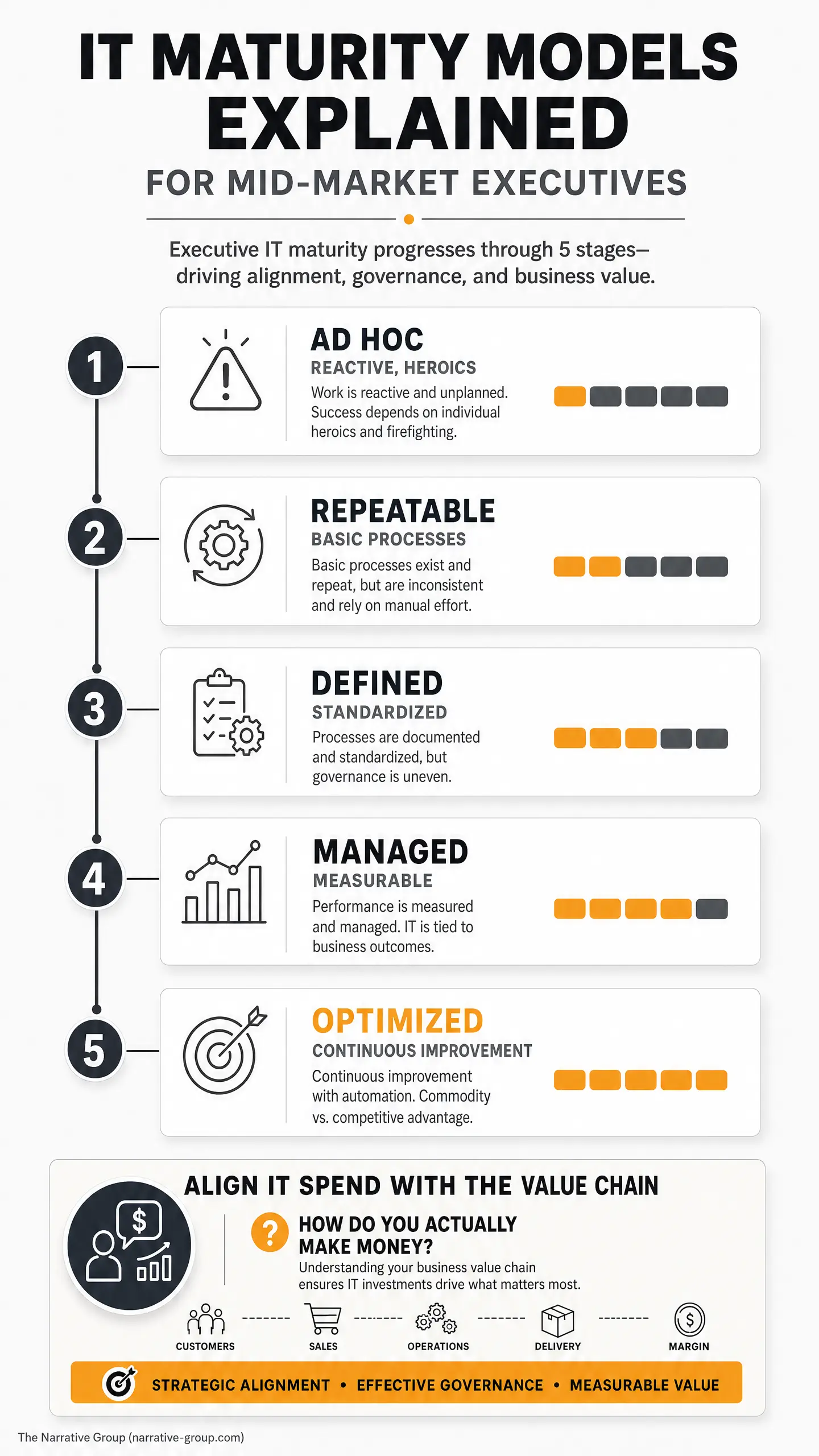
I always start in the same place. How do you actually make money? Every company on the planet is here to make money. Period. When you follow the money, you see the value chain. Then you can see where the people, process, and technology line up. You can also see where the technical architecture is in conflict with the value chain.
You are already spending real money on technology. Avasant puts the new normal for operational IT spending at around 2.8% to 3.0% of revenue. Deloitte’s broader technology benchmark showed budgets climbing to 5.49% of revenue in 2022. Still, Deloitte also found six in 10 executives still struggle to quantify the benefit of individual technology investments. That is why maturity models matter. They help you connect spend to outcomes.
What an IT Maturity Model Really Tells You

An IT maturity model is a simple way to describe how predictable your technology environment is.
Can you make a change without breaking something else? Can you scale without adding people everywhere? Can you recover from an outage fast? Can you govern vendors, security, and data quality in a repeatable way? Those are maturity questions.
I look at it through the lens of long-running business processes. Every business runs on them. Orders move to cash. Products get set up. Inventory gets updated. Employees get onboarded. Reports get produced. Data gets corrected. If those workflows depend on memory, heroics, and side spreadsheets, your maturity is low. If they run with clear business rules, clean handoffs, and measurable performance, your maturity is higher.
Most businesses have a productivity problem. The question is where and why. A maturity model helps you find it. It also gives you language the board can understand. Efficiency. Risk. Scalability. Those are executive issues, not IT issues.
Too many people talk about maturity in ambiguity. I am not interested in that. I want to know where the waste is, where the labor is being burned up, where the risk is hiding, and where the business is tolerating workarounds that should have been fixed years ago.
The Five Stages of IT Maturity
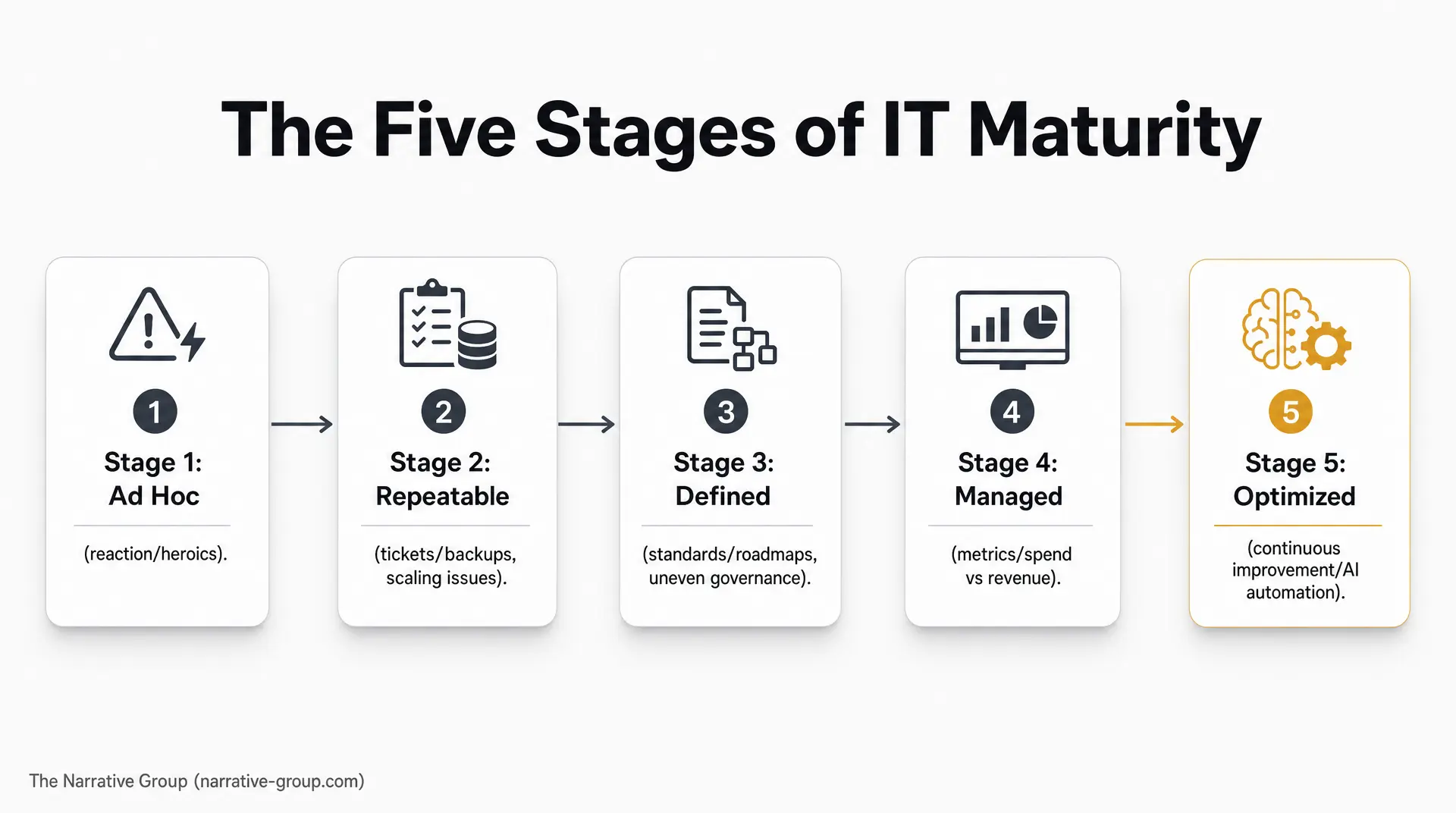
Stage 1: Ad Hoc

Stage 1 is pure reaction.
The business runs on hustle. One person knows the integration. Another person knows which spreadsheet is the real one. A change gets pushed into production because somebody is in a hurry and nobody wants to slow the meeting down. Security depends on good intentions. Documentation is either thin or stale.
At this stage, people often confuse heroics with competence. I do not. Heroics are expensive. They hide weak governance. They also make the company fragile, because too much sits in the heads of too few people.
Outages in stage 1 feel random. They usually are not. Uptime Institute found 54% of recent significant outages cost more than $100,000. The same survey found four in five operators believed their last major downtime incident was preventable with better management, processes, or configuration. That is not bad luck. That is low maturity.
If you are in stage 1, growth makes the pain worse. Every new customer, office, product, or vendor adds more strain.
Stage 2: Repeatable
Stage 2 feels better. That is why so many companies get stuck there.
There are tickets. There are backups. There is some patching. There is an MSP or an internal team handling the basics. A few things are repeatable. The problem is the seams. Systems do not talk cleanly. Manual work fills the gaps. People still move data by email, spreadsheets, and rekeying.
This is also where short-term savings start creating long-term drag. I have seen companies dodge software costs by bolting on old tools. One example was using Mail Manager to save emails into SharePoint to avoid Microsoft license fees. It looked cheaper at the time. Later, when the company needed to deal with upgrades like Windows 11, that old choice became a problem. The savings were visible. The future cost was hidden.
You see the same thing with low-cost IT providers. They can look fine when the business is small. Then the company grows, and you discover there is no scale, no architecture, and no clean path forward. The rework gets expensive fast.
Stage 2 companies can operate. They just cannot scale elegantly. Cutting software spend often shifts cost into labor. Then innovation slows down, and the culture gets stuck in historical patterns of behavior.
Stage 3: Defined
Stage 3 is where discipline starts to show up.
The company has standards. Some business rules are documented. There is a roadmap. There is a better sense of ownership. Teams are trying to stop the chaos. This is usually where executives begin to see that you cannot just codify broken business processes and expect good things to happen.
Most mid-market companies I see live somewhere around stage 3. They have made progress. They have more order. But the decision-making is still uneven. Governance still depends on personalities. Exceptions keep piling up. Vendors keep doing their own little thing in their own little vacuum.
That is common. APQC found only 30% of organizations had standardized process-management tools and technologies across the enterprise, while 26% still used ad hoc technologies. In separate order-to-cash research, fewer than four in 10 organizations had an end-to-end global process owner. That matters. If nobody owns the whole process, nobody fixes the seams.
Stage 3 is better than chaos. It is still not strong enough for serious scale.
Stage 4: Managed

Stage 4 is where you stop guessing and start measuring.
What gets measured gets managed. At this stage, you can tie technology performance back to the business. You know your IT spend as a percentage of revenue. You know your service levels. You can quantify downtime. You can see how much labor is being absorbed by bad workflows. You have something the board can use.
In my world, I want to see spend against revenue, the ratio of IT labor to non-labor expense, and overall service levels. I also want to see the impact on process cycle time. If a task took 20 hours before and now takes five, that is productivity. If a supporting function can absorb more volume without adding headcount, that is value. That is how you turn IT into a business discussion.
This is also where the executive team stops treating IT like a black box. You can show where the money is going and what it is doing. That matters because the board and the ownership group want the same thing you want. Better returns. Lower risk. Stronger scalability.
I saw this clearly with a six-office client. Their complaint was basic. People moved from one office to another and could not connect to the network. Meeting rooms barely worked. We did an assessment, replaced core switches and network gear, retired outdated servers, and put devices on a lifecycle plan. We also fixed the meeting room experience. Three years later, the managing director told me everybody wanted the rest of the offices to look like the new one. That is what managed maturity feels like. The environment stops fighting the business.
Stage 5: Optimized

Stage 5 is continuous improvement.
The company is current. Mainstream, not leading edge, not bleeding edge. Commodity processes run on vanilla software because vanilla software brings security, scale, robustness, and performance. Internal talent focuses on the work that actually drives enterprise value. What makes your company unique is the people, not the technology.
At this stage, you have the discipline to ask a hard question. Which processes are a true competitive advantage? Which ones are economic parity? Which ones are commodity? If a process is commodity, treat it like a commodity. Do not build a shrine to it. Standardize it. Simplify it. Move on.
This is also where automation and AI can help, but only if the groundwork is already there. AI gets sold as an all dancing, all singing, all performing tool. Executives should ignore that sales pitch. AI is useful in workflow management, data quality, and decision support. It is also a very good liar if you leave it on its own. When you are trying to get AI to make up what the business process is, you lose control.
The market data backs that up. McKinsey found 88% of organizations regularly use AI in at least one business function, but nearly two-thirds still have not scaled it across the enterprise. McKinsey also found workflow redesign had the largest effect on EBIT impact, still only 21% had fundamentally redesigned workflows. IBM found 63% of organizations lacked AI governance policies. Governance still matters. It always does.
I have seen what happens when the process is clear. In one engagement, we used AI and workflow automation to streamline an e-commerce product setup cycle. A task that had taken one person up to three weeks dropped to four hours inside a five-week setup cycle. That is measurable leverage. That is maturity.
Why Most Mid-Market Companies Get Stuck in the Middle
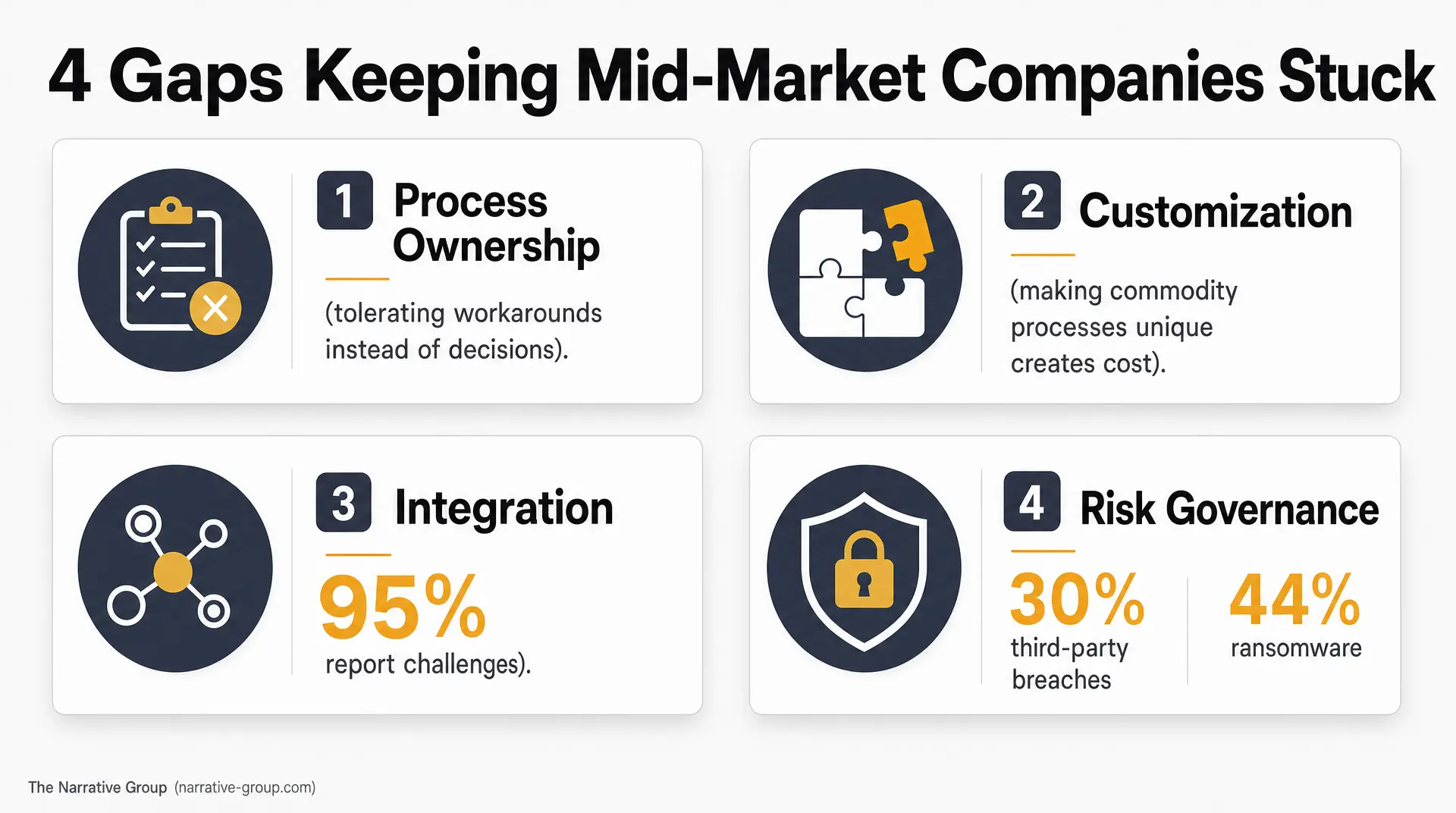
Most mid-market companies stall at stage 2 or stage 3. The biggest problem is governance. Budget matters, but it is rarely the main blocker.
Avasant found 59.0% of IT executives considered their budgets adequate or more than adequate to meet business needs. The same report found 68.7% planned to increase IT spending. Plenty of those companies are still stuck. Money is part of the picture. Decision-making is the bigger issue.
The first gap is process ownership. Sales owns one piece. Operations owns another. Finance owns another. IT gets blamed for the seams. So the business keeps tolerating workarounds instead of forcing decisions.
The second gap is customization. Companies love to believe their processes are special. Most are not. Master data management, inventory logic, order flow, and core e-commerce functions are very similar across companies in the same industry. Whenever you have a common process and you try to make it unique beyond the core commodity process, you create cost. That cost is extremely hard to remove later.
The third gap is integration. MuleSoft found 95% of IT leaders reported integration challenges, and only 2% had integrated more than half of their applications. That is why executives keep telling me their systems do not talk to each other. Nobody stepped back and mapped the flows.
The fourth gap is risk governance. Verizon found third-party involvement reached 30% in breaches, and 44% of breaches involved ransomware. If your vendors, access controls, patching, and backups are loosely managed, your maturity is lower than you think.
Then there is culture. Hero syndrome is real. A manager keeps stepping in to save the day. The business loves them for it. The team never learns. Governance never hardens. The company keeps paying for rescue work instead of building a foundation. If your IT environment is built solidly from the ground up, there is no firefighting, because things just work.
How to Tell Where You Are Today

Start with blunt questions.
Can someone on your team draw how an order turns into cash? Who owns that whole flow? Do you know how much downtime you had last year and what it cost? Can you explain which processes are a true competitive advantage, which ones are economic parity, and which ones are commodity? Do your systems share data in a controlled way, or does somebody clean it up in Excel every Friday?
Then ask the people doing the work. Show me the day in the life. Sit with customer service. Walk the warehouse. Walk the store with an operations leader. Watch how the month-end close actually happens. Listen to the frustrations. The pattern is usually the same. It is role definition, or technology not doing what the company is asking it to do.
Look for visual clutter. Look for duplicate screens. Look for manual approvals and side notes. Look for the moment where somebody says, “This is just how we do it.” That is where the maturity gaps live.
If the answers depend on a few people, you are around stage 1 or stage 2. If you have standards and documentation but weak metrics and weak executive governance, you are likely stage 3. If you can measure performance, govern change, and link investment to P&L impact, you are getting into stage 4. If continuous improvement is part of the operating model, and automation is built on clear business rules, you are moving toward stage 5. If you’d like to start the conversation, you can take the 5-minute IT Prioritization Investment Scorecard to get a quick baseline.
How to Move Up the Curve Intentionally

At The Narrative Group, we start with Financials First. We look at how you spend money on IT, how you deploy capital, how the value chain works, and where labor is absorbing bad technology decisions. I do not start with a shiny tool. I start with the business.
Then we map the data flows. Who is talking to who? How often? Where are the breaks? Where are the delays? The picture tells a thousand words, so we draw it all out. Once you see it clearly, the priorities usually organize themselves into three, four, or five themes.
From there, we move in phases. I do not believe in big-bang transformations for mid-market companies. You do the quick wins where you can. You build credibility. You find the boring foundational functions first. That might be network stability, device lifecycle, backup discipline, access control, or meeting room technology. Deloitte found the biggest reported impact came from cybersecurity and risk mitigation and core modernization and legacy renewal. That should not surprise anybody. The boring work matters.
Then you make the harder structural decisions. Stop focusing purely on requirements, and start asking core business questions. Specifically and ruthlessly figure out where exactly are you different. For the things that are commodity, treat them as a commodity. Take the pieces that do not represent a competitive advantage, outsource them.
I look at IT as effectively two departments. One part is the core operational IT team. That work is a commodity. You should be paying commodity-oriented prices for it. The other part is the business-facing function that learns the company deeply and focuses on workflow, data, decision support, and competitive differentiation. That is where enterprise value gets built.
Leadership matters here. It starts at the top of the house. My job is to give executives enough information to make decisions. Their job is to own those decisions. In some companies, that means an advisory role. In smaller mid-market businesses, it can mean acting as the IT department and executing the roadmap with them. Either way, the goal is the same. IT should be an enabler, not a blocker.
When leaders own the change, the company moves. Productivity improves. The rate of hiring often slows because employees can do more. Margins improve. Risk comes down. The business is easier to scale.
Final Thought

An IT maturity model is a management tool. It gives you a clear view of whether technology is helping the business make money, or quietly working against it.
Start with the simplest question I know. How do you actually make money? Follow the money. Map the value chain. Fix the conflicts. Then move up the curve deliberately.
That is how IT stops being a cost center conversation and starts becoming a value conversation. That is also where innovation lives. Innovation is making the operation of a business model elegant. And IT is intended to be an enabler, not a blocker.
Need Help Aligning IT Spend with Business Performance?
IT budget planning should not be a spreadsheet exercise.
For mid-market companies, the IT budget should show what the business is protecting, what it is improving, and where it is investing for growth.
Narrative’s Financials First assessment helps leadership teams connect technology spend to the value chain, risk profile, productivity opportunities, and growth priorities of the business.
Use the IT Investment Prioritization Scorecard to evaluate your next round of technology investments, or explore Financials First if your leadership team needs a clearer view of what to fund, what to fix, and what to stop.
Technology Investment Strategy (This Series)
- Technology Investment Prioritization: A Framework for Mid-Sized Companies
- IT Maturity Models Explained for Mid-Market Executives ← you are here
- Next –> How to Build a Technology Business Case Your CFO Will Actually Approve (coming soon)
- CapEx vs OpEx in IT Strategy (coming soon)
- When to Replace vs Optimize Your Business Systems (coming soon)
- The Hidden Cost of Reactive IT in Mid-Sized Companies (coming soon)
Frequently Asked Questions
How long does it typically take to advance one level in an IT maturity model?
Moving up a single stage usually takes 12 to 18 months. It is not just about buying software. It requires changing deep-rooted business behaviors. Fast-tracking creates friction. We move in phases, starting with foundational stability before tackling structural workflow redesigns to ensure sustainable adoption.
Does moving up the IT maturity curve require a massive budget increase?
Not necessarily. While Avasant found 68.7% of organizations plan to increase IT spend in 2025, maturity is about reallocating waste. You stop funding redundant software and ‘heroic’ manual labor, shifting those dollars toward automation. It is an exercise in capital efficiency.
How does an acquisition impact a mid-market company’s IT maturity?
M&A immediately stresses your IT maturity. You inherit the acquired company’s technical debt and undocumented workflows. If you are operating at a defined maturity stage but acquire an ad hoc business, your overall enterprise predictability drops until their systems are fully integrated under your central standards.
How do external vendors affect our internal IT maturity rating?
Vendors directly dictate your operational resilience. You cannot claim high maturity with ungoverned partners. According to Verizon, third-party involvement in breaches recently doubled to 30%. If your supply chain and managed service provider access controls are loosely managed, your true maturity is dangerously low.
Should we delay Generative AI investments until we reach stage five optimized maturity?
Largely, yes. AI scales your existing habits. If your workflows are broken, AI simply automates the chaos. Furthermore, IBM reports 63% of organizations lack AI governance policies. Before funding AI, you must build baseline data hygiene, process ownership, and strong security controls.