
Should you replace the system, or optimize what you already have?
I see companies get this wrong all the time. Most default to optimization because replacement feels expensive, risky, and disruptive. That instinct is understandable. But if a system is slowing work, forcing manual effort, increasing risk, and blocking growth, you may already be paying for the replacement. You are just paying for it somewhere else.
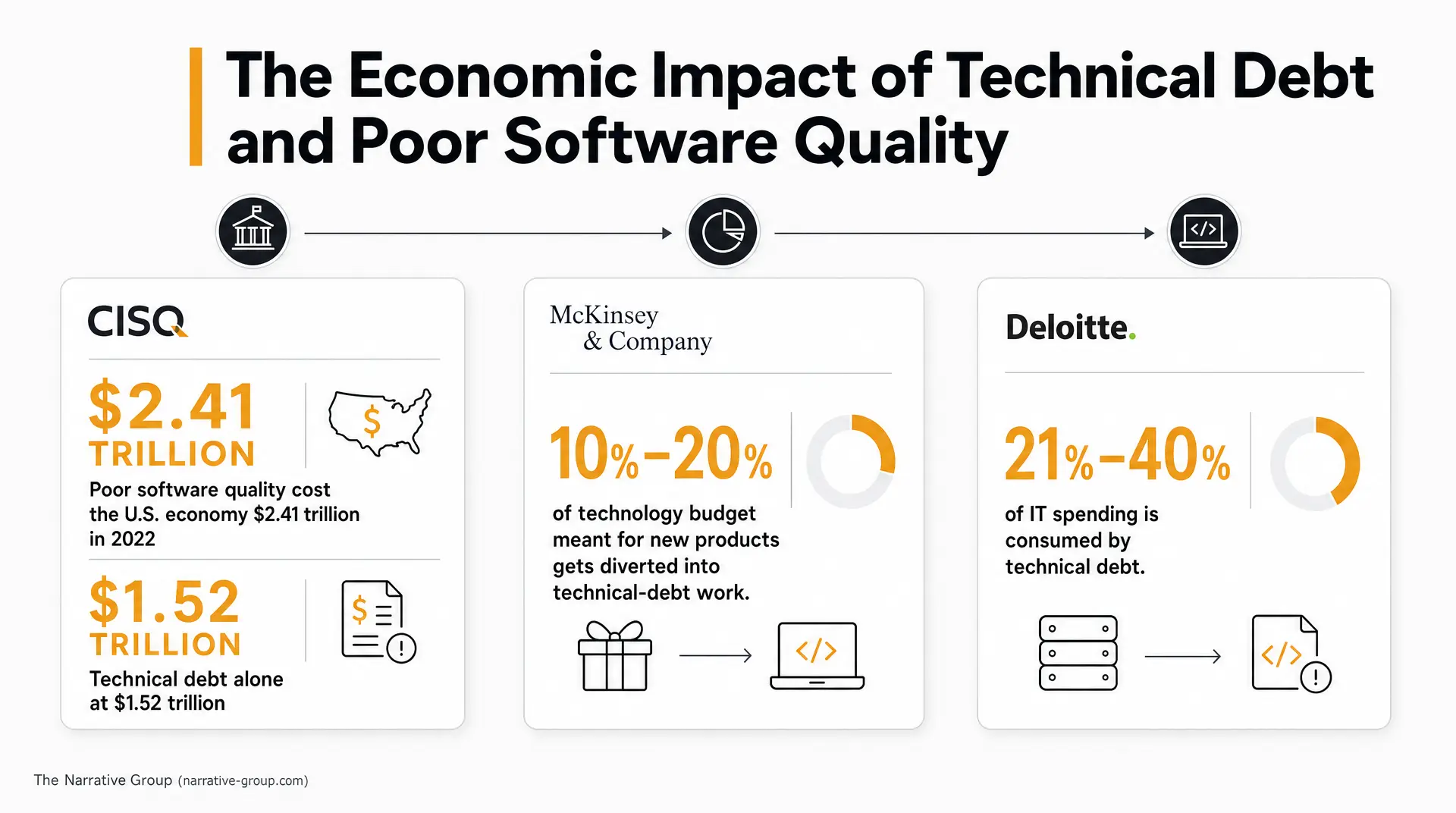
Often, that cost is buried in labor, downtime, poor service, rework, customer friction, and missed opportunities. CISQ estimated that poor software quality cost the U.S. economy $2.41 trillion in 2022, with technical debt alone at $1.52 trillion. McKinsey found 10% to 20% of technology budget meant for new products gets diverted into technical-debt work. Deloitte estimates technical debt consumes 21% to 40% of IT spending.
I have seen this in large enterprise and in mid-market firms. The visible cost of replacement gets all the attention. The hidden cost of keeping the wrong system usually sits quietly inside the P&L.
So I always start in the same place.
Follow the money.
Start with the Business, Not the Software

Before I care about software, I ask one question:
How does this business actually make money?
If you cannot answer that clearly, you should not be shopping for platforms yet. You should be studying the value chain.
Every business exists to create economic value. Once you understand how that value is created, delivered, billed, and measured, you can see where technology is helping, where it is neutral, and where it is getting in the way.
At The Narrative Group, we start with a Financials First lens. We look at where money is spent, where labor is concentrated, where capital is going, and how data moves through the company.
Then we draw it out.
- Who is talking to whom?
- How often?
- Where does the process break?
- Where does the customer wait?
- Where does finance reconcile?
- Where does the front line create workarounds?
Most businesses are really a series of long-running workflows. When the technical architecture is in conflict with the value chain, the business feels it everywhere.
I also think about IT in two parts.
The first is the commodity engine: networks, devices, collaboration tools, core support, infrastructure, security hygiene, and baseline operations. Keep this current. Keep it reliable. Keep it boring.
The second part of IT should understand the business deeply and focus on the workflows that actually drive enterprise value.
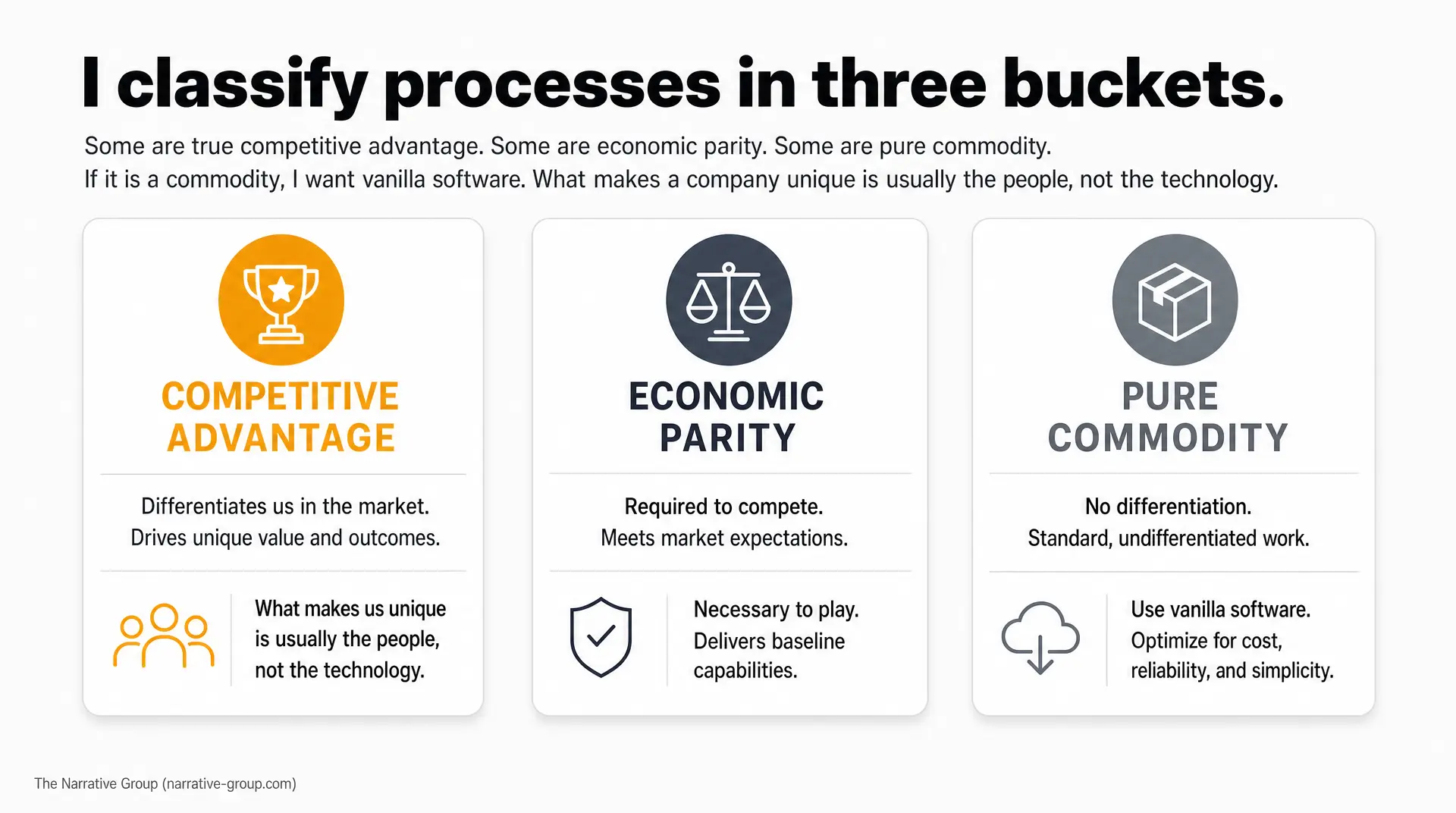
That is why I classify processes into three buckets:
- Competitive advantage
- Economic parity
- Commodity
If a process is a commodity, I want vanilla software. I want security, scale, robustness, supportability, and performance. I want mainstream, not leading edge. Definitely not bleeding edge.
What makes most companies unique is not the technology. It is the people, the operating model, the customer experience, the data, and the way decisions get made.
When companies try to make common processes overly unique, they usually create cost. Sometimes that cost shows up years later.
A “cheap” decision can become an expensive constraint.
So if you are a CFO, COO, or CEO, do not start with the vendor demo. Start with the business model.
Stop asking only, “What are the requirements?”
Where does this system help us make money, protect margin, reduce risk, or scale without adding unnecessary labor? These are the core business questions.
When Optimization Makes Sense

Optimization is often the right answer. But it has to be real optimization.
It cannot be denial dressed up as prudence.
The first signal is simple: the core engine still works.
The system performs its primary job well enough to build on. The pain is coming from sloppy process design, unclear business rules, weak data, poor role definition, bad configuration, or weak governance.
I see this constantly. People blame the software when the bigger problem is that nobody made the business rules explicit. Or nobody documented how the process is actually supposed to run. Or the technology is not doing what the company is asking it to do because the company never defined it clearly in the first place. You cannot just codify broken business processes.
The same warning applies to AI. I am optimistic about AI in the right places, especially in long-running workflows and in improving data quality. But when you are trying to get AI to make up what the business process is, you lose control. AI is not a shortcut around business comprehension.
A lot of optimization work starts with boring foundational functions. That matters more than people want to admit. Uptime Institute found that four in five respondents said their most recent serious outage could have been prevented with better management, processes, and configuration. That should get your attention. Sometimes the right answer is not a new platform. Sometimes the right answer is discipline.
Then I ask a harder question. Is the upside measurable?
If you optimize, what moves?
Cycle time?
Error rates?
Manual interventions?
Service levels?
Labor productivity?
Customer satisfaction?
Revenue leakage?
Margin?
Technology investment often does not show up as job loss. It shows up as a slower rate of hiring because employees get more productive. That is still financial leverage. In fixed-price businesses, using less labor to do the same work goes straight to margin.
I have seen that very clearly in an e-commerce engagement. The product setup cycle took five weeks, and one key setup task could take one person as long as three weeks. We used workflow automation and AI to streamline that work. The task dropped to four hours. We did not get there by throwing hype at the problem. We got there by understanding the workflow, the rules, and the data first.
Optimization also makes sense when replacement risk is high in the short term. Some systems sit inside regulated processes, peak seasons, or customer-facing operations that cannot tolerate a reckless cutover. Panorama Consulting’s 2024 ERP survey puts the median enterprise-software project at $450,000 and 15.5 months. That deserves respect. You do not launch into a replacement casually just because the vendor promises the platform can do everything.
So yes, optimize when the core functionality is sound, the business case is measurable, and the disruption of replacement outweighs the near-term benefit. Just be honest with yourself about whether you are optimizing or simply postponing a harder decision.
When Replacement Is the Right Call
There is a point where optimization becomes expensive delay. Once you cross that line, every patch, workaround, side spreadsheet, and custom interface makes the eventual replacement harder.
The first signal is technical debt that has turned into a tax. If the system depends on custom code, unsupported versions, one or two key people, or cheap short-term development, the risk is already compounding. McKinsey estimates tech debt can represent 20% to 40% of the value of the technology estate before depreciation. That is a huge amount of trapped value. In a mid-market company with a thinner bench, you feel it even faster.
This is where low-cost decisions usually come back to bite. Cheap providers often do not build for scale. Cutting software spend often pushes the work into human labor. That slows the pace of innovation and traps the culture in historical patterns of behavior. People spend their time reconciling, rekeying, validating, and apologizing. They are not creating value.
The next signal is growth blockage. Ask yourself a very plain question:
Can this system support your next location, next business line, next acquisition, next channel, or next wave of customers?
Or does every increase in volume require more people, more workarounds, and more heroics? Every business tends to have an incredible productivity problem. The biggest hurdle to scaling is usually productivity. My first levers are standardization and automation. If the platform fights both, replacement should be on the table.
Then there is integration sprawl. This one fools a lot of executives because the old core system still appears to run. So the company keeps wrapping more interfaces around it. Another connector. Another sync job. Another manual reconciliation. Another vendor. Before long, the integration layer becomes the operating model. That is fragile. It is expensive. And it is usually tied directly to revenue.
MuleSoft reports that 95% of organizations face integration challenges, 96% say AI-agent success depends on seamless, debt-free integration, and APIs now account for 40% of company revenue according to IT leaders. So draw it out. Who is talking to whom? How often? Where is data being keyed twice? Once the picture is on the wall, the problem is usually obvious.
Security, support, and compliance risk matter too. If the platform cannot be patched, monitored, governed, or supported properly, you are carrying a real business risk. IBM puts the global average data-breach cost at $4.4 million. Verizon’s 2025 DBIR found third-party involvement in breaches doubled to 30%, and vulnerability exploitation increased by 34%. Unsupported systems do not sit quietly in the background. They widen the attack surface and weaken your control.
Then listen to the people doing the work. Show me the day in the life. Where are the conflicts? Where are the interventions? Where does the workflow break? Front-line frustration is usually a signal that the technology is letting them down.
I saw that very clearly with self-checkout at Loblaw. The intervention rate was too high. Error rates were high. Adoption was poor. The labor model stopped making sense because too many staff had to step in and help. At that point, the experience was not worth polishing around the edges. We had to rebuild the entire front-end experience. That had become a replacement decision.
That is the key point. If the system is soaking up money, blocking growth, multiplying integration risk, creating security exposure, and frustrating the front line every day, you are not protecting the business by keeping it. You are dragging it.
The EBITDA Drag Most Leaders Miss
Legacy drag rarely shows up in one clean line item. It spreads across the business.
Manual work goes up. Hiring stays higher than it should. Finance spends more time reconciling. Operations invents workarounds. Reporting gets slower. Customer service gets weaker. Innovation slows because the team is buried in low-value work. I have seen companies cut license cost and feel good about it for a quarter, only to discover they made human labor the most expensive item on the P&L.
Downtime adds its own tax. Uptime Institute found that 57% of respondents said their most recent major outage cost more than $100,000, and one in five said it cost more than $1 million. Those are not just IT numbers. That is EBITDA walking out the door.
Then you get waste from poor asset discipline. Flexera found visibility across the technology stack fell to 43%, 35% of respondents said SaaS waste increased, and 45% spent more than $1 million on software audits over the prior three years. That is what happens when nobody owns lifecycle management properly.
This is why I want leaders to track total IT spend as a percentage of revenue, IT labor versus non-labor spend, uptime and incident trends, and the time it takes to execute critical processes. I would also track manual intervention rates, duplicate data entry, reporting delays, SaaS waste, integration complexity, and customer-facing service failures. If you move the cost from software into manual effort, you did not save money. You just hid it.
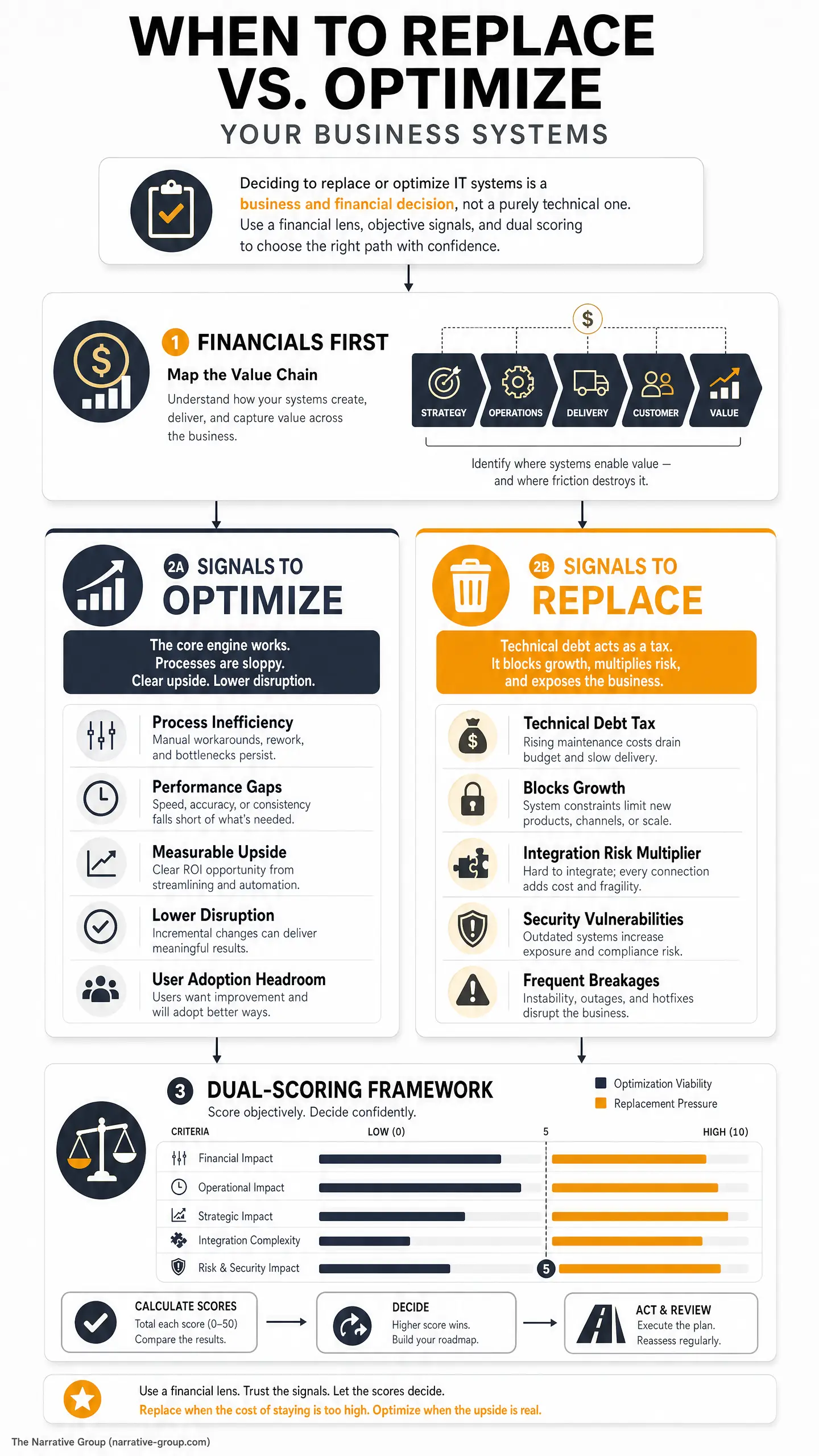
The Framework I Use
I do not make replace-versus-optimize decisions by emotion. I want a simple, board-ready way to talk about it. So after the Financials First assessment, I score two things. I score replacement pressure, and I score optimization viability. Each criterion gets a score from one to five. I multiply by the weight and add the total to get a score out of 100.
Before I score anything, I classify the process. Is it part of your competitive advantage? Is it economic parity? Or is it a commodity? If it is a commodity, my tolerance for customization drops fast. Take the pieces that do not represent a competitive advantage, outsource them, standardize them, and pay commodity-oriented prices. Keep your best people focused on the parts of the business that actually drive enterprise value.
Score One: Replacement Pressure
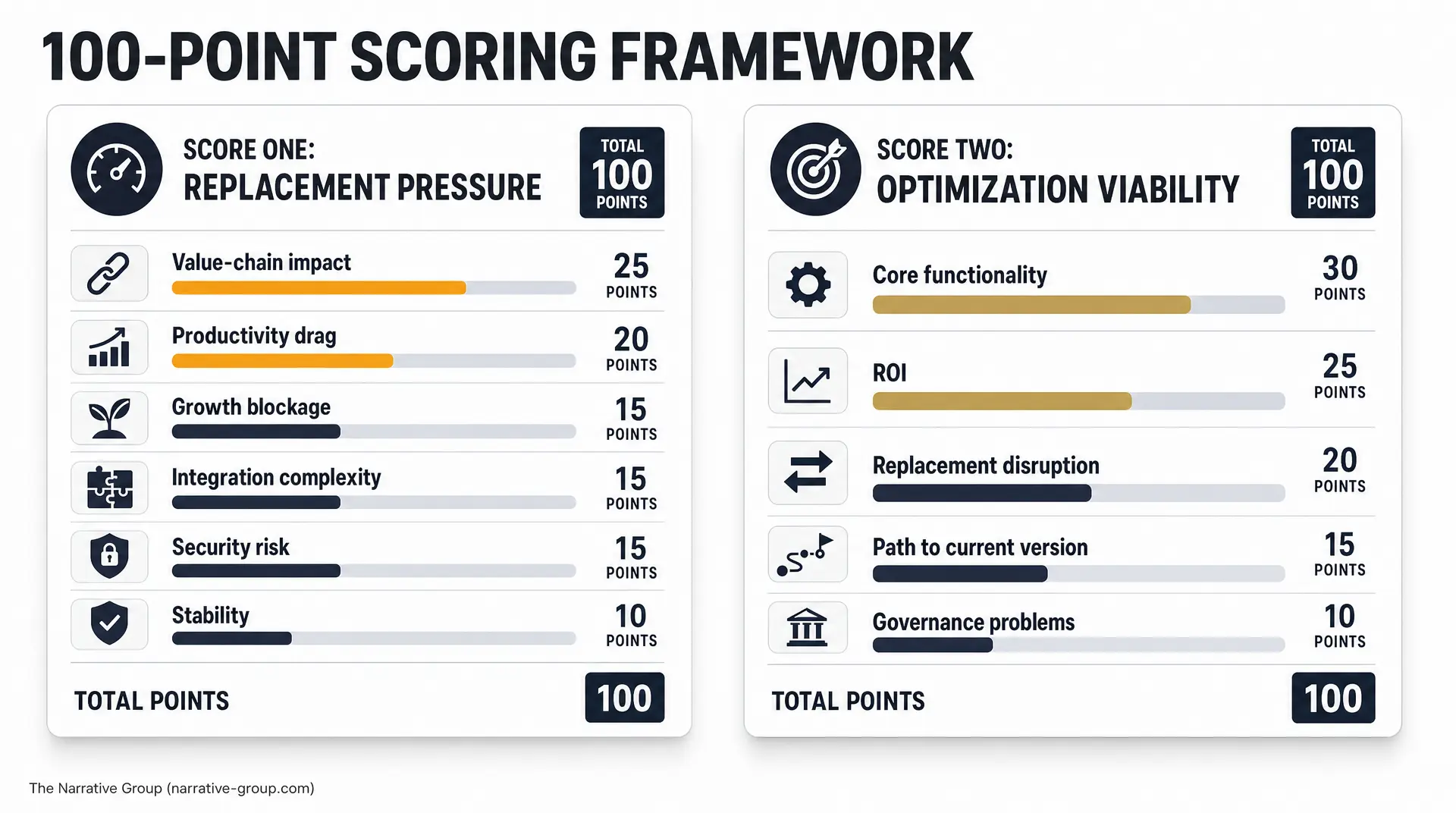
For replacement pressure, I put 25 points on value-chain impact. If the system goes down, does revenue stop, does fulfillment slow, does billing break, or does customer service fall apart? That carries the most weight because it hits the business fastest.
Productivity drag gets 20 points. I want to know how much manual work, duplicate entry, intervention, and exception handling the system creates. Growth blockage gets 15 points. If the business cannot add volume, channels, sites, or customers without piling on labor, that matters.
Integration complexity gets 15 points. Security, compliance, and vendor risk get another 15. Stability and service quality get the final 10. If outages and complaints are constant, I pay attention.
If the replacement pressure score is 70 or higher, replacement belongs on the active roadmap. If it lands between 50 and 69, I usually phase modernization while reducing risk. Below 50, optimization is usually the better first move.
Score Two: Optimization Viability

For optimization viability, core functionality gets 30 points. If the system still performs its primary job reliably enough, that matters a lot. Clear ROI on targeted improvements gets 25 points. I want measurable gains inside 6 to 12 months, not vague promises.
Replacement disruption gets 20 points. Sometimes the process is too critical to swap immediately, even when you know the longer-term answer. The path to a current, supported, mainstream version gets 15 points. I care about current more than shiny. Process and governance problems get the final 10. If the bigger issue is unclear business rules, poor change control, or weak data discipline, optimization may unlock more value than replacement.
If optimization viability is 70 or higher, I optimize. Between 50 and 69, I optimize while designing the future state. Below 50, I stop patching and start planning the replacement.
When replacement pressure is high and optimization viability is low, the answer is straightforward. Replace. When the pattern flips, optimize. When both scores are high, use a phased transition. Big-bang transformations create unnecessary risk. When both scores are low, the business usually still does not understand the process well enough. Go back. Listen. Map the flows. Show me the day in the life.
How to Make the Move Without Breaking the Business

Once the choice is made, execution matters more than the slide deck. It starts at the top. Leaders need skin in the game. They need to help prepare their teams, communicate the change, make decisions, and own the business outcomes. My team can fill a gap. We cannot own the business on the client’s behalf.
Then you pilot. You test in the lab, and then you test in the real world, because when the rubber hits the road, you learn things. Anybody promising a flawless rollout is selling certainty they do not have. BCG found that 70% of digital transformations fall short, while digital leaders deliver 1.8 times the earnings growth and more than double the growth in enterprise value. The ones that work are treated as business-value programs. They are not theatre for the board.
You also need quick wins. Talk is cheap. Actions speak volumes. Fix the daily frustrations. Build trust. Reduce manual work. Improve reporting. Remove duplicate entry. Stabilize the commodity engine. Keep the commodity systems current and vanilla. Focus your best internal people on the things that actually drive enterprise value. If your IT environment is built properly from the ground up, there is no firefighting, because things just work.
Final Thought

Replace versus optimize is not a technology debate. It is a money question. How does the business actually make money, and is the system helping or hurting that? Follow the money. Be ruthless about what is truly unique. Keep the rest current, simple, and well governed. Do not hide legacy technology costs in labor and call it savings. Innovation is making the operation of a business model more elegant. Do that well, and technology starts doing what it should have been doing all along: amplifying your people, their skills, their creativity, and their ability to improve the business.
Need Help Aligning IT Spend with Business Performance?
IT budget planning should not be a spreadsheet exercise.
For mid-market companies, the IT budget should show what the business is protecting, what it is improving, and where it is investing for growth.
Narrative’s Financials First assessment helps leadership teams connect technology spend to the value chain, risk profile, productivity opportunities, and growth priorities of the business.
Use the IT Investment Prioritization Scorecard to evaluate your next round of technology investments, or explore Financials First if your leadership team needs a clearer view of what to fund, what to fix, and what to stop.
Technology Investment Strategy (This Series)
- IT Maturity Models Explained for Mid-Market Executives
- Technology Investment Prioritization: A Framework for Mid-Sized Companies
- IT Budget Planning for Mid-Sized Companies
- How to Build a Technology Business Case Your CFO Will Actually Approve
- CapEx vs OpEx in IT Strategy
- When to Replace vs Optimize Your Business Systems
- The Hidden Cost of Reactive IT in Mid-Sized Companies
Frequently Asked Questions
How do we quantify the financial risk of postponing a legacy system replacement?
The risk shows up directly in EBITDA through downtime and lost labor. Stop looking just at licensing. According to the Uptime Institute, 57% of major outages cost over $100,000. Postponing replacement converts capital expenditure into unpredictable operational liabilities.
How does a highly customized legacy system impact company valuation during an acquisition?
It acts as a massive valuation anchor. Buyers discount for technical debt. Deloitte notes tech debt consumes 21% to 40% of IT spending. If your system relies on custom code and manual workarounds, that trapped value directly reduces your multiplier.
We have dozens of SaaS apps. Should we optimize them or replace them with a unified platform?
Replace them if the integration layer has become your operating model. Wrapping connectors around siloed apps creates fragile workflows. MuleSoft found 95% of organizations face integration challenges. If data cannot flow seamlessly across the value chain, consolidate onto a vanilla platform.
Can we reduce technical debt just by optimizing our infrastructure, rather than replacing core software?
Yes, foundational optimization yields real financial leverage. You do not always need to rip out the core ERP. Deloitte found infrastructure modernization alone reduces technical debt by 18% over five years. Stabilize your commodity engine first.
How do we prove the ROI of a full system replacement to a skeptical board?
Frame it as an enterprise value program, not an IT project. Tie the investment directly to labor productivity. BCG found that digital leaders deliver more than double the growth in enterprise value. Show the board exactly how the system expands margin.