
I’ve sat in both seats.
I’ve been the full-time technology executive inside very large organizations. I’ve also stepped in as the outside executive for mid-market companies that needed order, direction, and credibility fast. So when a CEO or CFO asks me which model is right, I do not start with the title.
I start with one blunt question.
How do you actually make money?
That question matters because the answer tells you how much technology leadership you really need. It tells you where the risk sits. It tells you where productivity is leaking out of the business. And it tells you whether you need a permanent executive in the building every day, or a senior operator who can come in, sort it out, and move the company forward.
Cost matters. Leadership capacity matters more.
A $40 million company in steady-state operations needs one kind of leadership. A $40 million company preparing for acquisition, a raise, or a major scale-up needs another. Same revenue. Very different pressure.
Start with the Business, Not the Org Chart
One reason I founded The Narrative Group was simple. I got tired of hearing people talk about “the business” and “IT” as if they were two separate companies. Same logo on the paycheck. Same customers. Same need to make money.
That is why I always start with a Financials First view. I want to understand the value chain. I want to see how the company creates value, where the supporting functions are slowing that down, and where the technical architecture is in conflict with the value chain.
Most companies also need to accept another truth. IT is effectively two departments. One side is commodity work. Networks, devices, patching, backups, service desk, core infrastructure. The other side is strategic. Architecture, cybersecurity, vendor control, automation, data, governance, and process improvement.
If you mix those together badly, you waste money. If you separate them properly, you can move a business a lot faster.
And unless your product is technology itself, what makes your company unique is usually the people. The technology should amplify their skills, their creativity, their superpower. It should help them do more. It should not become a vanity project.
What a Full-Time CTO Really Costs
Let’s deal with the money first.
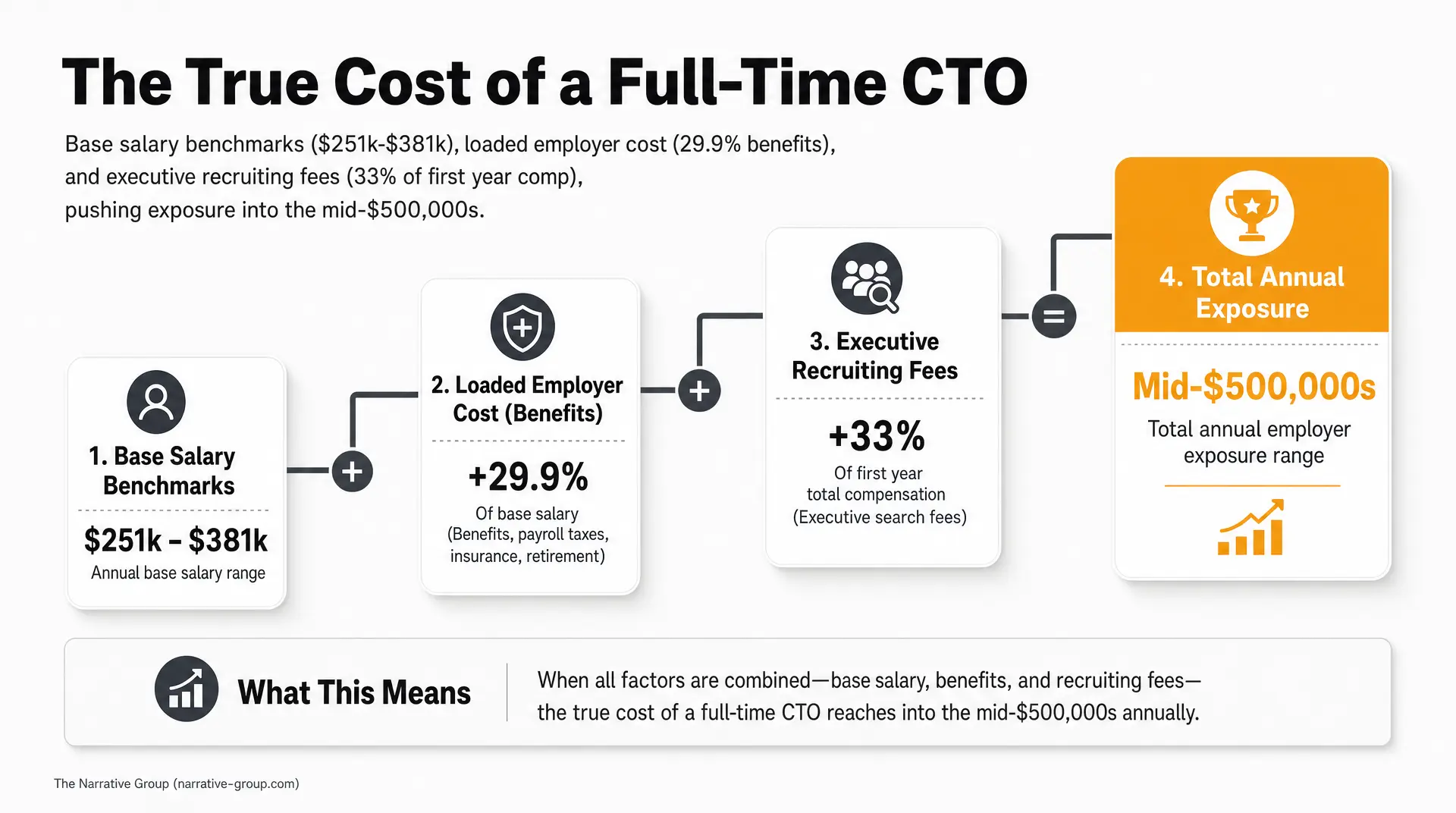
Current U.S. benchmarks put CTO base salary in the low- to mid-$300,000s. The 2025 LHH guide places base salary at $251,800 to $381,950. Salary.com puts the average CTO salary at $309,539. Use those as directional North American planning numbers.
Now add employer cost. A broad BLS benchmark shows benefits represented 29.9% of total employer compensation costs. If you use the LHH average base salary of $317,100, your loaded employment cost lands around $452,000 before bonus, equity, or severance. Use the enterprise-end salary benchmark and you are around $545,000 on a loaded basis.
Then comes recruiting. Korn Ferry states executive search fees are generally one-third of the estimated first year compensation. On an average CTO hire, that can easily add another $100,000 or more. If you are recruiting someone with strong product, platform, or M&A depth, equity often enters the package too. That pushes the true cost higher again.
Time matters as well. SHRM puts median executive time-to-fill at 45 calendar days. That is before notice period, onboarding, and the time it takes for a new executive to build enough trust to make hard calls.
So when a leadership team tells me a full-time CTO will cost “about 300 grand,” I know they are looking at only part of the picture. First-year exposure can move into the mid-$500,000s very quickly. In some cases it will be more.
What a Fractional CTO Costs
Fractional works differently.
You are buying leadership capacity, not permanent headcount. You are buying decision quality. You are buying speed. And very often, you are buying access to a broader bench without carrying that bench on payroll.
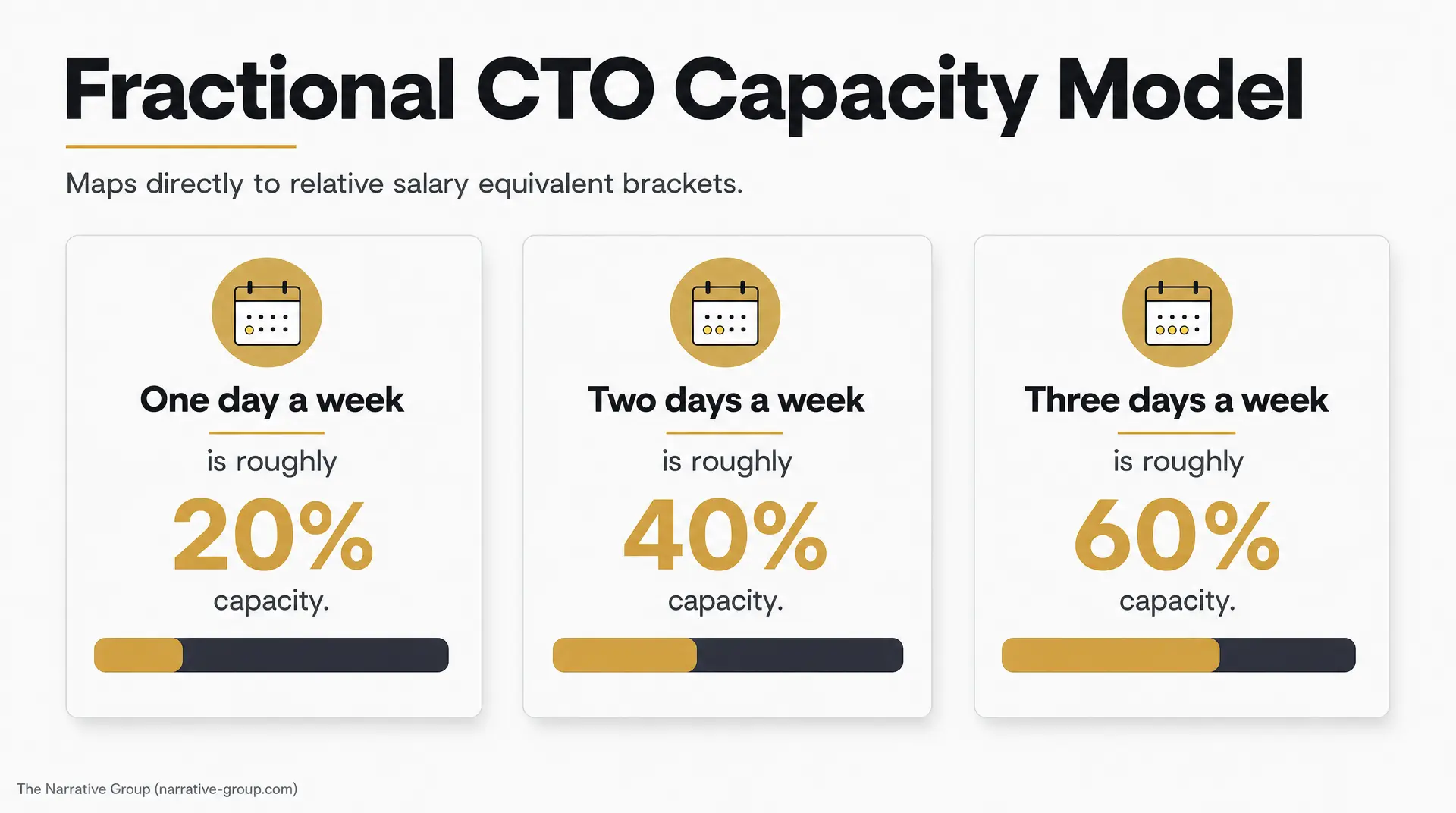
I usually think about it in slices of a full-time role. One day a week is roughly 20% capacity. Two days is roughly 40%. Three days is roughly 60%. Using the LHH salary range as a planning baseline, a one-day-a-week salary equivalent works out to roughly $50,000 to $76,000 a year. Two days a week works out to about $101,000 to $153,000. Three days a week moves into the $151,000 to $229,000 range.
Real fractional pricing may sit above those pro-rated numbers. That is normal. You are buying senior capability without the hiring drag, without long ramp periods, and often with access to people who have already seen the movie before. The range also moves with scope. Board reporting changes it. Cybersecurity oversight changes it. Vendor cleanup changes it. M&A diligence changes it. Hands-on execution changes it.
This is also why a fractional CTO is not the same thing as your managed service provider. Deloitte’s outsourcing work shows cost reduction was no longer the dominant reason companies used managed services. Capability and operating model change matter more now. That lines up with what I see every day. Your MSP keeps the foundation running. Your CTO decides where the business should invest, what should be standardized, what should be outsourced, and how technology should improve the P&L.
At The Narrative Group, we sometimes serve only as the strategic layer. In other situations, especially for smaller mid-market firms, we can function as the IT department itself. That means infrastructure, cybersecurity, managed services, and executive leadership can be combined. The structure depends on the business stage. That is the point.
A Simple Comparison
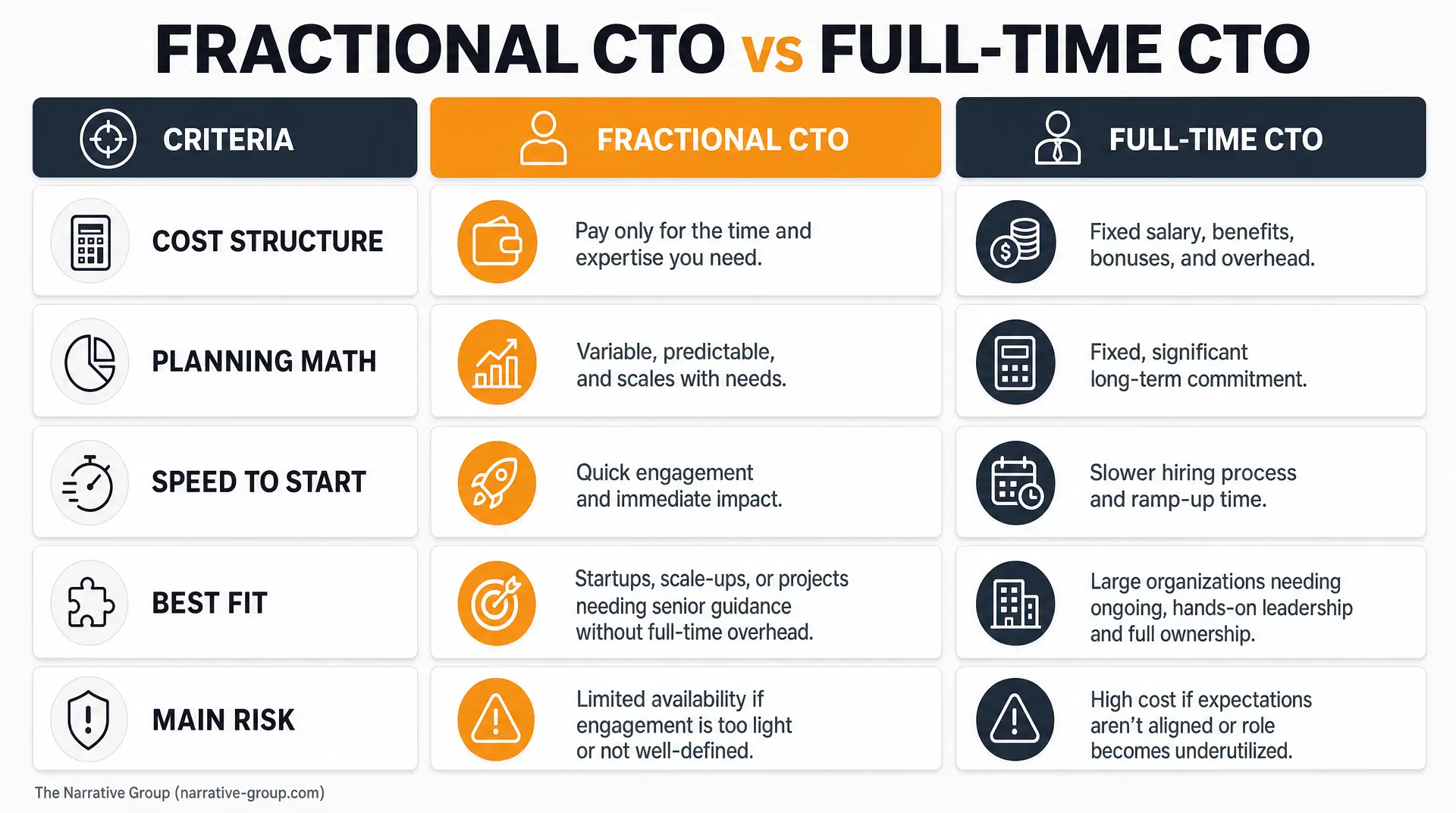
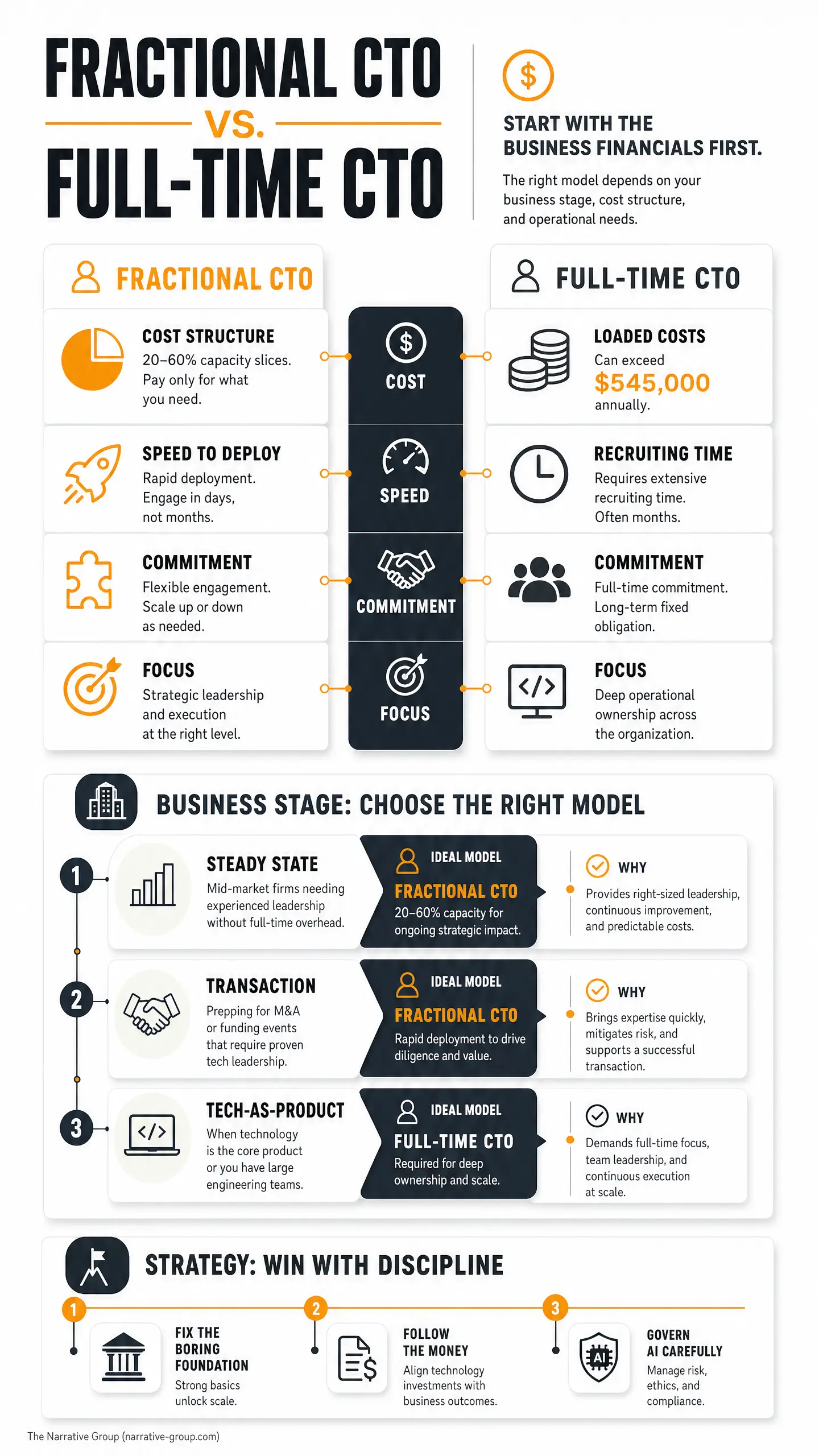
| Dimension | Fractional CTO | Full-Time CTO | |—|—|—| | Cost structure | Pro-rated share of senior leadership capacity, usually with a premium for speed, accountability, and access to a broader bench | Salary, benefits, recruiting, variable compensation, and often equity | | Planning math | One day a week is about 20% of the seat. Two days is about 40%. Three days is about 60% | Base salary benchmarks sit around $252K to $382K, with loaded employer cost often much higher | | Speed to start | Usually faster | Slower because search, hiring, and ramp take time | | Best fit | Mid-market firms that need strategy, governance, vendor control, cyber leadership, and a roadmap | Firms that need daily ownership of engineering, architecture, talent, product, and capital allocation | | Main risk | Keeping it fractional after the need has clearly become full-time | Hiring too early and consuming too much budget in a role the business cannot fully use |
Business Stage Changes the Answer
A $40M Company in Steady-State Operations

This is where I see a lot of companies make the wrong call.
Deloitte found the average technology budget reached 5.49% of revenue in 2022. Fine. But that average hides a big spread by industry. Consumer products and retail sat at 2.0% of revenue. Construction and industrial products sat at 2.2% of revenue.
Run the math on a $40 million business. In retail, a 2.0% budget is about $800,000. In construction or industrial, 2.2% is about $880,000. One full-time CTO seat can swallow a very large share of that budget in year one. That leaves less room for cybersecurity, infrastructure, core platforms, licenses, and project work.
This is often where a fractional model wins. You get senior leadership. You get governance. You get vendor control. You get a roadmap. But you do not crowd out the rest of the technology budget.
I’ve seen this play out very clearly. One company came to us with six offices. When people moved from one office to another, they could not reliably connect to the network. Their meeting rooms barely worked. IT had become a blocker. We assessed the infrastructure, replaced core switches and network gear, replaced outdated servers, put devices on a lifecycle plan, and stabilized the environment office by office. That business did not need an expensive permanent executive seat on day one. It needed the boring foundational functions fixed first. Once that was done, credibility went up and the broader transformation became possible.
A $40M Company Preparing for Acquisition or a Raise
Now change the stage.
Same revenue. Different reality.
In a transaction, buyers and investors care about things many companies have ignored for too long. They care about architecture. They care about cybersecurity. They care about data. They care about dependencies on a few key people. They care about whether the platform can scale without breaking.
KPMG found scalability of technology platforms was the top diligence topic for private equity investors. Corporate buyers focused on data privacy and cybersecurity compliance. Bain’s tech due diligence framework pushes across product, architecture, cybersecurity, data, organization, and benchmarking.
This is exactly where a strong fractional CTO can be the right move. One of the companies I advised was a startup insurance distributor operating in Canada and the United States. We put an enterprise-wide IT structure in place, clarified the use of funds within IT for a B/C raise, and introduced investment governance. The result was a completed $100 million USD raise with an IT organization prepared to scale.
That company needed serious executive technology leadership. It needed it quickly. It also needed the flexibility to match leadership cost to business stage.
A company in this position may still decide to hire full-time. If the deal thesis depends on proprietary technology, product roadmap credibility, or a large internal engineering function, I would lean harder toward a permanent CTO. But acquisition prep by itself does not automatically mean full-time.
A Company Whose Product Is Technology

Some businesses simply need a full-time CTO.
If technology is the product, if you run a meaningful engineering organization, or if capital allocation decisions around platforms are constant, you need someone in the seat every day. You need ongoing ownership of architecture, priorities, talent, security, and execution discipline.
I have done that kind of work at scale. At Loblaw, I was responsible for aligning more than $300 million in capital spend to the enterprise strategy. At Shoppers Drug Mart, part of the job was reshaping the IT function itself and mentoring leaders across the organization. That level of decision-making is continuous. It belongs inside the company.
The Hidden Cost of Choosing the Wrong Model
Hiring a full-time CTO too early creates one kind of damage.
Scarce budget gets trapped in executive overhead. The business starts paying senior rates for somebody to swim around in commodity problems. Then the executive becomes a firefighter. They spend their time on urgent issues, miss the strategic conversations, and the larger spending decisions drift. I see this a lot. It feels busy. It does not create enterprise value.
Keeping the role fractional for too long creates a different problem.
Nobody owns the function deeply enough. Decisions wait for the next call. Talent development stalls. Architecture gets patched instead of designed. If the business needs senior technology judgment every day, the role has already become full-time whether anybody has admitted it or not.
Then there is the cheap IT trap. This one is common. Leaders cut software licenses, cut foundational spend, or hire low-cost providers and temporary developers because the number looks better in the short term. Later, the business pays for it in manual work, brittle integrations, and painful upgrades. I have seen organizations save a little money on tools and then shift the cost straight into labour. That slows innovation. It keeps culture stuck in old patterns. It makes growth harder.
My preference is simple. Use vanilla software for common processes. Stay current. Mainstream, not leading edge, not bleeding edge. Specifically and ruthlessly figure out where exactly you are different. For the rest, use standard platforms with security, scale, and performance built in. Whenever you have a common process and try to make it special, you are creating cost that is very hard to unwind later.
Security makes the whole discussion even more serious. Verizon found 96% of small-business breaches came from system intrusion, social engineering, or basic web application attacks. IBM puts the average U.S. breach cost at $10.22 million. So if your current structure leaves no one clearly accountable for cyber posture, governance, and recovery, you are carrying real risk.
What Good CTO Leadership Looks Like in Either Model
Follow the Money

A good CTO starts where the business makes money. Always.
That means understanding the value chain, the supporting functions, and the flow of data between systems. Draw it out. The picture tells a thousand words. Once you see the pattern, you can see where waste lives, where handoffs are broken, and where technology is getting in the way.
I also want measurement. What gets measured gets managed. Show me IT spend against revenue. Show me service uptime. Show me downtime cost. Show me the ratio of IT labour to non-labour spend. Show me how much time a business process takes today, and how much time it should take after improvement. Good technology leadership shows up in the P&L. Often it shows up as a slower rate of hiring because people get more productive.
Show Me the Day in the Life

Then I want to see the work as it actually happens.
Show me the day in the life. Show me where the technology is letting people down. Show me the visual clutter, the workarounds, the manual handoffs, the screens people keep retyping into. Most businesses have a productivity problem. The clues are usually sitting right in front of the front line.
That matters for trust too. People are often not resisting change for the sake of resisting change. They are frustrated. They are telling you the technology is not doing what the company is asking it to do. If you listen properly, they will show you the truth very quickly.
Build on the Boring Foundation
I always tell teams to find the boring foundational functions first.
If the network is unstable, if devices are outdated, if the meeting rooms do not work, if change management is weak, then the rest of the roadmap will wobble. Fix the base. Build credibility. Then move up into process and transformation. Talk is cheap. Actions speak volumes.
The operating change has to show up in measurable results.
That is how we work at The Narrative Group. We start with a Financials First discovery assessment. We look at how the company spends money on IT, how capital is being deployed, and how technology is being used. Then we map data flow and the value chain, organize the work into a few strategic themes, knock off quick wins where we can, and build a phased roadmap. Big-bang transformations create more pain than they need to.
Use AI Carefully
AI belongs in this conversation too, but it needs adult supervision.
McKinsey estimates generative AI could automate work that absorbs 60% to 70% of employees’ time today. Fine. The upside is real.
But governance still matters. IBM found 63% of organizations lacked AI governance policies. I am optimistic about AI improving workflow engines, data quality, and decision support. I am not interested in letting AI make up the business process as it goes. When you are trying to get AI to make up what the business process is, you lose control.
You can’t just codify broken business processes. You have to understand them first.
My View
Here is the simplest way I know to say it.
If your business needs senior technology judgment part-time, tied to governance, growth, risk reduction, vendor management, cybersecurity, and phased transformation, start with a fractional CTO. That is often the smartest move for a mid-market company.
If your business needs daily ownership of architecture, engineering, product, talent, and capital allocation, hire the full-time CTO. The seat has become permanent at that point.
And if you are in between, use the evidence. Follow the money. Measure the pain. Look at the stage of the business. Then match the leadership capacity to the moment.
That is how I think about it. Keep it practical. Keep it measurable. Make the business model more elegant. Innovation is making the operation of a business model elegant. That is the standard.
Need Help Choosing the Right Technology Leadership Model?
If your company is deciding between a fractional CTO, full-time CTO, MSP, or project-based technology support, start with the business model. The right structure depends on how technology affects revenue, margin, risk, productivity, and enterprise value.
Narrative Group provides fractional CTO services built around Financials First: helping mid-market companies align technology leadership with business performance, governance, and measurable outcomes.
Explore Fractional CTO Services or book a 15-minute discovery call.
Fractional CTO Series
- What Is a Fractional CTO – and When Does Your Business Need One?
- Fractional CTO vs Full-Time CTO: Which Is Right for Your Business?
- How Much Does a Fractional CTO Cost? A Mid-Market Pricing Guide
- 7 Signs Your Mid-Sized Company Needs a Fractional CTO
- How a Fractional CTO Prepares a Mid-Sized Company for Acquisition
Frequently Asked Questions
How quickly should a mid-market CFO expect ROI from a fractional CTO?
You should see financial clarity within the first 30 days. ROI begins by stopping budget leaks in commodity IT and vendor bloat. A good fractional CTO maps the value chain immediately, stabilizing the foundation before deploying capital for growth. Action speaks volumes, and it shows up in your P&L.
Can a part-time fractional CTO adequately protect us from data breaches?
Yes, by establishing clear governance. Small business breaches are severe. <A href=’https://www.verizon.com/business/resources/infographics/2025-dbir-smb-snapshot.pdf’ target=’_blank’>96% stem from basic attacks</a>. A fractional CTO doesn’t install firewalls – they hold your MSP accountable, auditing policies and recovery protocols so an incident doesn’t become a catastrophic financial loss.
Is a fractional CTO sufficient to handle technical due diligence during private equity buyouts?
Absolutely. PE firms demand rigorous assessments. KPMG found scalability is their top diligence priority. A fractional CTO brings executive credibility, organizing your architecture, data privacy, and cyber compliance to withstand institutional scrutiny and protect your business valuation.
How can a fractional CTO safely implement AI for our operations?
By prioritizing governance before deployment. AI drives real productivity, but 63% of organizations lack AI governance. A fractional CTO provides adult supervision. We map the business process first, ensuring AI amplifies your value chain rather than codifying broken processes or exposing proprietary data.
What is the financial impact of transitioning from a fractional to a full-time CTO?
Expect a heavy upfront hit. Beyond loaded salaries exceeding $450,000, SHRM data shows median executive time-to-fill is 45 days. A fractional CTO buys you speed and momentum while you navigate that slow, expensive hiring reality.