
How much does a fractional CTO cost? I get that question all the time.
If you want one neat number, I am probably going to disappoint you. The price depends on what you need that person to do, how broken the environment is, and how closely technology touches the way you make money.
For mid-market companies, the cost of a fractional CTO depends less on the title and more on the leadership capacity, governance, vendor oversight, and business outcomes required.
I have spent more than 20 years in enterprise technology, including leadership roles at Shoppers Drug Mart and Loblaw. The pattern is always the same. When a business buys technology leadership before it understands its own value chain, the technical architecture ends up in conflict with the value chain. Then the business pays twice.
So I start in one place. How do you actually make money?
That sounds basic. Good. It should. If we cannot answer that clearly, any pricing discussion is guesswork.
The market is only getting louder. Gartner expects $6.31 trillion in worldwide IT spending in 2026. It also expects IT services to exceed $1.87 trillion. There is no shortage of firms ready to sell you advice. The harder job is figuring out what kind of advice you actually need.
If you are a CEO, CFO, or COO in a mid-market company, here is how I want you to think about it.
Key Takeaways
- The Narrative Group utilized AI and workflow automation to reduce an e-commerce client’s manual product setup cycle from five weeks to just four hours.
- Fractional CTO pricing varies because the work varies. A light advisory role is not the same as acting technology leadership, cybersecurity oversight, vendor governance, or managed delivery support.
- The first question is not “what does it cost?” The first question is “what technology leadership does the business actually need?”
- The Narrative Group starts IT strategy engagements with a fixed-fee Financials First discovery phase to map capital allocation, data flows, and workflow bottlenecks.
- System sprawl, vendor complexity, technical debt, cloud waste, cybersecurity risk, and AI governance all increase the scope of fractional CTO work.
- A fractional CTO can give mid-market businesses strategic leverage against the high cost of full-time technology leadership.
- The ROI should show up in clearer governance, reduced waste, stronger vendor accountability, better uptime, lower risk, and improved operating capacity.
Why Fractional CTO Pricing Is All Over the Map
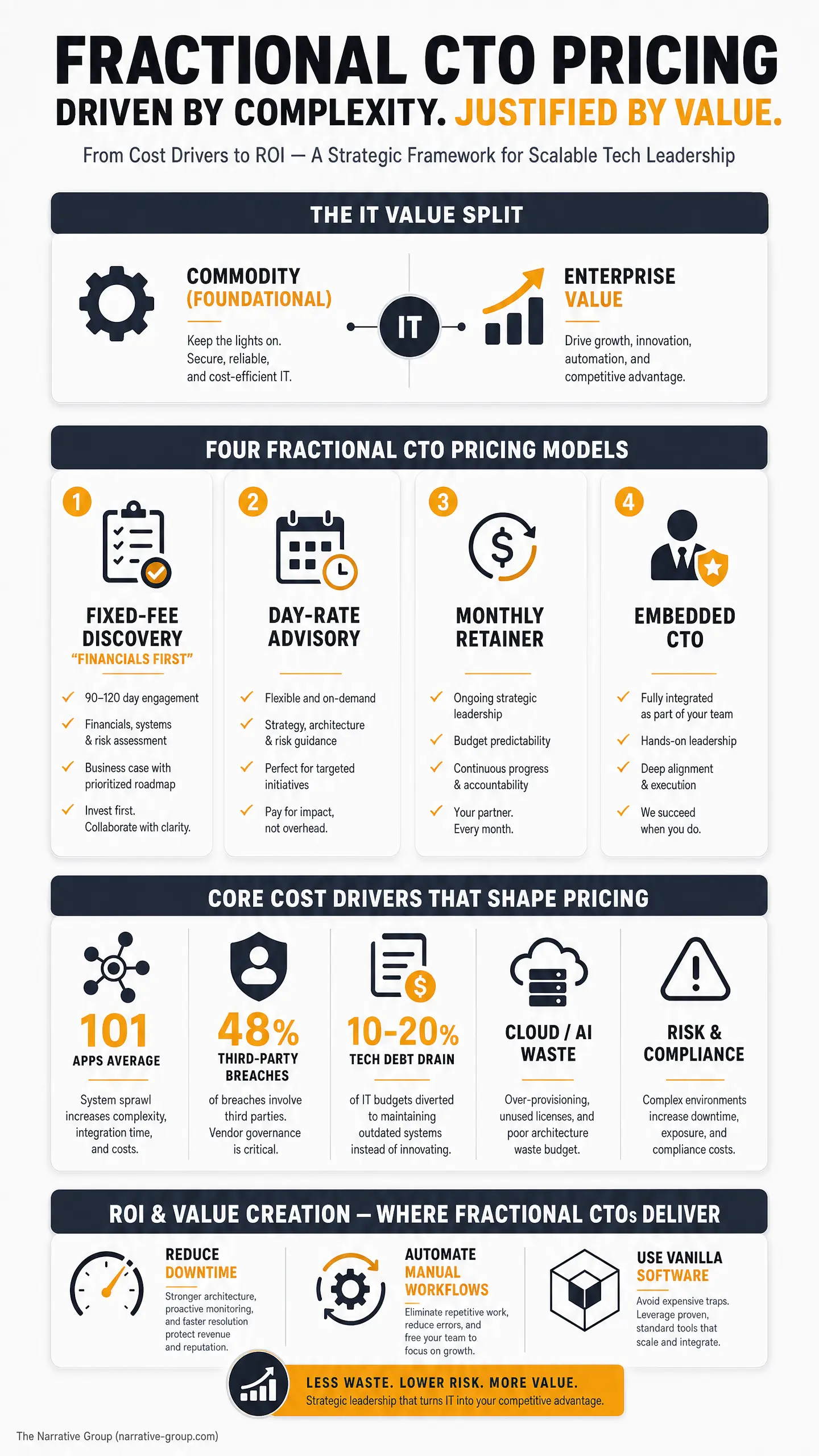
Fractional CTO pricing varies because the work varies.
One provider is giving you a few strategy calls each month. Another is stepping in as your acting technology leader. Another is bundling that with cybersecurity oversight, vendor management, and managed services. Those are very different jobs.
I often say IT is effectively two departments. One is foundational. Networks, devices, uptime, cyber hygiene, backups, and end-user support. That entire layer is a commodity. You should be paying commodity-oriented prices there.
The second layer is where enterprise value gets built. Architecture. Workflow. Data. Automation. Governance. Capital allocation. Vendor alignment. This is where a strong fractional CTO earns the fee.
Take the pieces that do not represent a competitive advantage and outsource them. Keep your executive attention on the things that actually drive enterprise value.
And unless your value proposition is technology itself, what makes you unique is the people, not the technology. The role of technology is to amplify their skills, their creativity, their superpower. That is the lens I use when I look at cost.
How Fractional CTO Work Is Usually Priced
Fixed-Fee Discovery
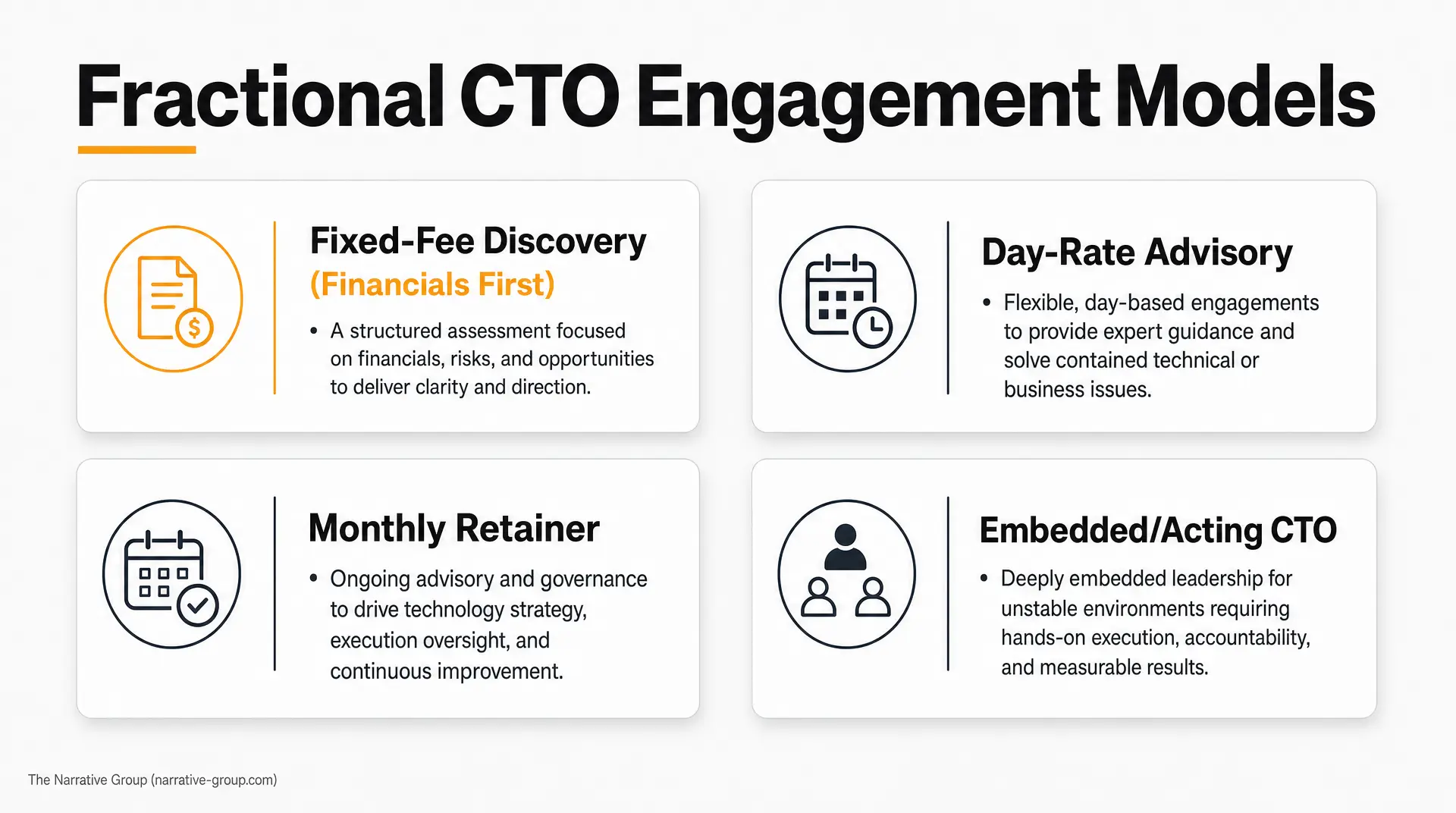
A fixed-fee discovery assessment is usually the smartest first spend.
At The Narrative Group, we call this Financials First. We look at how you spend money on IT, how you deploy capital, how the value chain is executed, and how data moves through the business. Then we go deeper. Who is talking to who? How often? Where does the handoff break? Draw it out. The picture tells a thousand words.
We also get practical. We go on site. We ask people to show us the day in the life. We look for physical bottlenecks, visual clutter, undocumented workarounds, and the places where the technology is letting them down. That is where the real friction shows up.
This fee should buy clarity. You should come out with a clear view of what is broken, what is risky, what is simply annoying, and what matters now. You should also get a phased roadmap. Quick wins first. Then the bigger moves. Big-bang plans make for nice slides and messy operations.
Day-Rate Advisory
Day rates make sense when the issue is contained.
Maybe you need help with a board meeting, a budget cycle, a cyber review, a major vendor decision, or diligence on a transaction. Then you are buying focused executive judgment for a defined moment. That can be a very good use of money.
This model falls short when the business has chronic confusion. If your systems are fragmented, your vendors are all doing their own little thing, and nobody owns the roadmap, a few workshop days will not clean that up. At that point, you are not buying advice. You are buying continuity, accountability, and decision rhythm.
Monthly Retainer

For many mid-market firms, the monthly retainer is the right shape.
A retainer gives you rhythm. You meet regularly. You keep the roadmap current. You stay on top of vendor performance, security risk, budget drift, and project priorities. You get board-ready reporting instead of a pile of technical updates. Most important, you get continuity. Somebody is there to help you make decisions before small issues turn into expensive ones.
The size of the retainer should follow the depth of access and accountability. A lighter retainer may cover scheduled executive sessions and targeted reviews. A heavier one means the fractional CTO is deeply involved with your leadership team, coaching IT managers, helping manage change, and making sure decisions actually land.
If you only need help with a few hard decisions each quarter, day-rate support may be enough. If you need ongoing governance, buy cadence.
Embedded or Acting CTO Support
Some companies need more than advice. They need an acting CTO.
That usually happens when the business is changing fast, the internal team is overstretched, or the environment is unstable. In that case, you are paying for leadership, follow-through, and accountability. The fee is higher because the responsibility is higher.
For smaller mid-market organizations, there is also a blended model. My team can act as the IT department while also providing the strategic layer above it. We often build credibility by fixing the boring foundational functions first. Then we move up into business process, architecture, and transformation work. If your IT environment is built solidly from the ground up, there is no firefighting, because things just work.
What Actually Drives the Fee Up
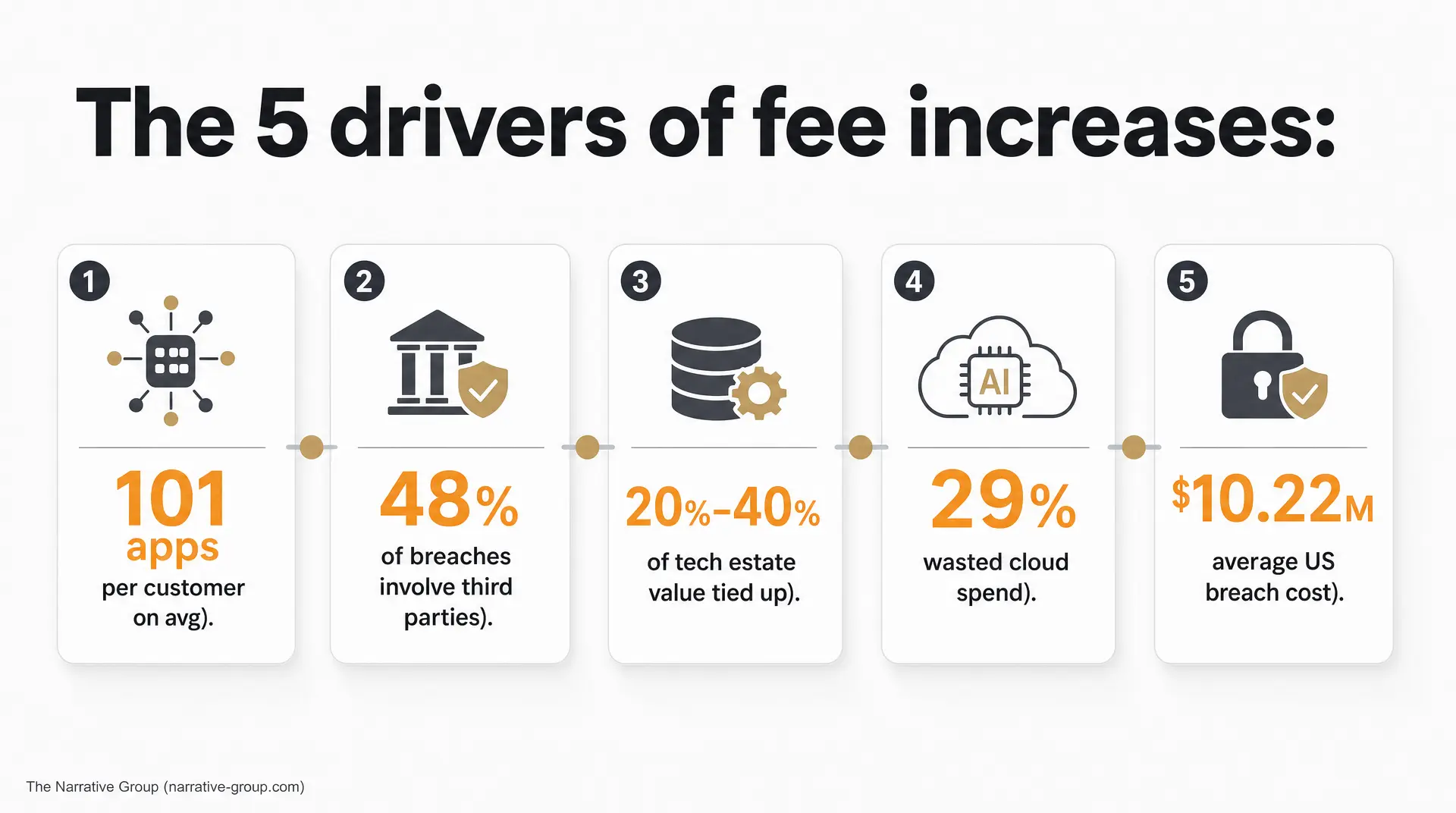
The first driver is complexity.
A single-site professional services firm with a clean cloud stack is one thing. A multi-location manufacturer, distributor, retailer, or regulated financial services company is another. The more systems that have to talk to each other, the more judgment the role requires.
System sprawl matters too. Okta found 101 apps per customer on average. That sounds flexible. It also means more overlap, more handoffs, more manual workarounds, and more vendors who can point fingers at one another when something breaks.
That brings me to the second driver. Vendor governance.
Verizon found 48% involve a third party when it comes to breaches. It also found third-party breach involvement rose 60%. If your fractional CTO has to clean up ownership, tighten accountability, and bring order to a vendor-heavy environment, the scope goes up.
The third driver is technical debt.
McKinsey found 10% to 20% diverted to tech debt from budgets meant for new products. It also estimated 20% to 40% of technology-estate value is tied up in technical debt. Another McKinsey study found 60% of CIOs saw tech debt rise over the prior three years.
I have seen how this happens. One client used an old tool called Mail Manager to save emails into SharePoint because they wanted to avoid Microsoft license fees. It looked like a saving. Later it complicated upgrades they needed, including Windows 11. Cheap choices have a way of creating expensive traps.
The fourth driver is cloud and AI governance.
Flexera reported 29% wasted cloud spend. It also found 64% now use business-value metrics to judge cloud progress. Good. That is the right conversation. Follow the money.
The AI piece needs even more discipline. The FinOps Foundation found 98% now manage AI spend. IBM found a one-in-five shadow AI breach rate. A lot of AI use cases are still not ready for prime time in core operations. You cannot just codify broken business processes and expect AI to clean them up. When you are trying to get AI to make up what the business process is, you lose control.
The fifth driver is risk. Cybersecurity and resilience are material financial issues now.
IBM reported a $10.22 million average U.S. breach cost. Verizon found 31% of breaches start with software vulnerabilities. Uptime Institute found 57% of major outages cost over $100,000. If your environment is shaky, your fractional CTO is helping protect cash flow, service quality, and reputation.
Leadership alignment also affects price. If the owners and executives have skin in the game, work moves faster. If every decision gets delayed, revisited, or watered down, the role gets heavier. That changes cost too.
Why the Cheapest Option Usually Costs More
I understand why leaders chase the lowest price. CFOs are supposed to be disciplined.
The problem is that low price often hides future cost. I have seen businesses choose low-cost providers, cut platform spend, or build custom shortcuts because the upfront number looked attractive. Later they pay through downtime, rework, manual labor, and missed opportunities.
This is where I push hard on vanilla software. Mainstream, not leading edge, not bleeding edge. Specifically and ruthlessly figure out where exactly you are different. For common processes, use standard platforms. They already give you security, scale, robustness, and performance. Whenever you have a common process and try to make it unique beyond the core commodity model, you are creating cost.
I also push hard on productivity. When leaders cut software or infrastructure spend without understanding workflow impact, the expense often moves into labor. People rekey data. They chase errors. They do work the system should have done. Innovation slows down because all the energy goes into keeping the operation alive.
Find the boring foundational functions. Fix them first. That is how you create room for better decisions later.
Fractional CTO or Full-Time Hire?
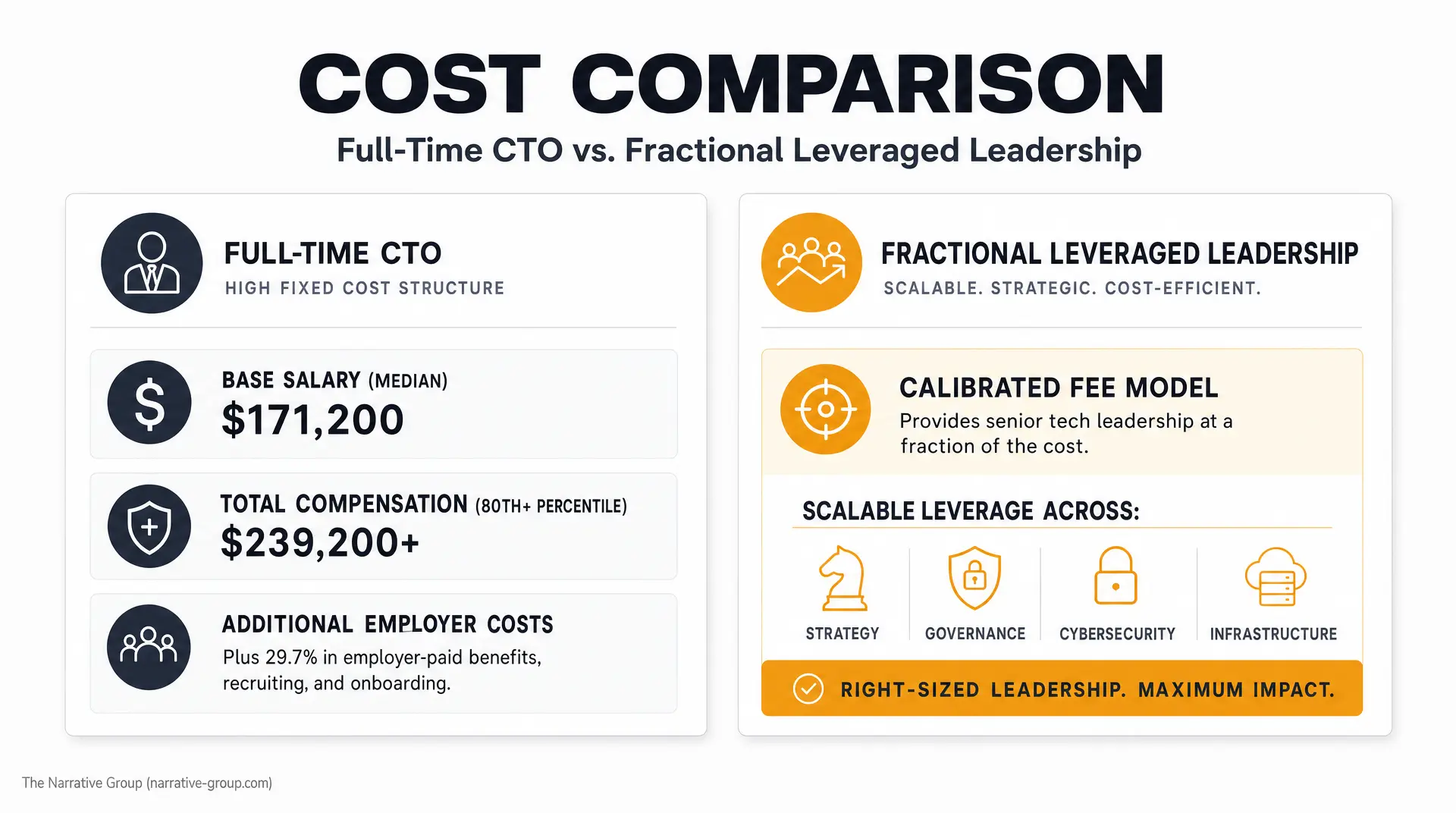
Now let’s get to the question underneath the question. Do you really need a full-time CTO?
Sometimes you do. If technology is your product, if you are building proprietary software, or if you need daily engineering leadership, hire the person. Keep them close to the business. Give them real authority.
Many mid-market firms are in a different place. They need enterprise-level judgment, board-ready reporting, security oversight, vendor discipline, and a roadmap that ties back to growth and margin. They do not need that seat filled full time every day.
The labor market is expensive. The U.S. Bureau of Labor Statistics says the $171,200 median annual wage for computer and information systems managers is already substantial. The top 10% earn more than $239,200. Employer-paid benefits for professional roles average 29.7% of total compensation. The same role is projected to grow 15% through 2034, with about 55,600 openings a year.
So the real cost of a full-time senior technology hire goes well beyond salary. Add bonus, recruiting, onboarding, and the cost of getting the wrong person, and the number climbs quickly.
A fractional model gives you leverage. You buy the level of leadership you need, when you need it. You can also get a broader bench behind that leader. At The Narrative Group, that can mean strategy, governance, cybersecurity, infrastructure, and delivery support sized to the business.
And remember this: IT is not about ones and zeros. It is about how the company makes money, where it wastes time, and how risk gets governed.
How I Think About Evaluate Fractional CTO ROI

When I talk to CFOs, I do not start with features. I start with value creation.
What are you trying to transform? Where does that show up in the P&L? What gets measured gets managed.
I look at IT spend against revenue and expenses. I look at the ratio of IT labor to non-labor spend. I look at uptime, downtime, and service levels. I look at how long key business processes take today. Then I measure again after the change.
A good example is a six-office client we supported. Their people could move from one office to another and fail to connect to the network. Their meeting rooms barely worked. Every request seemed to get blocked in the name of security. My view is simple. IT is intended to be an enabler, not a blocker.
We assessed the environment, replaced core switches and network gear, dealt with outdated servers, put devices on a lifecycle plan, and improved the meeting rooms. Over time the landscape stabilized. Years later, the managing director told me we had created a problem for him because everyone wanted the rest of the offices to look like the new office we built. Foundational work like that improves productivity, trust, and employee experience. It also gives the business a stable base for bigger changes.
Another example comes from e-commerce. We used AI and workflow automation to tackle a product setup cycle that had stretched to five weeks. One person could spend up to three weeks doing that work. We brought it down to four hours. That changes capacity in a very real way. The company can move faster, scale with less friction, and redeploy people into higher-value work.
That is how I want you to think about return. How much downtime did you suffer last year? What did it cost? Where are you hiring because people are doing manual work that should have been automated? Where are you carrying vendors or platforms that add complexity but no value?
If a fractional CTO helps you answer those questions and act on them, the fee becomes very easy to defend in a boardroom.
What I Would Ask Before Signing a Fractional CTO Agreement
If I were buying fractional CTO support, I would keep it straightforward.
Start with a Financials First discovery. Map the value chain. Map the systems. Map the data flows. Get out of the conference room and go see the business in motion. Stop focusing purely on requirements, and start asking core business questions.
Then look for a phased plan. Quick wins first. Bigger moves next. Make sure the provider can tell you what they will measure, how they will report it, and which decisions will stay with management.
If the provider is talking in ambiguity, keep looking. If they promise a flawless rollout with no pain, keep looking. Real change takes work. You assess it, you find the conflicts, you do the quick wins where you can, and then you incrementally transform with the business leaders. Talk is cheap. Actions speak volumes.
The operating change has to show up in measurable results.
Need Help Understanding the Right Level of Fractional CTO Support?
Fractional CTO pricing only makes sense when it is tied to the business problem. A light advisory model, a monthly governance rhythm, and an acting CTO engagement all solve different problems.
Narrative Group provides fractional CTO services built around Financials First: connecting technology leadership to business performance, risk reduction, operating capacity, and enterprise value.
Explore Fractional CTO Services or book a 15-minute discovery call.
Still sorting through competing technology investments? Start with the IT Investment Prioritization Scorecard.
Final Thought

So how much does a fractional CTO cost?
It depends on the depth of leadership you need, the condition of the environment, and the speed at which you need to move.
The better question is what value that leadership will create or protect. If the work reduces downtime, improves productivity, tightens security, cleans up vendor sprawl, and gives your executives a clearer line from technology to enterprise value, the math gets very clear.
Start with how you make money. Follow the money. Find the boring foundational functions. Then invest in the level of CTO support that helps your business operate more elegantly. Innovation is making the operation of a business model elegant. That is the goal.
Need Help Deciding Whether Fractional CTO Leadership Makes Sense?
If two or three of these signs sound familiar, the question is not whether you have technology issues. The question is whether those issues now require executive technology leadership.
Narrative Group provides fractional CTO services built around Financials First: connecting technology decisions to revenue, margin, productivity, risk reduction, and enterprise value.
Explore Fractional CTO Services or book a 15-minute discovery call.
Still sorting through competing technology requests? Start with the IT Investment Prioritization Scorecard.
Fractional CTO Series
- What Is a Fractional CTO – and When Does Your Business Need One?
- Fractional CTO vs Full-Time CTO: Which Is Right for Your Business?
- How Much Does a Fractional CTO Cost? A Mid-Market Pricing Guide
- 7 Signs Your Mid-Sized Company Needs a Fractional CTO
- How a Fractional CTO Prepares a Mid-Sized Company for Acquisition
Frequently Asked Questions
How long does it take for a fractional CTO to generate measurable ROI?
You should see initial returns within 90 days. We start by hunting wasted spend, like the 29% wasted cloud spend Flexera reports. By renegotiating vendor contracts and eliminating shadow IT, a fractional CTO often funds their own retainer quickly before moving to deeper workflow automation.
What is the financial risk of delaying the hire of senior IT leadership?
The cost of delay is usually a breach or an outage. Uptime Institute found 57% of major outages cost over $100,000. Waiting means compounding technical debt and leaving vulnerabilities open. You are gambling with your cash flow and reputation to save on a monthly retainer. It is bad math.
Should we budget for fractional CTO fees as OpEx or CapEx?
Treat the monthly retainer as OpEx. It is a predictable operating expense for ongoing executive governance. However, if the fractional CTO leads a major infrastructure transformation or develops proprietary software, portions of that specific project execution can often be capitalized. Always align with your controller, but expect an OpEx baseline.
How does existing technical debt impact the initial fractional CTO contract size?
Heavy technical debt directly increases upfront costs. McKinsey estimates tech debt equals 20% to 40% of your technology estate value. If your systems rely on manual workarounds, the initial engagement requires intensive un-tangling. Fix the boring foundational functions first to actively lower your ongoing governance fee.
Will bringing in a fractional CTO cause costly turnover in our current IT department?
Not if communicated correctly. A fractional CTO provides the executive air cover your internal team desperately lacks. We take over board reporting, budget defense, and complex vendor negotiations. This actually improves retention, freeing your technical staff to focus on system delivery instead of fighting boardroom battles they cannot win.