
Mid-sized companies rarely overspend on technology because they are careless. More often, they overspend because technology decisions accumulate faster than strategy, governance, and operating discipline. New tools get added. Legacy systems stay in place. Departments solve problems in isolation. Budgets rise, but the business still struggles to see cleaner reporting, smoother execution, or better financial performance.
I see the same pattern over and over. A midmarket company spends more on software, more on cloud, more on outside help, and more on security tools. The budget goes up. The frustration goes up with it. Operations still says the systems do not talk to each other. Finance still cannot get clean reporting. Front-line teams still feel the technology is letting them down. That pattern is exactly the kind of rising spend without clear outcomes your brief says Narrative should address for executive buyers.
The market data points in the same direction. In 2023,53% of mid-market companies reported spending more than 5% of revenue on technology, up from 20% two years earlier.
After more than 20 years doing this work, including leading technology at Shoppers Drug Mart and Loblaw, I have a simple view of the problem: midmarket companies overspend when they lack investment logic, a governance, and an operating roadmap.
One technology decision at a time may feel reasonable. Taken together, those decisions create overlap, confusion, and technical architecture that works against the value chain instead of supporting it.
That is why I founded The Narrative Group. I wanted midmarket leaders to have access to the kind of enterprise discipline I used in much larger organizations. I also got tired of hearing people talk about “the business” and “IT” as if they were separate. They are not. If technology is not helping the company make money, improve operations, reduce risk, or protect enterprise value, it is off course. That is consistent with Narrative’s positioning: technology should be framed as a business investment decision, not a tool purchase.
The Missing Investment Logic

Most companies start with the wrong question.
They ask, “What tool should we buy?”
I start somewhere else: How do you actually make money?
That question forces leadership back to the value chain. It forces you to follow the money, identify where labor is being consumed, where delays are showing up, where bad data is creating drag, and where operational friction is eating margin. Until that is clear, a technology decision is often just spending.
This is what I mean by Financials First. I want to understand the primary value chain and the supporting functions around it. I want to know where the business creates value, where labor is getting consumed, where delays show up, and where bad data is slowing the company down. Then we can talk about technology. That directly reflects Narrative’s brief: technology spending should be evaluated against growth, efficiency, risk, and enterprise value, not treated as a generic IT cost.
When I was at Loblaw, I helped align more than $300 million in capital spend to the enterprise strategy. That kind of discipline matters. Without it, capital gets scattered across pet projects, local fixes, and vendor promises. Consultants speak in ambiguity. Vendors sell the all-singing, all-dancing platform. Everyone nods. Then the work begins and nobody has defined the business rules, ownership model, or financial outcome.
For me, innovation is making the operation of a business model elegant. If technology makes the company harder to run, harder to scale, and harder to govern, it is not elegant. It is just expensive.
Tool Sprawl and Custom Work Burn Cash
The next problem is tool sprawl.
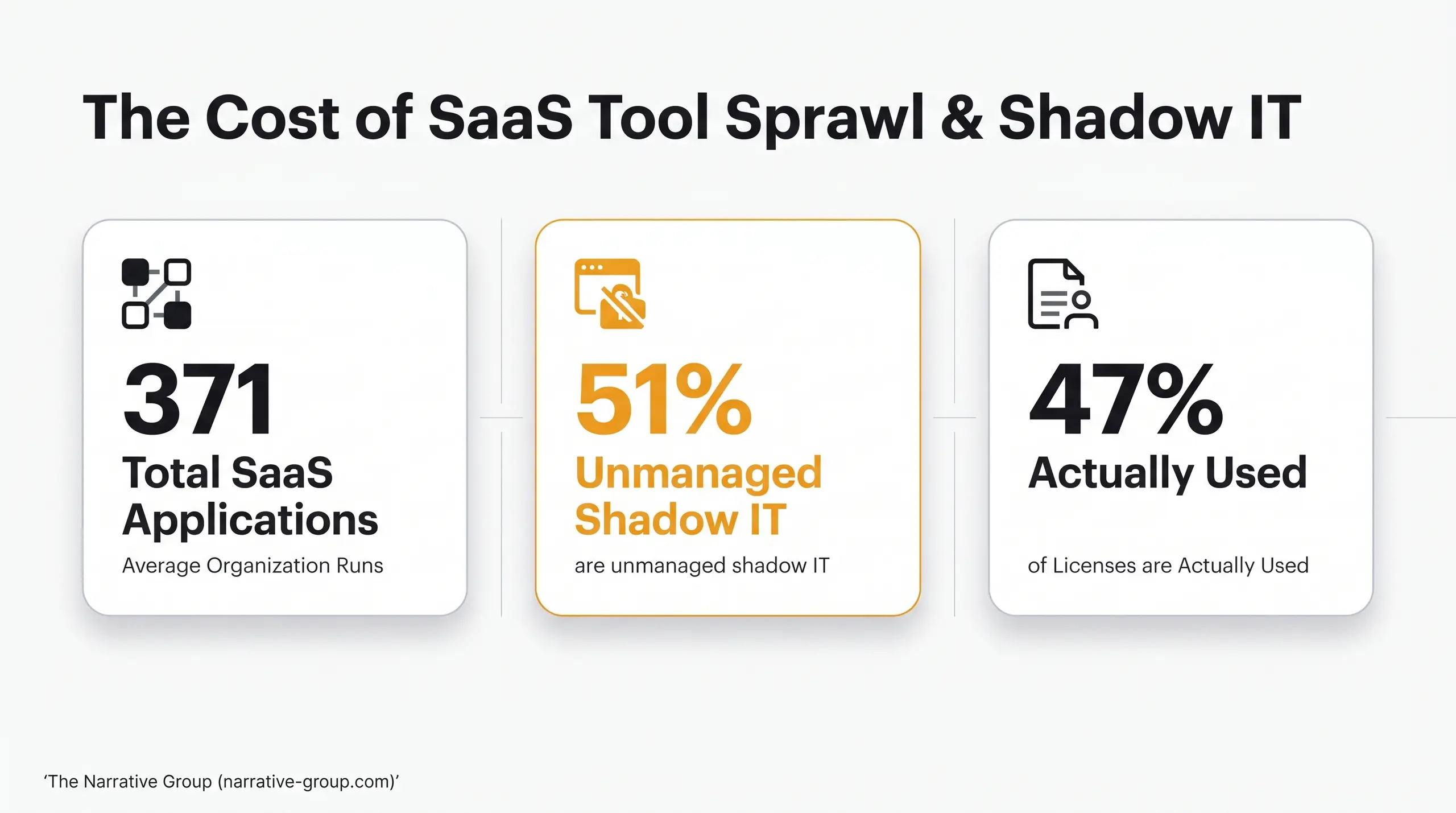
The average organization now runs 371 SaaS applications. About 51% are unmanaged shadow IT. A Productiv analysis found roughly $9.6K per employee is now going to SaaS, while only 47% of those licenses are actually used over a 90-day period. That pattern creates a tax on growth.
Why does it happen? Because every department solves its own pain in its own way. Sales buys one thing. Operations buys another. Finance adds something else. IT tries to stitch it together afterward. Now you have more vendors, more contracts, more logins, more data movement, and more risk.
Then customization makes it worse.
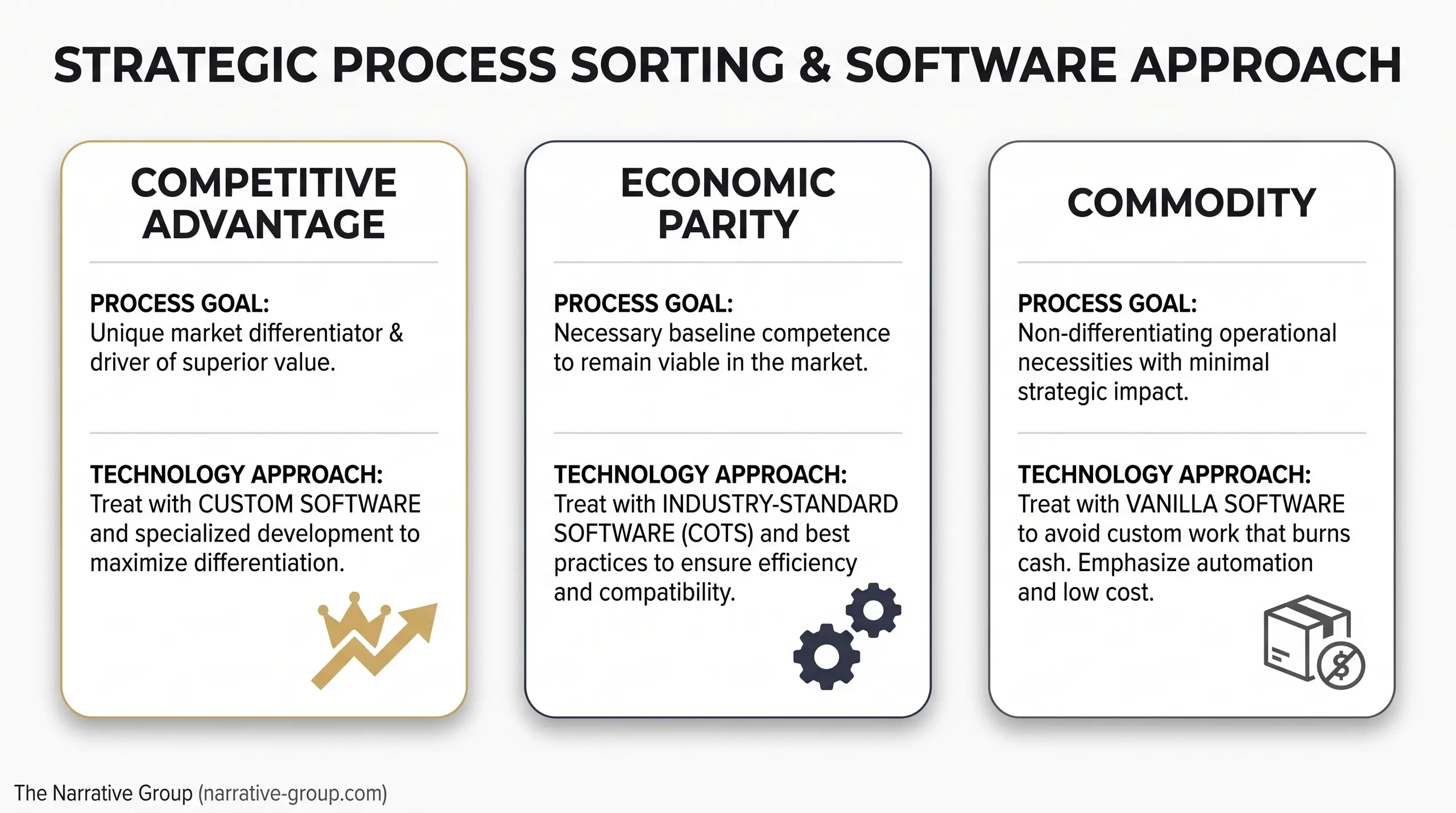
Most businesses feel they are unique and special. Some parts of the business genuinely are. But leaders have to be precise about where that uniqueness actually lives. I sort processes into three buckets: competitive advantage, economic parity, and commodity. If a process is common across the market, treat it that way. If it is nearing commodity status, treat it that way too.
That is why I push hard on vanilla software. Standard platforms give you security, scale, robustness, and performance. They also let you stay current. I want companies mainstream, not leading edge and certainly not bleeding edge. When you customize a common process beyond what the business really needs, you create cost that is very difficult to remove later.
One client used an older tool called Mail Manager to save emails into SharePoint because they wanted to avoid Microsoft license fees. It looked cheaper at the time. Later, it complicated a Windows 11 upgrade they needed to make. The savings were temporary. The drag lasted much longer.
I see the same thing when companies rely on temporary contractors, co-op students, or one clever internal person to build cheap custom software. That looks efficient in the short term. In reality, it often creates a scalability problem that the business pays for later.
CFOs can unintentionally make this worse. They cut software budgets and celebrate the reduction in license cost, but the expense often shifts into manual labor. People start keying data between systems. Teams create spreadsheets, workarounds, and email-driven processes. Innovation slows. Underinvest in enablement long enough, and human labor becomes the most expensive line on the P&L
Firefighting Feels Useful and Keeps You Stuck

Then you get Hero Syndrome.
A lot of midmarket firms reward the IT leader who saves the day. The intent is positive. They want the business to keep moving. But if your head of IT is constantly getting interrupted, they cannot do value creation work. They miss strategic meetings. They do not build governance. They spend their days reacting
New Relic research reinforces the cost of that pattern. IT teams spend about 30% of their time on unplanned outages, and organizations with full-stack monitoring see 79% less downtime and 92% lower outage costs. Some organizations estimate the cost of a major outage at at $1 million per hour. Firefighting is expensive. It drains time, money, and executive attention.
My view is blunt: firefighting should be minimized at all costs. If the IT environment is built solidly from the ground up, there is less firefighting because things simply work. The objective should be service level and service quality. Once that foundation is in place, your people can focus on the work that actually drives enterprise value.
I saw this with a client that had six offices. People could not move from one office to another and connect to the network. Meeting rooms barely worked. Every time they asked IT for help, security got used as the reason nothing could get done. That is the wrong mindset. Yes, you need security. But you cannot get in people’s way. IT is intended to be an enabler, not a blocker.
So we did the boring foundational work. We assessed the infrastructure. We replaced core switches and network gear. We replaced outdated servers. We put devices on a lifecycle plan. We fixed the meeting rooms and made sure people knew how they were supposed to work. Three years later, the managing director told me we had created a problem for him: everybody wanted the rest of the offices to look exactly like the new one because it worked that well.
At scale, I saw the same effect at Loblaw. We introduced manufacturing-oriented infrastructure-as-software principles and provisioning dropped from six weeks to one day. That kind of work is not flashy. It changes cost, speed, and service quality quickly.
Weak governance sits right beside hero syndrome. One feeds the other. In one client environment, a developer pushed through an unauthorized production change tied to a storage process without involving infrastructure. It broke the function for everyone else. Leadership only got serious about approval and change management once the consequences became visible.
Governance matters inside IT too. At Shoppers Drug Mart, we re-engineered the IT organization through Project Symphony. Specialized resources were embedded into portfolios and work was managed differently. Year-over-year productivity improved by 40% as measured by total invested capital. That kind of result does not come from heroics. It comes from structure, ownership, and discipline.
Technology Magnifies the Business Rules You Give It
A lot of failed rollouts get blamed on the software. Usually the deeper issue is that the business rules were underdefined.
You cannot codify broken business processes.
Self-checkout is a useful example. At Shoppers Drug Mart, we piloted it in two stores. The experience was simple and intervention rates were low, which gave us confidence to scale. At Loblaw, the intervention rates were so bad that we had to rewrite the front-end interface. Same broad category of technology. Very different result. The difference came down to user experience, accurate data, and a real understanding of the process.
That same lesson applies to scale. In a lab, a lot of things work. In the real world, with real users and real timing pressure, far more gets exposed. I was involved in a loyalty rollout that got delayed by months because performance testing revealed issues at scale. Painful, yes. Necessary, absolutely. Real-world pilots are worth the time because they reveal what the lab never will.
AI Will Help Only When the Process Is Under Control
AI is the newest place companies risk repeating the same mistake.
I am optimistic about AI. I am also cautious. It is immature, it does not know what it does not know, and it can sound more certain than it should. If leaders treat it like magic, they will overspend on it the same way they overspent on earlier waves of technology.
That said, the upside is real when the process is understood first. Midmarket firms using AI are reported to be more than twice as likely to achieve high growth, and Deloitte found 47% of companies with active AI reported revenue growth of 20% or more versus 23% of companies without AI.
The point is not that AI replaces discipline. The point is that AI amplifies disciplined process design.
I have seen that payoff directly. In one project, an e-commerce product setup cycle stretched across five weeks. One person spent three of those weeks doing tedious setup work. Once the workflow and business rules were clear, automation reduced that work to four hours. That is the kind of AI and workflow improvement I like: less drag, lower cost to operate, and more room for people to move into higher-value work.
The Operating Model That Actually Works
Reducing wasted technology spend usually does not require one dramatic decision. It requires a more disciplined operating model for how investments are evaluated, sequenced, and measured. That is consistent with Narrative’s engagement model: assessment first, leadership next, execution after that.
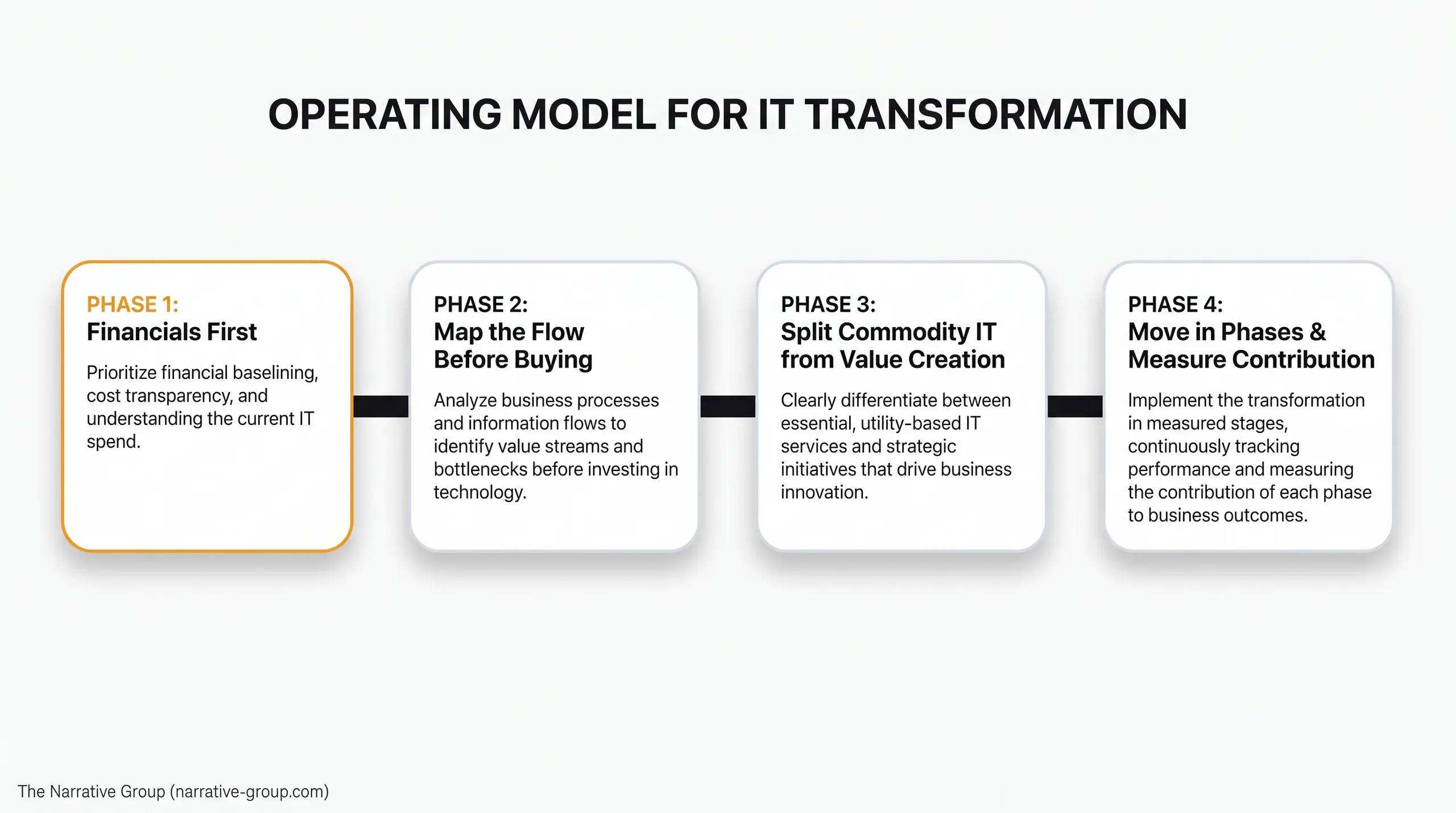
Start with Financials First

I start with discovery. Financials first. I look at how the company spends money on IT, how it deploys capital, and how it uses technology across the value chain. I want to know what is driving revenue, what is driving margin, and what is inflating cost. Then I can show the leadership team how technology spend affects specific lines on the P&L
Map the Flow Before Buying

From there, I go deeper. I ask people to show me the day in the life. Show me how the work actually gets done. Show me where the delays are. Show me what people are doing by hand because the system will not do what the company is asking it to do. When you go on site, the undocumented process usually reveals itself.
If a COO tells me the e-commerce platform does not talk to store inventory, I do not start with a replacement project. I start with the flow. How are you fulfilling orders? From a distribution center? From the store? Through click and collect? Which location owns the inventory? How often does the data move? Until you map that, you are guessing.
Split Commodity IT from Value Creation
I often tell leadership teams that IT is effectively two departments.
One part is core operational IT: help desk, devices, networks, infrastructure, and the basics that keep the company running. Much of that is commodity work and should be managed with commodity discipline.
The other part is business enablement. Those people need to understand workflows, data, economics, and the decisions that shape enterprise value. Internal talent should be focused on the things that actually create advantage. That is fully aligned with your positioning that technology should serve business performance, not just support operations.
Move in Phases and Measure Contribution
Transformation should be phased. Assess first. Find the conflicts. Do the quick wins where you can. Then build the broader roadmap and move through it with business leaders, not around them. In midmarket companies, when ownership buys in, the organization moves faster.
At Loblaw, we ran more than 60 proofs of value in 18 months and moved more than 10 into scaled implementation. That included self-checkout at Shoppers Drug Mart and robotic process engineering across four functional areas, producing more than $10 million in annualized savings. You pilot. You learn. You scale what works.
And you measure contribution, not activity. I want leaders to see year over year what IT is adding to the business: spend against revenue and expense, labor versus non-labor cost, service levels, uptime, cycle-time improvement, and the rate of hiring as productivity improves. That kind of measurement is exactly the kind of business-outcome framing your brief requires.
Final Thought
If your technology spend keeps rising and your business is not getting easier to run, do not start with another demo.
Start with a harder conversation.
How does the business actually make money? Which processes truly make you different? Which ones are baseline or commodity functions? Where is labor getting burned? Where are outages, bad data, and workarounds eating margin? Who owns the business rules? What will you measure?
Answer those questions first, and the spending starts to make sense.
Ignore them, and technology becomes a drag on growth.
My view has not changed: IT should help a business move faster, operate more cleanly, reduce waste, and amplify people’s capability. Build it that way, and the results start to show up where they matter most: in the operation, in the P&L, and in enterprise value.
If technology spend has grown faster than the business value it delivers, the problem is usually not one bad purchase. It is a broader alignment issue. Narrative helps mid-market companies assess technology investments, reduce waste, and build a roadmap tied to business performance.
Frequently Asked Questions
How can CFOs identify and eliminate hidden SaaS costs across departments?
Start with an audit of department-level credit card expenses. The average organization runs 371 SaaS applications, and roughly 51% are unmanaged shadow IT. Centralize procurement and ruthlessly cut licenses. Companies spend about $9.6K per employee on SaaS but only actively use 47% of them. That is pure margin leakage.
What is the true financial risk of deferring core network upgrades?
Deferring maintenance creates catastrophic P&L exposure. Over 84% of businesses report rising network outages, and 62% of organizations state a major IT outage costs them at least $1 million per hour. Outdated gear is not a cost-saving measure. It is a ticking time bomb that destroys revenue and paralyzes operations.
Should our board mandate AI implementation to accelerate revenue growth?
Only if your core business processes are already strictly defined. While 47% of companies with active AI report 20% or more revenue growth, AI cannot fix broken workflows. Mandate process governance first. Applying AI to undocumented, chaotic operations will only generate faster, more expensive errors.
How do we justify the capital expense for comprehensive IT monitoring tools?
The ROI is found directly in recovered labor and uptime. Organizations using full-stack IT monitoring experience 79% less downtime and 92% lower outage costs. Currently, IT teams waste 30% of their time firefighting. Monitoring shifts IT from a reactive cost center to a proactive, value-driving business enabler.
What is the most effective way to prevent software vendors from driving our IT strategy?
Force vendors to map their tools directly to your financial value chain before you sign anything. If they cannot prove how their solution specifically reduces labor consumption, accelerates fulfillment, or cleanses master data, walk away. You dictate the business rules. The vendor simply provides the commodity enablement.