

Most mid-sized companies build the IT budget backwards.
Someone starts with last year’s number. Finance asks for a cut. IT shows up with a shopping list. A vendor walks in with an AI deck and promises magic. Everybody nods. Nobody is really clear on what the business is buying.
That is not IT budget planning. That is cost allocation.
Global pressure is real. Gartner expects worldwide IT spending to hit $6.31 trillion in 2026. The question for you is simple. Are you funding value, or are you funding noise?
I do not start with tools. I start with one question: How do you actually make money? I have never liked the old language of “the business” and “IT” as if they are separate. They are not. Follow the money. Once you understand the value chain, you can see where technology helps, where it slows things down, and where the budget needs to go.
After more than 20 years in enterprise technology, including CTO roles at Loblaw and Shoppers Drug Mart, I have seen the same budgeting mistakes show up again and again.
Effective IT budget planning for mid-sized companies starts with the business model, not the spreadsheet.
How much should a mid-sized company spend on IT?
Most mid-sized companies spend between 3% and 9% of annual revenue on IT, but the right number for you depends heavily on your industry. The more your business runs on technology, the higher the share; the more it runs on physical assets, the lower it tends to be.
Here’s where mid-market IT budgets typically land by sector:
Industry and Typical IT spend (% of revenue)
- Banking | 8–10%
- SaaS / Technology | 7–9%
- Financial Services | 6–9%
- Legal | 5–7%
- Professional Services | 5–7%
- Engineering Consulting | 4.5–6.5%
- Healthcare | 4–6%
- Retail & E-commerce | 3.5–5.5%
- Logistics & Transportation | 3–5%
- Manufacturing | 2.5–4.5%
- Energy | 1.5–3.5%
The spread is wide for a reason. A bank runs on its systems, so technology is a large, defensible share of revenue. An energy or manufacturing company carries enormous revenue against a relatively small IT footprint, so the same dollar figure shows up as a much lower percentage. Spending well below your industry’s range isn’t a saving – it usually resurfaces a year or two later as security gaps, deferred upgrades, and systems no one wants to touch.
But the percentage is only half the planning question. The other half is where the money goes. A healthy mid-market IT budget splits across three jobs: maintenance (keeping existing systems secure and running), improvement (optimizing what you already have), and growth (funding new, revenue-generating technology). Most companies under-fund the third – the running costs quietly crowd out the work that actually moves the business forward.
Why Most IT Budgets Fail

Arbitrary Cuts Create Expensive Problems Later
One of the biggest budgeting mistakes is the arbitrary top-down cut. 10% comes out because somebody needs a number. Licenses get trimmed. Device refresh gets delayed. Old servers stay in service. Support contracts get squeezed. It looks disciplined on a spreadsheet. It usually creates a bigger bill later. This is an IT budget failure.
I have seen companies cut software cost and then push the work onto people. One business used an old tool called Mail Manager to save emails into SharePoint so it could avoid Microsoft license fees. It looked cheaper at the time. Later, when the company needed to move forward, that shortcut made the upgrade path harder.
I have seen companies cut software cost and then push the work onto people. One business used an old tool called Mail Manager to save emails into SharePoint so it could avoid Microsoft license fees. It looked cheaper at the time. Later, when the company needed to move forward, that shortcut made the upgrade path harder.
Microsoft confirms Windows 10 support ended on October 14, 2025, and Windows 11 requires TPM 2.0. Deferred lifecycle planning always catches up with you.
The same thing happens when a company picks the lowest-cost provider and ignores scale. One of the hidden costs of low-cost IT is loss of scalability. You save a little now. Later you pay in rework and missed opportunity. Cheap custom tools built by a short-term contractor or a co-op student create the same kind of risk. Manual effort rises. Innovation slows. The culture gets stuck in old patterns because the business is busy working around the system.
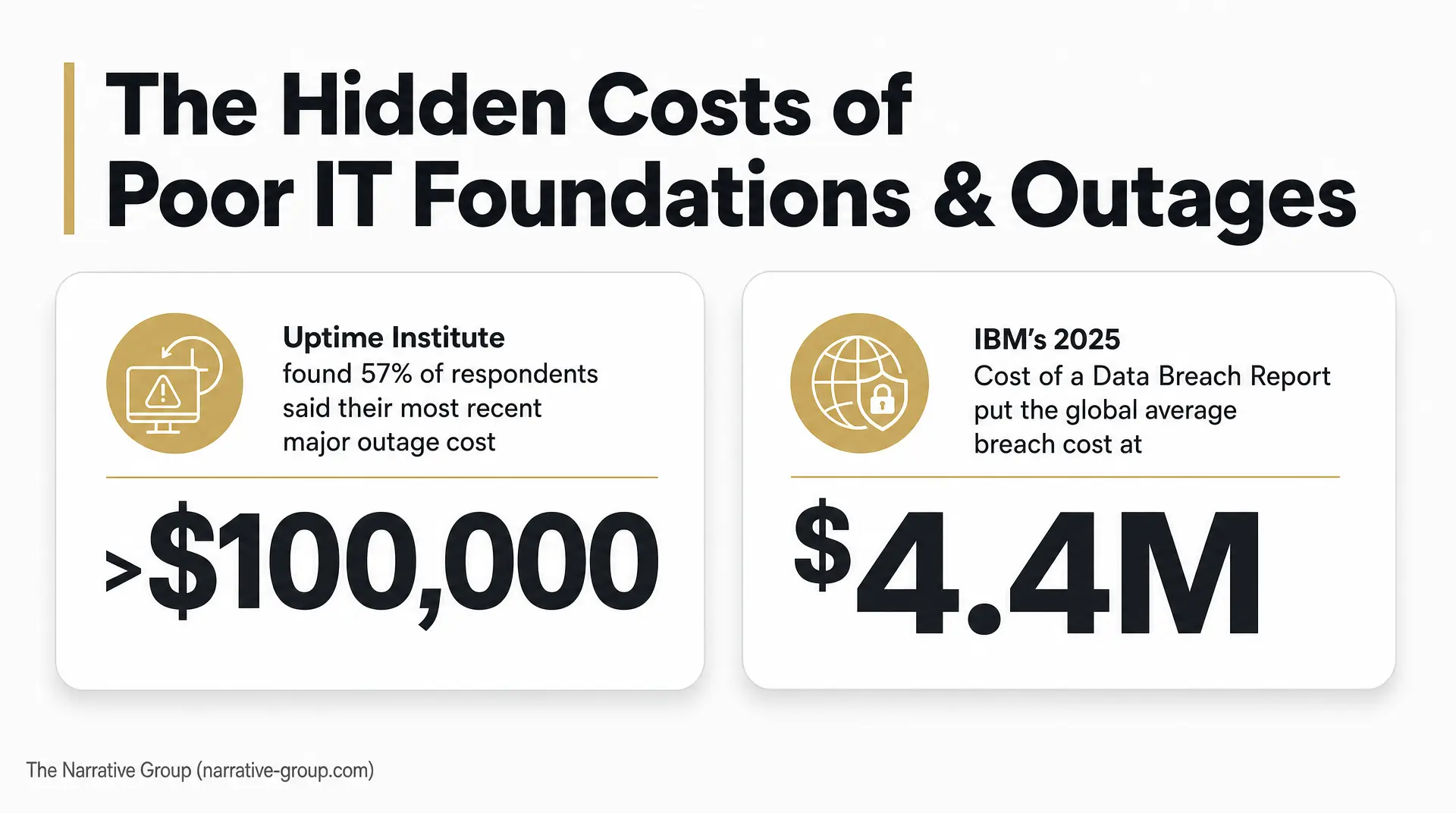
Underfunding the foundation also creates hard cash risk. Uptime Institute’s 2026 Annual Outage Analysis found 57% of respondents said their most recent major outage cost more than $100,000, and one in five said it cost more than $1 million. A lot of that pain is avoidable. Uptime Institute’s 2024 analysis found four in five serious outages could have been prevented with better management, process, or configuration. Those are budget decisions. They are not just technical problems.
Wish Lists and Vague Business Cases Do Not Help Leadership

The opposite mistake is the bottom-up wish list. Every team wants a new tool. Every vendor promises a tool that is presented as if it will solve every operational problem at once. AI gets dropped into every conversation whether the company is ready for it or not. When the rubber hits the road, leadership is left with a pile of line items and no clear business story.
This is why boards get frustrated. Deloitte found six in 10 executives say it is difficult to quantify the benefits of individual technology investments. McKinsey saw the same problem from another angle. Its survey of 1,331 executives found organizations captured only 31% of expected revenue benefits and 25% of expected cost benefits from recent digital transformations. If the budget is not tied tightly to business value, the return leaks out fast.
When leaders view IT only as a cost center, they drive exactly that outcome. Complexity grows. Downtime grows. Service levels drop. Employees decide IT is in the way. Then the business spends even more trying to patch over the damage.
Start with Financials First
My answer is Financials First. Before I recommend anything, I want to understand the business model. How is value created? Where does margin come from? Where does time get burned? You cannot pick technology before you understand the business model. I do not walk in assuming I know your business better than you do. I listen. Then I start mapping.
Financials First means technology decisions are evaluated through the business model first: how value is created, where margin is lost, where risk exists, and where technology can improve performance.
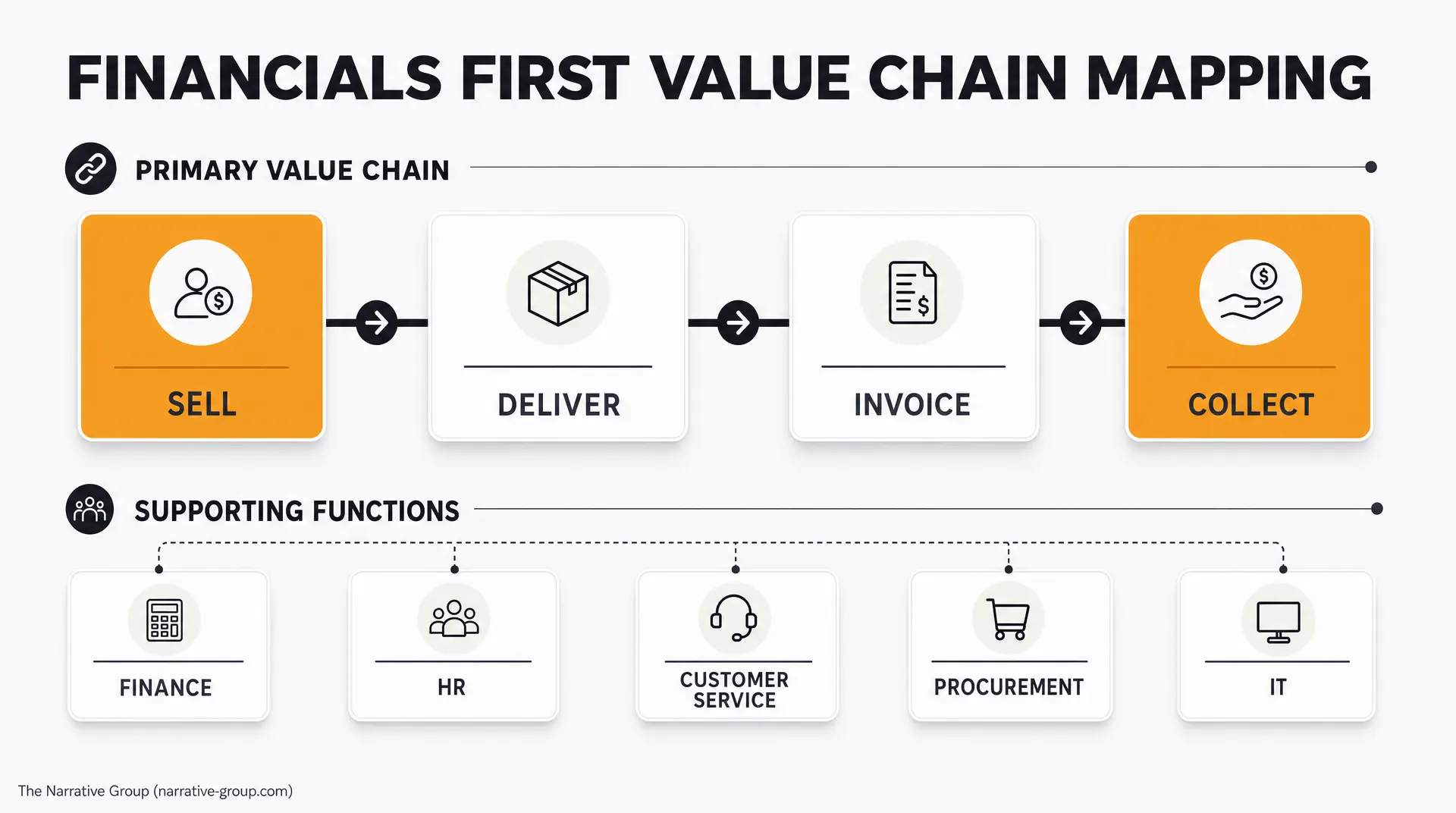
I split the analysis into two views. First, I look at the primary value chain. How do you sell, deliver, invoice, and collect? Where is the bottleneck? Where is the waste? Then I look at the supporting functions. Finance, HR, customer service, procurement, IT, and the rest. How much labor do they consume, and how can technology help them do more work without adding more people?
Then I want to see how data actually moves. Which systems talk to which? How often? Where do people rekey information? Where do spreadsheets show up because the systems do not connect? Draw it out. The picture tells a thousand words. When you map the flow, you can see very quickly where the technical architecture is in conflict with the value chain and which vendors are helping versus just doing their own little thing in a vacuum.
Then I go to the people closest to the work. Show me the day in the life. Show me what happens when an order comes in, when inventory changes, when a claim gets touched, when a report is built, when a customer calls. In my experience, the pain usually comes down to role definition or technology not doing what the company is asking it to do. Those frustrations are signals. They tell you where the budget will create the biggest return.
This is also where IT leaders need to stop focusing purely on requirements and start asking core business questions. Go to the branch. Go to the warehouse. Go to the office. Walk it with the people who run it every day. Look for clutter. Look for side files. Look for manual logs and sticky notes. Those are the places where undocumented process and weak systems are costing you money.
After that, leaders need to be ruthless about what is actually unique. Every process falls into one of three buckets. It is a competitive advantage, an economic parity function, or a commodity. Most companies think they are unique in more places than they really are. For common processes, use vanilla software. Stay current. Mainstream, not leading edge, not bleeding edge. Take the pieces that do not represent a competitive advantage and outsource them where it makes sense. Keep your internal people focused on the things that actually drive enterprise value. Unless your value proposition is technology itself, what makes you unique is your people, not the technology.
I often say IT is effectively two departments. One part keeps the foundation secure, stable, and current. The other part works with the business on productivity, workflow, and growth. If all your money is trapped in unstable foundational work and firefighting, the strategic side never gets funded.
Build the Budget in Three Buckets
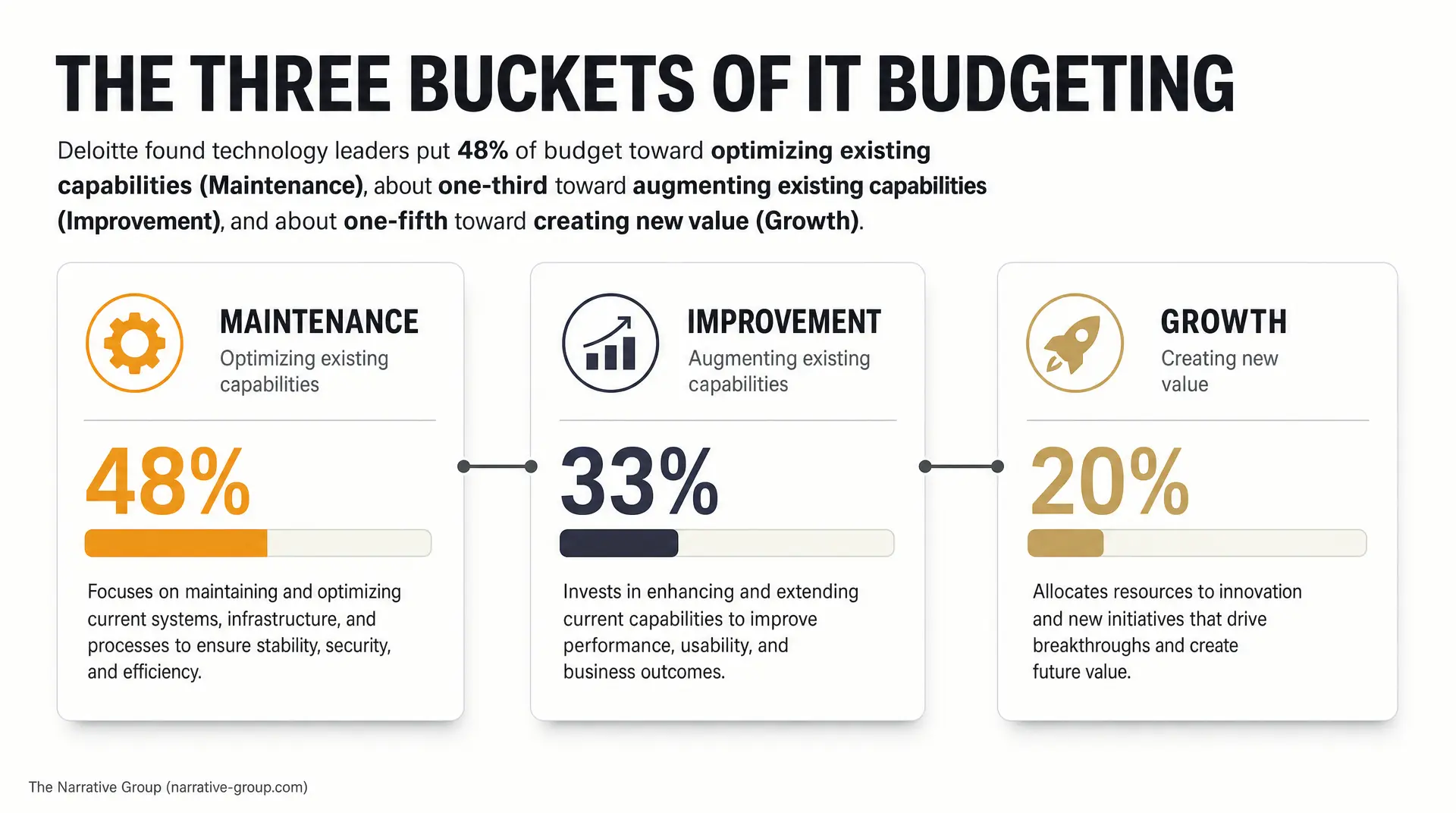
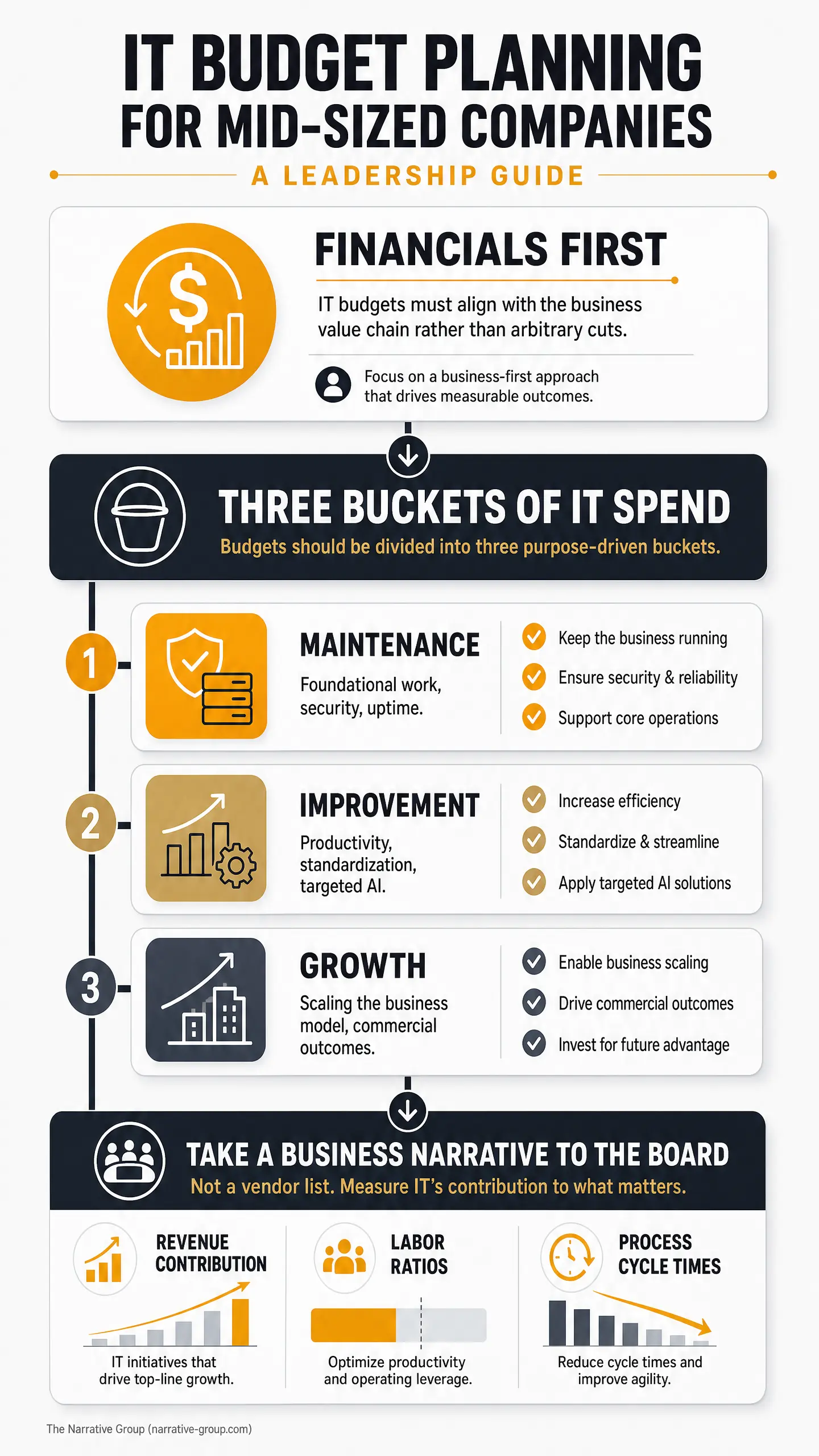
A useful IT budget separates spending into three categories: maintenance, improvement, and growth. Each category serves a different business purpose. Mixing them together is how companies end up underfunding the foundation while overfunding noise.
For budgeting, I want those priorities separated into three clear buckets. Maintenance. Improvement. Growth. If you blur them together, every budget meeting turns into a fight between keeping the lights on and funding the future. A healthy shape is visible in the market as well. Deloitte found technology leaders put 48% of budget toward optimizing existing capabilities, about one-third toward augmenting existing capabilities, and about one-fifth toward creating new value or entering new markets. I use that as a starting shape, not a rule.
Maintenance
Maintenance is the boring foundational work. Networks, devices, identity, patching, backup, recovery, cloud hygiene, meeting rooms, service desk, lifecycle replacement, and compliance all live here. Find the boring foundational functions first. Leaders often try to squeeze this because it does not feel strategic. That is a mistake. Good maintenance buys uptime, trust, and the space for the business to move.
At The Narrative Group, we often start here because credibility matters. One client came to us with six offices and a simple complaint. People moved from one office to another and could not reliably connect to the network. Meeting rooms barely worked. We assessed the environment, replaced core switches and network gear, replaced aging servers, put devices on a lifecycle plan, and improved the meeting room setup. Over time the whole landscape stabilized. Three years later, the managing director told me everyone wanted the rest of the offices to look like the new one because it worked that well. The whole point was simple. IT should be an enabler, not a blocker.
Security belongs in this bucket too. Verizon’s 2026 DBIR shows 31% of breaches now start with software vulnerabilities, 48% involve ransomware, and third-party involvement now accounts for 48% of breaches. IBM’s 2025 Cost of a Data Breach Report put the global average breach cost at $4.4 million and showed extensive use of AI in security lowered that by $1.9 million. Patching, vendor risk, identity controls, recovery planning, and monitoring are business protection. Treat them that way.
If your IT environment is built solidly from the ground up, there is no firefighting, because things just work. That is what the maintenance budget is there to deliver.
Improvement
Improvement money should go after productivity. This is where I start with standardization and automation. I want to know how long a task takes now, how often it happens, how many people touch it, and where errors show up. Then I want to measure the gain with your metrics, not mine. If a task took 20 hours and now takes five, the improvement is real. If the same team can do more work without adding more people, the P&L feels it.
In one e-commerce engagement, the product setup cycle took five weeks. The actual setup work could consume up to three weeks of one person’s time. We used AI and workflow automation on a very specific part of that process. The task dropped to four hours. That is how I like to use AI. Tight scope. Clear business rules. Measurable output. The goal is to reduce the cost to operate and redeploy people into higher-value work.
There is good evidence for this when the use case is clear. An NBER study found a 14% productivity increase for customer support agents using a generative AI assistant. I am optimistic about AI in long-running workflows and data quality work. I am not a fan of headline projects with no process discipline behind them. McKinsey’s 2025 State of AI survey says 88% of respondents report regular AI use in at least one function, but only about one-third are scaling and only 39% see any enterprise-level EBIT impact. Gartner predicts over 40% of agentic AI projects will be canceled by the end of 2027.
Before you fund AI, document the process, clean the data, and put governance around it. IBM also found 63% of breached organizations lacked AI governance policies. When you are trying to get AI to make up what the business process is, you lose control.
Growth
Growth money should support the next move in the business model. A new channel. Better customer experience. Stronger planning data. More throughput without burning out the team. My view is simple: innovation is making the operation of a business model elegant. For most mid-sized companies, the biggest hurdle to scale is productivity, which is why this bucket depends on getting the first two right.
Mid-sized companies usually do not need 10 growth bets. They need a few clear ones, phased properly, tested where possible, and tied to commercial outcomes. Real world experience matters. Pilot, learn, and then scale. When this bucket is funded well, technology amplifies people’s skills, their creativity, their superpower, and helps the company grow without breaking the operation.
What Should You Spend?

Now let’s deal with the question every CFO asks. What should IT spend be as a percentage of revenue? There is no single magic number. Context matters too much. Still, you can use market data as a reference point. Deloitte’s 2023 Global Technology Leadership Study found average technology budget as a share of revenue rose from 4.25% in 2020 to 5.49% in 2022 and pointed toward 5.85% by 2024. That tells you the pressure is broad. It also tells you low spend is not automatically smart.
The same study makes the deeper point. Companies that generate revenue from selling data, technology, or tech-enabled services run at 8.54% of revenue versus 3.66% for companies that do not. So ask again: how do you actually make money? A manufacturer, lender, distributor, retailer, and professional services firm will not land in the same place.
For many mid-sized companies, a sensible starting shape is roughly half the budget on maintenance and core optimization, roughly a third on improvement, and roughly a fifth on growth. Then adjust. If maintenance keeps swallowing everything, complexity is too high or the foundation is weak. If growth projects dominate while the basics are shaky, you are funding noise. If spend looks low because people are covering the gaps with manual work, you are underinvested.
How to Take the Budget to the Board

When you take the budget to the board, do not walk in with a vendor list. Walk in with a business narrative. Every major line of spend should answer five questions. What business objective does it support? What problem or risk is it dealing with? Does it belong in maintenance, improvement, or growth? How will success be measured? Who owns the outcome on the business side? Someone needs skin in the game. If those answers are weak, the item is not ready.
I want the board to see clear measures. Show total IT spend against revenue. Show the ratio of IT labor to non-labor spend. Show uptime, recovery performance, cyber exposure, and process cycle time changes. Show where productivity improved enough to slow the rate of hiring. What gets measured gets managed. At The Narrative Group, we use a model that shows leaders the contribution IT makes to business success year over year. When executives can see that movement, the conversation gets practical very quickly. If a CFO still sees IT as overhead, calculate what last year’s downtime cost in lost productivity. That number gets attention.
I also want executive ownership. Change starts at the top. If senior leaders buy in, they prepare the organization for it. If they approve the spend and then disappear, resistance shows up on the front line and the return drops. When I meet store managers, office leaders, or line managers who are nervous about a technology project, I tell them we are there to help because the technology is letting them down. Then I listen. Then I deliver. Talk is cheap. Actions speak volumes.
Keep execution phased. Do the quick wins where you can. Build credibility. Then take on the bigger changes. I rarely recommend a big-bang move for a mid-sized company. Assess it, find the conflicts, fix the obvious pain, and then move through the larger program with discipline. Review it quarterly, not once a year. The business will move, and the budget needs to stay connected to reality.
Before You Finalize the Budget, Prioritize the Investments
Not every technology request deserves funding.
Some initiatives protect the business. Some improve productivity. Some support growth. Some are useful but not urgent. Some are expensive distractions dressed up as innovation.
Before finalizing the IT budget, leadership teams need a consistent way to compare competing technology investments.
That means scoring each initiative against:
- Business impact
- Risk reduction
- Implementation complexity
- Strategic alignment
- Financial value
- Timing
- Operational readiness
This is where the IT Investment Prioritization Scorecard can help.
The scorecard gives leadership teams a practical way to evaluate what should be funded, what should be delayed, and what needs more analysis before it belongs in the budget.
For a deeper review, Narrative’s Financials First process connects technology spending to business performance and identifies what to fund, what to fix, and what to stop.
Final Thought

An IT budget is a leadership document. It tells you what you are protecting, what you are fixing, and what you are trying to grow.
Start with Financials First. Follow the money. Fund the boring foundational functions. Put improvement money into measurable productivity. Keep growth bets tied to the business model. Use vanilla software where the process is common. Keep your best people on the things that actually make you different. At the end of the day, the most important thing is having a business model that works. Technology just empowers it.
Do that, and IT becomes what it should have been all along: an enabler of the business and a driver of enterprise value.
Need Help Aligning IT Spend with Business Performance?
IT budget planning should not be a spreadsheet exercise.
For mid-sized companies, the IT budget should show what the business is protecting, what it is improving, and where it is investing for growth.
Narrative’s Financials First assessment helps leadership teams connect technology spend to the value chain, risk profile, productivity opportunities, and growth priorities of the business.
Use the IT Investment Prioritization Scorecard to evaluate your next round of technology investments, or explore Financials First if your leadership team needs a clearer view of what to fund, what to fix, and what to stop.
Technology Investment Strategy (This Series)
- IT Maturity Models Explained for Mid-Market Executives
- Technology Investment Prioritization: A Framework for Mid-Sized Companies
- IT Budget Planning for Mid-Sized Companies
- How to Build a Technology Business Case Your CFO Will Actually Approve
- CapEx vs OpEx in IT Strategy
- When to Replace vs Optimize Your Business Systems
- The Hidden Cost of Reactive IT in Mid-Sized Companies
Frequently Asked Questions
How do we manage strategic IT planning without the budget for a full-time CIO?
Fractional leadership is the answer. Mid-market companies often do not need a full-time CIO, but they absolutely require executive-level technology strategy. Bring in a virtual CIO to align your technology roadmap with the business model, build the three-bucket budget, and hold vendors accountable while keeping fixed payroll costs lean.
How should we evaluate the hidden costs of third-party technology vendors?
Vendor risk is business risk. Do not just look at subscription fees. You must rigorously evaluate their data security posture. According to the Verizon 2026 DBIR, third-party involvement now accounts for 48% of data breaches. Budget for strict vendor risk assessments and foundational access controls before signing any new service contracts.
When does it make financial sense to replace a legacy system instead of maintaining it?
Replace it when downtime outpaces the cost of capital. Legacy systems look cheap on paper but carry massive hidden risks. The Uptime Institute reports 57% of major outages cost over $100,000. When manual workarounds and unplanned maintenance consume your team’s time, holding onto legacy tech destroys your enterprise value.
Can we use artificial intelligence to directly reduce our cybersecurity budget?
Yes, but it reduces the cost of failure, not the cost of software. The IBM 2025 Cost of a Data Breach Report shows organizations using AI in security saved $1.9 million during a breach. Budgeting for automated security tools accelerates incident recovery, turning security from pure overhead into measurable risk reduction.
How do we prevent digital transformation budgets from spiraling out of control?
Stop funding massive, unproven tech rollouts. Tie every dollar to a specific operational bottleneck. According to McKinsey, organizations capture just 31% of expected revenue benefits from digital transformations. Force leaders to prove measurable productivity gains in a small pilot before you release the capital to scale it globally.