

A technology business case your CFO will approve does not start with a vendor deck.
It starts with a business problem, a financial baseline, and a clear path from technology spend to EBITDA, capacity improvement, or risk reduction.
Too many technology proposals start with the tool: AI, cloud, ERP, cybersecurity, analytics, automation. The platform may matter, but the platform is not the business case.
The business case is the financial logic behind the investment.
I have spent more than 20 years leading enterprise technology, including roles at Shoppers Drug Mart and Loblaw, and now I help small and midsize companies through The Narrative Group.
This led to our Financials First IT Value Alignment Assessment. Before debating systems, vendors, or architecture, leadership needs to understand how the business creates value, where margin is being lost, and where technology can improve performance.
A CFO does not need a tour of the tool. They need to understand why this investment deserves capital ahead of every other competing priority.
Finance is under pressure too. A Gartner forecast put worldwide IT spending at $5.435 trillion in 2025, up 7.9%. Deloitte found the average technology budget rose to 5.49% of revenue. So when your CFO looks at a technology request, they are looking at a real capital-allocation decision.
Why Most Technology Business Cases Fail

The first problem is simple. Most cases start with the tool. AI. Cloud. ERP. Cyber. Analytics. Usually, it is pitched as a tool that will solve every operational problem at once
. Fine. But what are you trying to transform? Where is the business under pressure? How do you actually make money? If you cannot answer those questions in plain English, the case is not ready.
The second problem is weak value logic. Deloitte says six in 10 executives struggle to quantify the benefit of individual technology investments. I see that all the time. The paper is full of architecture and thin on economics. There is no clean line from the spend to EBITDA, cash, capacity, or reduced risk.
Then there is the status quo problem. Too many cases treat the current state like it is free. It never is. The cost is buried in manual work, downtime, workarounds, rekeying, and upgrade pain. I saw one company use an old tool called Mail Manager to save emails into SharePoint so they could avoid Microsoft license costs. That looked cheaper in the moment. Later it complicated a Windows 11 upgrade and turned a small saving into a much bigger problem.
Risk framing is usually weak as well. Some cases pretend the rollout will be smooth and the current state is stable. That is wishful thinking. Uptime Institute found that more than half of recent serious outages cost over $100,000, and 16% cost more than $1 million. It also found four in five serious outages could have been prevented with better management, process, or configuration. Downtime is a business cost. So is poor governance. And if you show finance only one option, it looks like a sales pitch.
Start Where Finance Starts: How the Business Makes Money
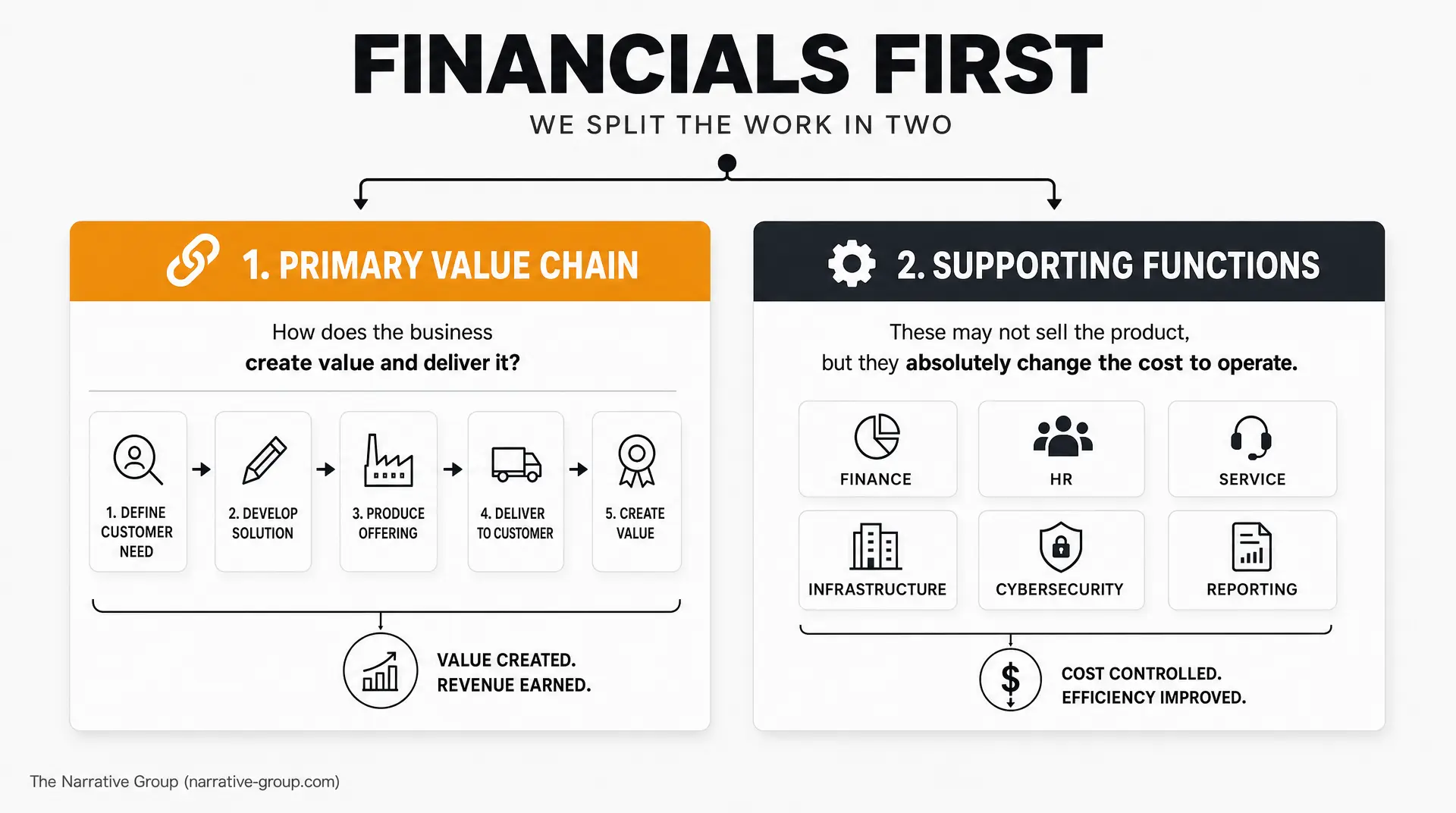
When I sit with a CFO, a COO, or an owner, my first question is always the same: How do you actually make money? I want to understand the value chain. I want to see how revenue is created, how work gets fulfilled, and where margin gets lost. Until I know that, I do not want to debate platforms.
At The Narrative Group, we call this Financials First. We split the work in two. First, the primary value chain. How does the business create value and deliver it? Second, the supporting functions. Finance, HR, service, infrastructure, cybersecurity, reporting. These may not sell the product, but they absolutely change the cost to operate.
Look, most businesses have a productivity problem. They just do not call it that. They call it backlog, overtime, hiring pressure, or missed deadlines. So I map how the work actually flows. Who talks to who? Which system updates which system? How often? Where does the data stall? Draw it out. The picture tells a thousand words. Then go see the process. Show me the day in the life. That is where you find the technical architecture in conflict with the value chain.
That is also where I get ruthless about standardization. Every process should be judged honestly. Is it a competitive advantage, an economic parity, or a commodity? Most companies think more of their processes are unique than they really are. They are not. Use vanilla software for common processes. Stay mainstream, not leading edge, not bleeding edge. In most companies, IT is effectively two departments. One runs the commodity foundation. The other helps the business create value. Save your best people for the second one.
This is the core of Narrative’s Financials First approach: technology decisions should be evaluated based on how they affect the value chain, cost structure, risk profile, and growth capacity of the business.
What an Approvable Technology Business Case Actually Includes
A Clear Executive Summary

The first page should include the:
- Business problem
- Current-state cost
- Recommended investment
- Expected financial impact
- Implementation timeline
- Key risks
- Decision required
A Real Current-State Cost

This section needs honesty. Show total IT spend against revenue. Show labor and non-labor. Show downtime, incident levels, manual work, rework, service gaps, and the cost of slow execution. Deloitte found companies were investing an average of 7.5% of revenue in digital transformation, and a lot of that sits outside the IT budget. So your baseline has to include business-side labor, workaround cost, and process drag. If it does not, the current state will look cheaper than it really is.
I also want you to listen to people. Front-line frustration is evidence. In my experience, the pain usually shows up in role definition or in technology not doing what the company is asking it to do. When people are frustrated, the technology is letting them down somewhere in the process. That belongs in the baseline too.
And be careful with false savings. Cutting software or provider cost can look smart for a quarter and hurt you for years. The expense often moves into manual labor. People pick up the slack. Innovation slows down. Flexera estimated 29% of cloud spend is wasted. That is the kind of leakage a CFO cares about.
Use the company’s own metrics wherever you can. If operations tracks cycle time, use that. If the service desk tracks outages, use that. If finance knows what an hour of downtime costs, use that. I trust the client’s own numbers far more than generic vendor benchmarks. They make the board conversation cleaner too, because nobody is arguing about somebody else’s assumptions. These are some KPI’s every CIO should track.
A Future-State Benefit Tied to EBITDA
Now we get to the part that matters most. The technology investment roadmap. How does the investment improve the business? Tell me how it affects revenue, gross margin, operating expense, working capital, or the rate of hiring. If the business can grow without hiring at the old pace, the P&L improves. If a fixed-price business uses less labor to deliver the same work, margin improves. If better stability reduces lost sales or unplanned labor, EBITDA improves.
For the supporting functions, I am looking for leverage. Can finance close faster without adding people? Can customer service handle more volume with the same team? Can operations stop drowning in manual exceptions? Technology investment often lowers the rate of hiring, and that shift surprises business leaders. It should not. Better productivity changes the economics.
For productivity, keep the measure simple. How long does the task take now? How long will it take after the change? Use the company’s own numbers. If a process drops from 20 hours to five, that is real. If a team can handle more volume without more people, that is real. At the end of the day, the benefit has to land somewhere. Talk is cheap. Actions speak volumes.
A Serious View of Risk

A good case also shows the cost of doing nothing. Unsupported systems, weak integrations, poor master data, manual approvals, and bad governance all create future expense. Sometimes it arrives fast. IBM put the average cost of a breach at $4.4 million. Sometimes it arrives slowly through delays, churn, compliance issues, or expensive upgrades. Either way, the risk of inaction has to be visible. Some look to experts for help with their It Strategy.
Security belongs in the case, but it needs to be framed properly. Fear language is lazy. Business language works better. IBM found organizations that used AI and automation extensively in security saved an average of $1.9 million in breach costs. Good. Now explain who owns the controls, how governance works, and what exposure you are reducing. IT is intended to be an enabler, not a blocker.
Options, Projections, and a Recommended Path
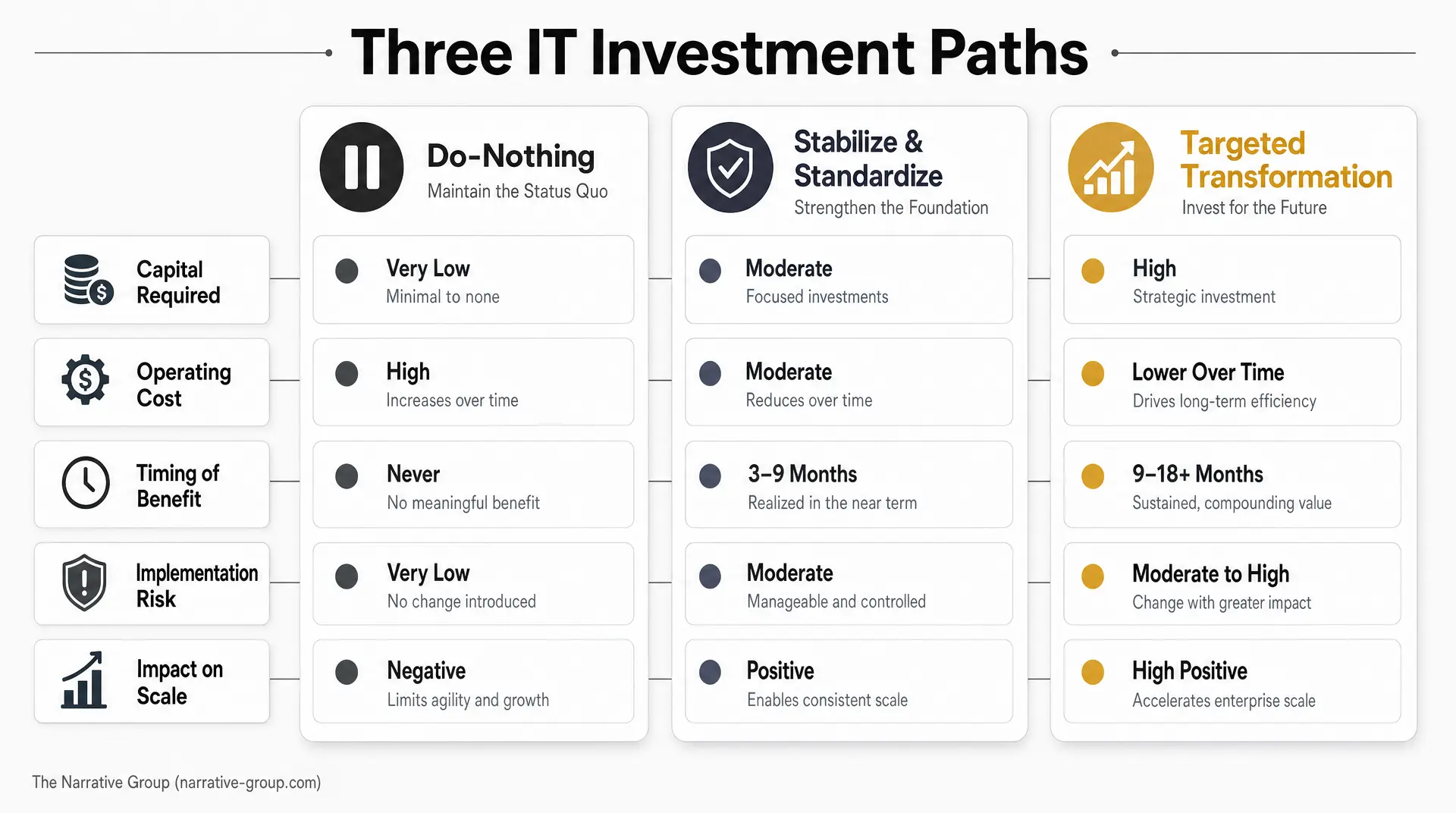
Do not show finance one answer. Show them the choices. I usually want to see a technology investment prioritization including a do-nothing path, a stabilize-and-standardize path, and a targeted transformation path. For each one, show the capital required, the operating cost, the timing of the benefit, the implementation risk, and the impact on scale. Once you lay that out, the trade-offs become clear.
And do not just compare purchase price. Compare the operating model around it. What support burden comes with it? What skills do you need? What happens when the business doubles? One of the hidden costs of cheap IT is the loss of scalability. The bill shows up later through rework, missed opportunities, and expensive cleanup.
The winning path is often the mainstream one. Use the standard platform. Avoid heroic customization. Avoid the low-cost provider who cannot scale with you. Whenever you take a common process and make it special for no good reason, you create cost that is hard to remove later. Foundational IT should be bought at commodity-oriented pricing and held to strong service levels. Then your internal talent can focus on what actually drives enterprise value.
Ownership, Governance, and Proof
If the business leader is not attached to the case, the case is weak. IT can recommend. The business has to own the decision. Deloitte found many organizations still lack joint ownership between IT and the business, and many still lack a clear process for prioritizing investments. That is why approved projects drift.
I prefer an incremental path with solid IT governance. Get the quick wins. Pilot where you can. Learn in a controlled setting. Then scale. Lab testing matters, but real-world experience matters more. At The Narrative Group, we often organize the work into three to five themes and manage each one as a program. We also measure the contribution IT makes year over year. What gets measured gets managed.
Change management belongs here too. Employees can sink a good project if leaders leave them in the dark. The business leader has to set the stage, explain why the change is happening, and help people through it. Our job is to support that. We cannot own their business decisions for them.
What This Looks Like in the Real World

Shoppers Drug Mart and Self-Checkout

Self-checkout is a good example because the business case sounds easy until you test it. Labor is a major cost in retail, so letting customers scan their own basket is attractive. But the economics only work when the user experience is easy, the pricing and item data are right, and staff interventions stay low. If people keep getting stuck, the labor benefit disappears very quickly.
At Shoppers Drug Mart, we piloted self-checkout in two stores. We simplified the user experience and fixed the early service-level issues. The pilot performed well enough that the rollout expanded into 100 stores and eventually more than 400. That is the sequence I want in a business case. Start small. Measure what matters. Prove the operating model. Then scale. External research adds a useful reminder here. Self-checkout loss has been measured at 9.5% of total recorded shrink, so the labor story only holds when usability, controls, and loss are managed together.
AI and Workflow Automation in E-Commerce
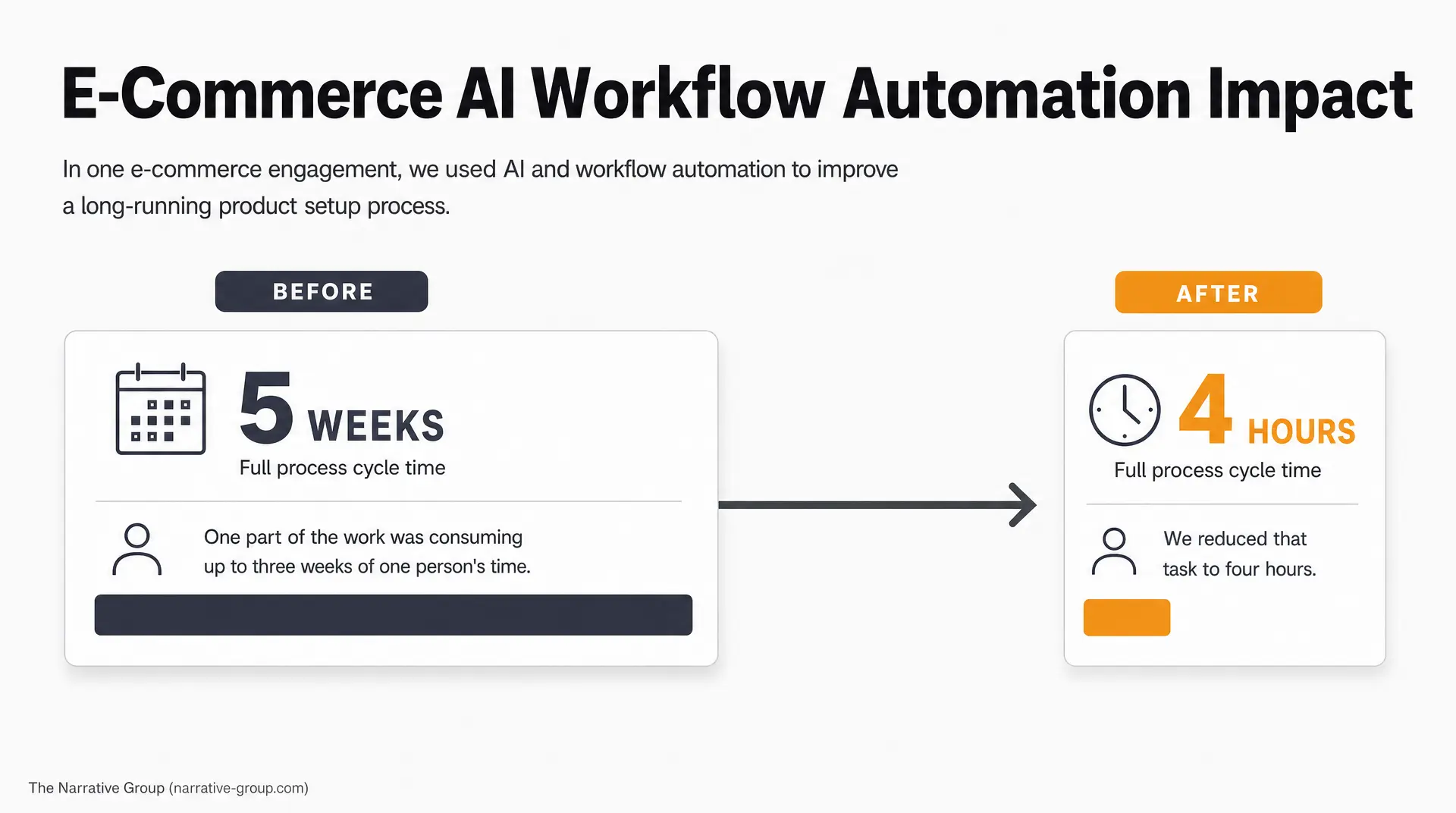
I also like business cases that begin in boring foundational work. That is where you often find the cleanest return. In one e-commerce engagement, we used AI and workflow automation to improve a long-running product setup process. The full cycle was taking five weeks. One part of the work was consuming up to three weeks of one person’s time. We reduced that task to four hours.
Now the finance conversation is real. You can see the labor impact. You can see the capacity gain. You can see how people can be redeployed into more valuable work. That is how I think about AI. It should help improve workflow, data quality, and decision support. McKinsey found only 39% of respondents reported enterprise-level EBIT impact from AI, and the strongest performers were much more likely to redesign workflows. That fits what I see. You cannot just codify broken business processes.
Start small here too. Find the boring foundational functions first. If you chase the flashy demo before the data, the process, and the rules are ready, you will spend money and create confusion. AI is useful when it is supervised, production-minded, and tied to a clear workflow.
The goal is not to have AI wander off on its own and make decisions without oversight. The goal is to lower the cost to operate and give the business more room to grow. When you do that well, you increase capacity. You give people better tools. You put the business on a stronger growth path.
How to Know If Your Technology Business Case Is Ready for CFO Review
Before presenting the business case, ask these questions:
- Does it explain the business problem in plain English?
- Does it show the real cost of the current state?
- Does it connect the investment to EBITDA, capacity, risk reduction, or growth?
- Does it compare multiple options?
- Does it show the risk of doing nothing?
- Does it identify who owns the outcome?
- Does it define how success will be measured after approval?
- Could the CFO use the summary in a board discussion?
If the answer is no, the case is not ready.
Do not bring a vendor deck to finance and hope the value is obvious. Make the value visible.
Before You Build the Business Case, Prioritize the Investment
Not every technology initiative deserves a full business case.
Some requests are urgent. Some are useful but not strategic. Some are expensive distractions. Some should be stopped entirely.
Before building a detailed business case, leadership teams need a consistent way to compare technology investments.
That means scoring each initiative against:
- Business impact
- Risk reduction
- Implementation complexity
- Strategic alignment
- Financial value
- Timing
- Operational readiness
This is why Narrative created the IT Investment Prioritization Scorecard.
The scorecard helps leadership teams evaluate which technology investments deserve funding, which need more analysis, and which should not move forward.
For a deeper assessment, Narrative’s Financials First process connects technology spending to business performance and identifies what to fund, what to fix, and what to stop.
Final Thought
Before you walk into the CFO meeting, slow down and follow the money. Ask yourself how the business actually makes money. Show the real cost of the current state. Translate the future state into EBITDA, capacity, and risk reduction. Show the options. Show who owns the decision. Show how you will measure the return after approval.
Done properly, this also changes the relationship between finance and IT. IT stops showing up as a cost center asking for money and starts showing up as a partner that understands the business model, protects the downside, and helps create value.
Done properly, a technology business case changes the relationship between finance and IT. IT stops showing up as a cost center asking for money and starts showing up as a partner that understands the business model, protects the downside, and helps create value.
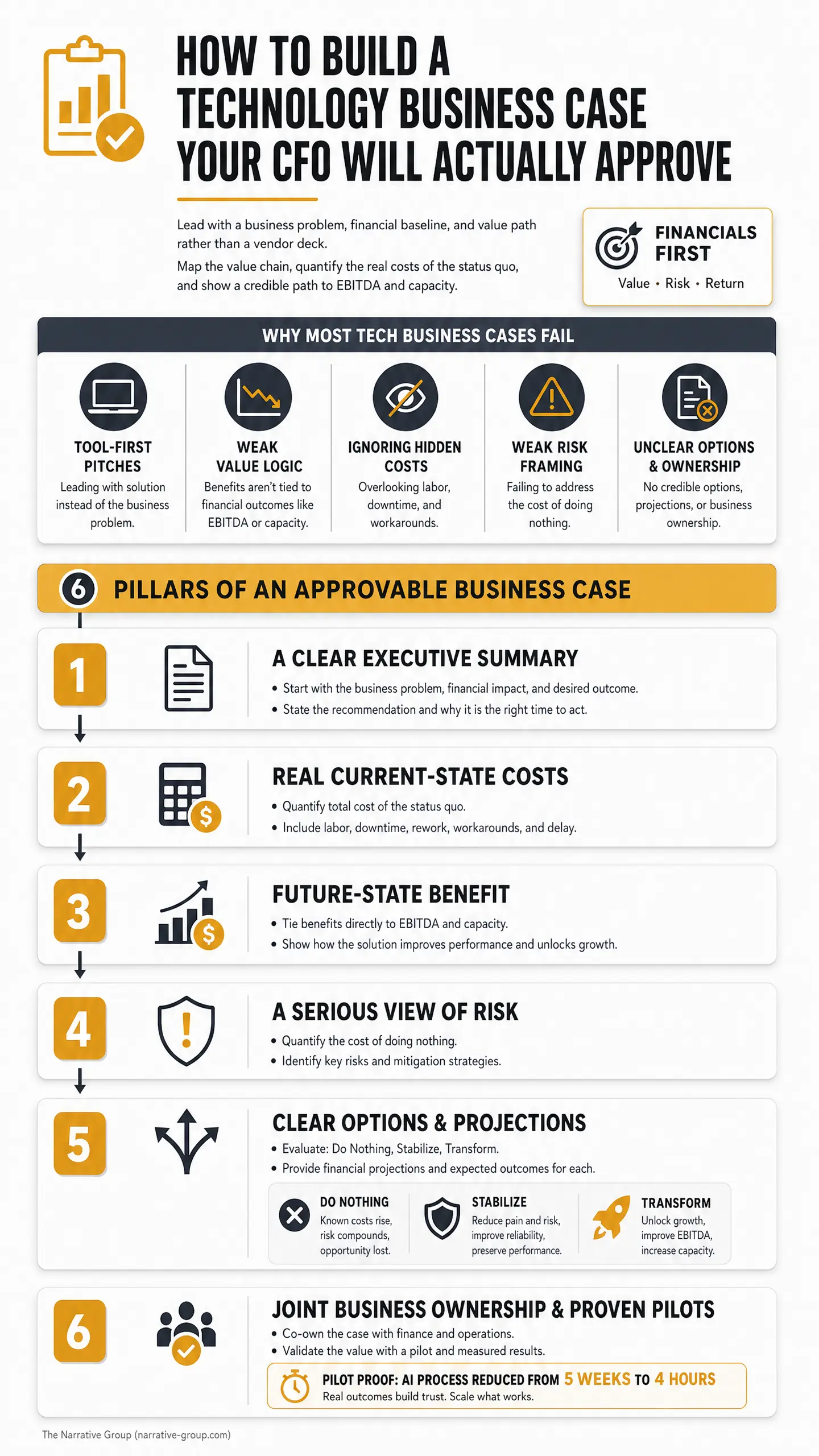
Need Help Aligning IT Spend with Business Performance?
IT budget planning should not be a spreadsheet exercise.
For mid-market companies, the IT budget should show what the business is protecting, what it is improving, and where it is investing for growth.
Narrative’s Financials First assessment helps leadership teams connect technology spend to the value chain, risk profile, productivity opportunities, and growth priorities of the business.
Use the IT Investment Prioritization Scorecard to evaluate your next round of technology investments, or explore Financials First if your leadership team needs a clearer view of what to fund, what to fix, and what to stop.
Technology Investment Strategy (This Series)
- IT Maturity Models Explained for Mid-Market Executives
- Technology Investment Prioritization: A Framework for Mid-Sized Companies
- IT Budget Planning for Mid-Sized Companies
- How to Build a Technology Business Case Your CFO Will Actually Approve
- CapEx vs OpEx in IT Strategy
- When to Replace vs Optimize Your Business Systems
- The Hidden Cost of Reactive IT in Mid-Sized Companies
Frequently Asked Questions
How can I prevent ballooning cloud costs after the business case is approved?
Establish strict FinOps governance immediately. Flexera estimates that 29% of cloud spend is wasted. Treat cloud consumption like variable labor by monitoring it monthly. If you do not tie cloud consumption directly to unit economics and business volume, your projected ROI will evaporate through over-provisioning.
Should digital transformation costs come exclusively from our IT budget?
Absolutely not. Deloitte notes that while overall tech investment averages 7.5% of revenue, only 5.4% comes from IT. Transformation is a cross-functional decision. If a new platform dramatically improves operations or sales, those departments must co-fund the initiative and own the resulting EBITDA improvements.
How do we measure the ROI of a cybersecurity business case?
Frame it as quantifiable cost avoidance, not fear. IBM puts the average global breach cost at $4.4 million. However, organizations utilizing AI and automation in security saved $1.9 million per incident. The ROI is the mathematical reduction of business interruption risk and the protection of current EBITDA.
How can we evaluate enterprise AI requests without falling for vendor hype?
Demand a fundamental redesign of the workflow. McKinsey found only 39% of respondents report enterprise-level EBIT impact from AI. High performers are nearly three times as likely to have re-engineered their processes. If the business case just slaps AI onto a broken operational process, reject it outright.
Can a mid-market company build these financial models without a full-time CIO?
Yes. Mid-market companies rarely need the overhead of a full-time CIO to execute a strategic roadmap. Leverage fractional leadership or external enterprise architects to build your financial baseline, align IT directly with your value chain, and establish board-ready governance at a fraction of the traditional cost.