

Lightspeed Commerce announced new agentic capabilities for its Lightspeed AI retail platform on October 15, 2026. The company says the AI reasons across a retailer’s catalog, inventory, sales and purchasing data. It then prepares actions in the same conversation, like purchase orders for low-stock products, clearance tags on unsold items and inventory transfers toward the locations where demand signals are strongest. According to Lightspeed, each action is previewed, waits for the retailer’s explicit approval and is recorded in an audit log. The tools are being introduced to select customers through an opt-in beta, with broader availability described as coming soon.
For a chain with 10 to 100 locations, this is exciting. Approving every action is the right way to start, and those approvals should loosen as the agent proves itself. These tools are coming faster and doing more than ERP systems, forecasting tools and traditional automation. That’s why clean data, clear process ownership, guardrails and a plan before rollout matter as much as ever.
How Do Agentic AI Tools Differ from Hard-Coded Retail Automation?
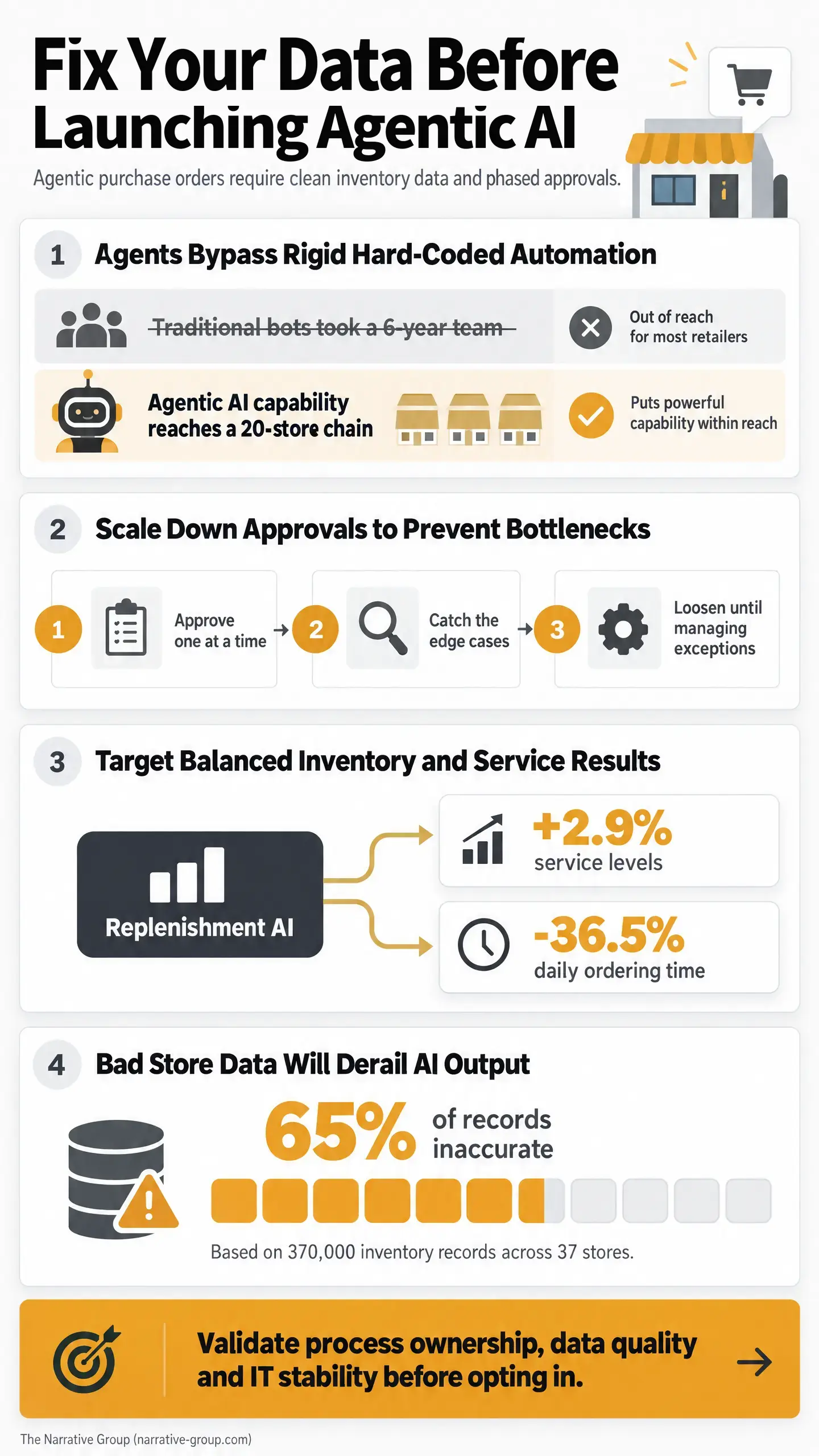
The 200-plus bots my team built in grocery were traditional automation. Every interface and business rule had to be programmed in. We were at the mercy of whoever designed the process to ask the right questions. An agent that understands context and makes recommendations without that hard-coding is leaps and bounds beyond what traditional tools bring to the table.
I agree with Lightspeed’s CTO, Bhawna Singh, that the value comes from that business context and from working inside the systems merchants already use. Delivering those bots took a team we built over six years. A 20 store chain won’t staff anything like that, and an agent like this puts some of the same capability within its reach.
How Should Retailers Manage Agentic AI Approval Workflows for Purchase Orders?
Deciding how much control to grant an agent is similar to when retailers began centralizing forecasting and ordering. Buyers previously created every single order. The new systems stripped that control away, causing immense initial hesitation. Once those systems went live and proved themselves, however, there was no going back. Large retailers now allow forecasting tools to create purchase orders without manual approval, having rigorously tested them before scaling.
I wouldn’t let an agent run workflows out of the gate without controls. I also wouldn’t hand an important process to a bot I built yesterday, or to an employee who started yesterday. Whether the worker is human or digital, they have to meet the same standards. But if you layer in too much control and approval and keep it there, you’ll never get the full benefit. So approve the first actions one at a time, then loosen the approvals until you’re only managing exceptions. The early approvals also give you a chance to catch the edge cases. The unwritten rules in your buyers’ heads rarely surface until something goes live.
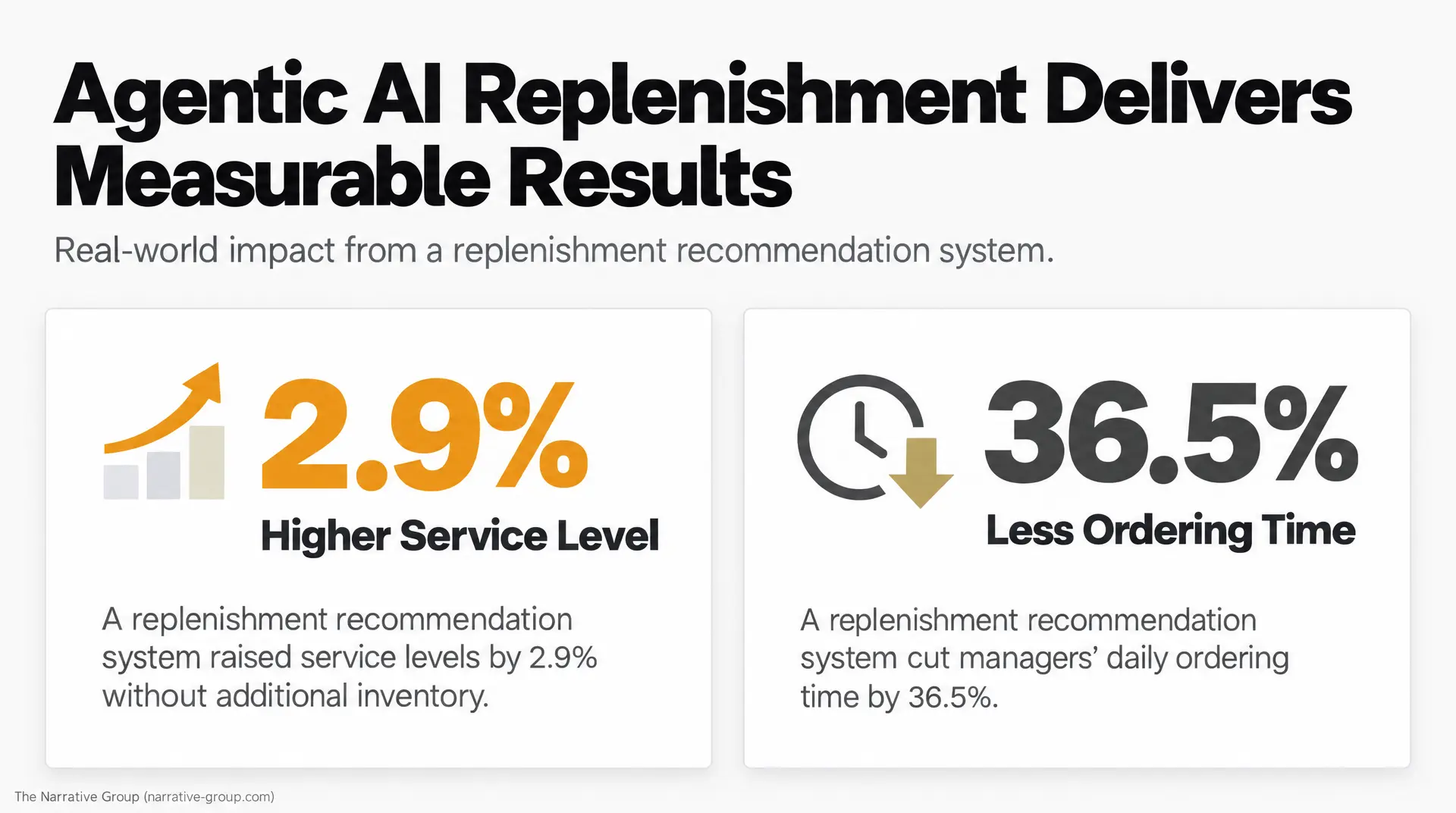
Define the scope before you opt in: which workflows, who owns each one, and what good looks like in numbers. Reducing inventory while maintaining or improving service level is a way more impressive statement than either number on its own. A study with a convenience-store chain shows what a balanced result looks like. There, a replenishment recommendation system raised service levels by 2.9% without additional inventory and cut managers’ daily ordering time by 36.5%. The managers still adjusted its recommendations, ordering ahead on popular items and delaying some orders on slow movers.
Same thing with sales. If the tools and the tokens cost more than the revenue the agent generated, who cares that the revenue was generated. Judge every sales opportunity it surfaces on net margin, after the cost of the tool and its tokens.
Why Is Store Inventory Data Accuracy Critical for Agentic AI Tools?

The preview shows you the purchase order or transfer the agent built, but the on-hand counts behind it come from your stores. In a 2008 study of nearly 370,000 inventory records across 37 stores at one retailer, 65% of the records were inaccurate.
In grocery, I once put an observer on a receiving dock. Workers were picking the first error code on their pallet scanners, whatever the actual problem was, because it was the fastest option. Those codes fed the reporting. With the observer’s data, we put a plan in place to correct it. People aren’t going to tell you where the dirty laundry is. You’ve got to go looking for it. Walk your receiving areas and talk to your receivers before an agent builds purchase orders off that data.
The beta is opt-in, so a chain your size can get its counts, owners and targets in order before switching anything on. That’s the work our readiness assessments at The Narrative Group do. We validate process ownership, data quality and IT stability, and we pick the high-ROI, low-complexity pilots worth running first. I’d be glad to work through it with you before you sign up.